Education is at a critical crossroads. As we navigate through 2026, Artificial Intelligence is no longer a futuristic scenario but a daily reality that has permeated classrooms and lecture halls. Recent reports from Vietnam highlight a disturbing trend: the use of sophisticated AI-driven systems for cheating in high-stakes examinations. This phenomenon, however, is not limited to Southeast Asia; it is a global challenge threatening to completely devalue degrees and the very concept of meritocracy.
The Evolution of Cheating: From Crib Notes to Algorithms
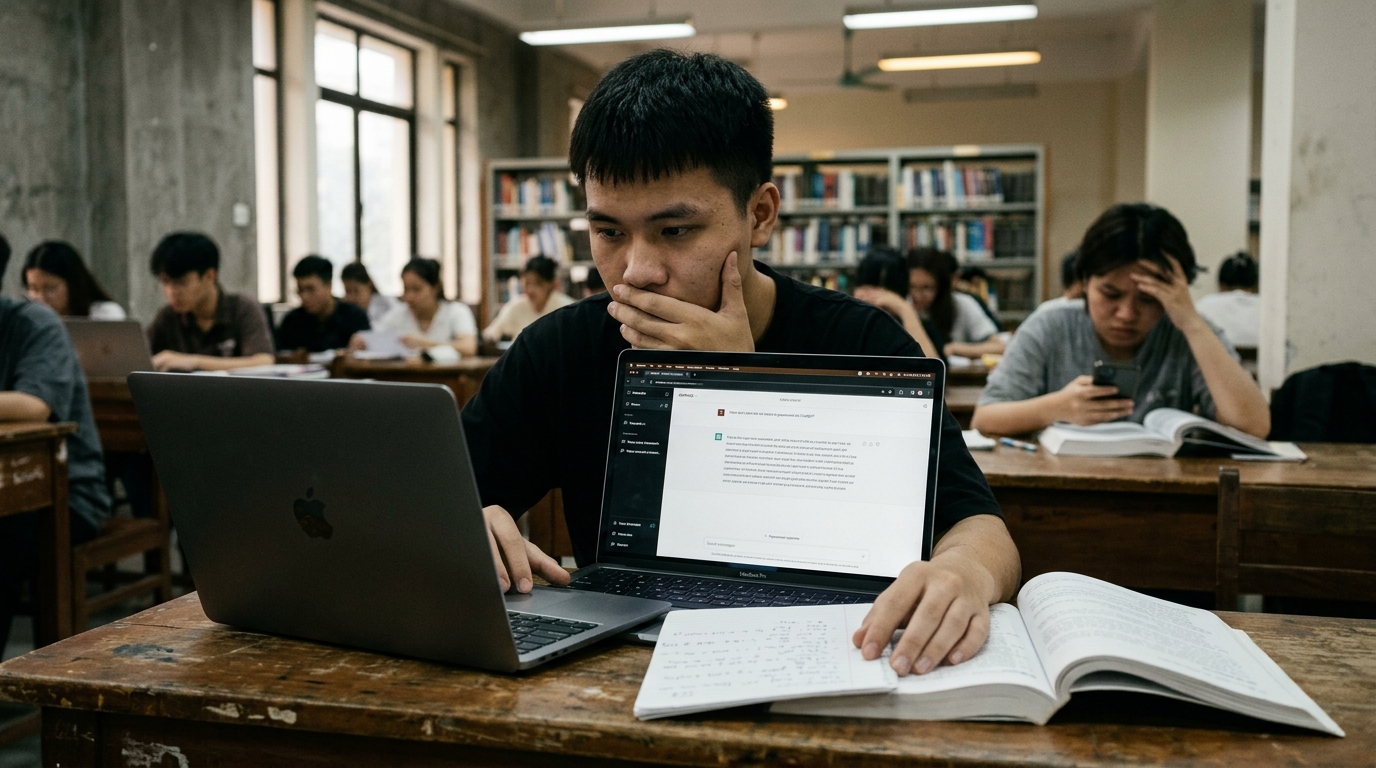
In the past, cheating required physical effort and risk: a hidden slip of paper, a glance at a neighbor's script. Today, technology has rendered deception nearly invisible. In Vietnam, authorities have uncovered networks using micro-cameras hidden in shirt buttons to broadcast exam papers to external accomplices. These helpers, in turn, feed the data into advanced Generative AI models and relay answers back via bone-conduction earpieces, which are virtually undetectable by traditional proctoring systems.
This "industrialization" of cheating demonstrates that we are not merely dealing with individual unruly students, but with an organized effort to bypass educational standards. The AI models of 2026 are now capable of synthesizing original responses that evade traditional plagiarism detectors, making their identification an almost impossible task for educators.
The Failure of AI Detectors and the Technological Paradox
Despite the promises of many software companies, "AI detectors" have proven to be unreliable. Studies show these tools have high false-positive rates, often unfairly accusing students whose native language is not English or those who simply possess a very structured writing style. Furthermore, students have learned to use "humanizing" techniques—altering syntax or intentionally introducing minor errors—to trick the algorithms.
"Trying to catch AI with AI is like trying to catch the wind with a net," says a computer science professor at the University of Hanoi. "The technology is evolving faster than our ability to police it."
This realization is leading many top institutions worldwide to a drastic decision: a return to roots. In Europe and the US, there is a massive shift back to in-person, written exams using pen and paper, and the banning of laptops during assessments. Oral examinations are also making a comeback as the only foolproof way to verify a student's actual knowledge.
Redesigning Education: The Solution Beyond Suppression
Addressing AI-based cheating cannot rely solely on punishment or surveillance. It requires a radical redesign of how we assess learning. If a robot can answer the questions on an exam, then perhaps those questions are no longer relevant to the needs of the 21st century.
- Shifting from Rote Memorization to Critical Thinking: Exams must focus on applying knowledge to original scenarios where AI can assist but not replace human judgment.
- Continuous Assessment: Instead of one final high-stakes exam, grading can be based on long-term projects, presentations, and laboratory exercises.
- Integrating AI into the Curriculum: Rather than being banned, AI can be used as a drafting tool, with students assessed on their ability to critique and improve the generated output.
In Vietnam, the government is considering harsher penalties for syndicates trading in cheating devices, but experts warn this only treats the symptom. The real cure lies in fostering a culture of academic integrity, where students realize that knowledge holds more value than a grade obtained through fraud. In a world where AI can do almost anything, the only value that remains unassailable is authentic human capability.