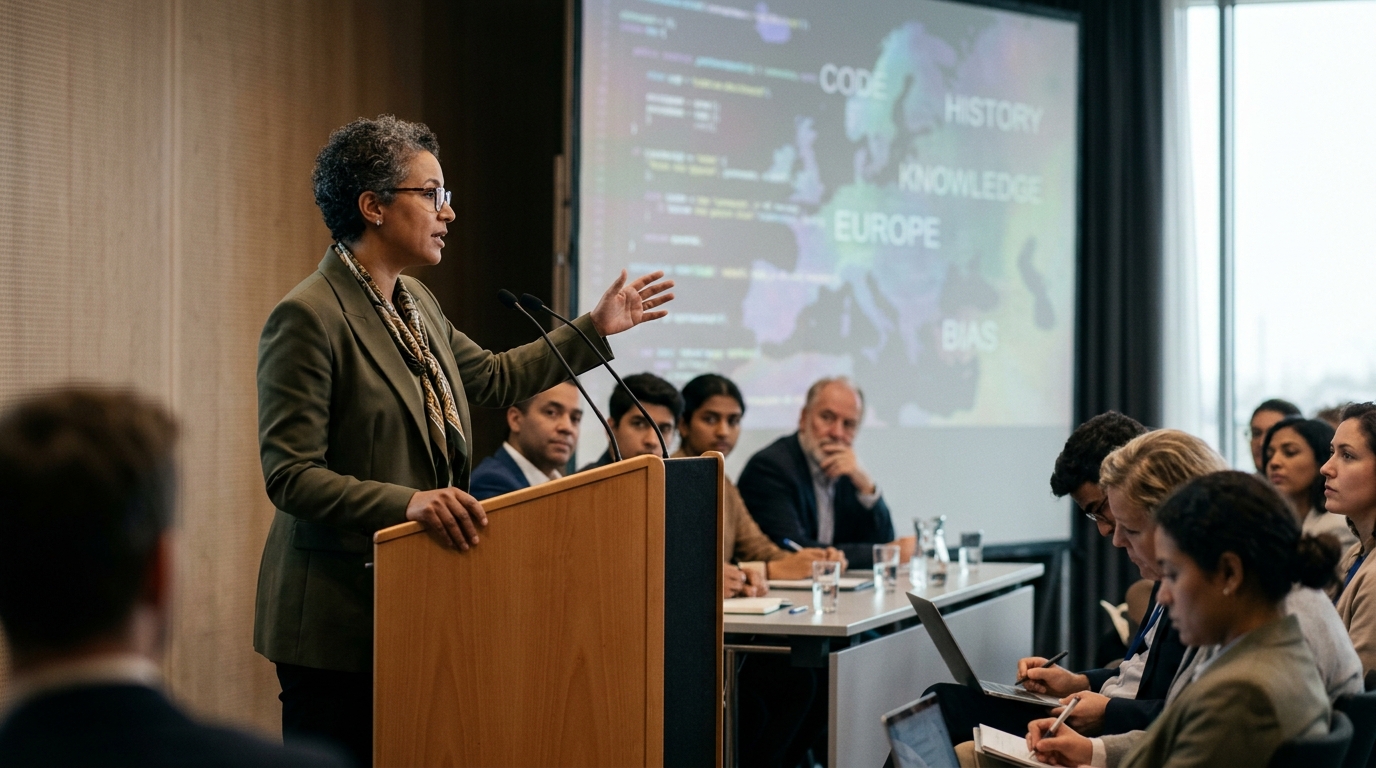
At the dawn of the fifth industrial revolution, Artificial Intelligence (AI) is no longer viewed merely as a tool for automation, but as a mirror of human knowledge. However, a close examination of the architecture of Large Language Models (LLMs) reveals a disturbing reality: this mirror is deeply distorted. The vast majority of training data, ethical frameworks, and logical structures governing modern AI originate from the "Global North," establishing a Eurocentric hegemony that threatens to marginalize alternative ways of thinking and being.
Cognitive and Linguistic Monoculture
The foundation of modern AI is data. When the bulk of training data comes from Common Crawl and digitized Western libraries, AI learns to "think" in English, even when translating into other languages. This is not just a technical issue of translation; it is an ontological one. Languages are not merely codes for communication; they carry worldviews. For instance, the concept of the "individual" in Western philosophy is fundamentally different from the concept of "Ubuntu" in Southern Africa, which defines existence through relationships with the collective.
When an AI is asked to resolve ethical dilemmas, it tends to follow utilitarian or deontological approaches rooted in the Enlightenment. This "cognitive monoculture" leads to what many scholars call "epistemic injustice." Indigenous knowledge regarding environmental management, non-linear perceptions of time, and communal forms of justice are ignored or classified as "noise" by algorithms, resulting in the loss of a vast wealth of human experience.
Digital Colonialism and the Data Economy
The imposition of Eurocentric standards through technology is not accidental; it is inextricably linked to the power structures of the global economy. Tech giants, primarily based in the US, extract data from the Global South to train models that are then sold back to these countries. This process strongly echoes classic colonial practices of raw material extraction.
Furthermore, AI evaluation and "alignment" systems often rely on low-wage workers from developing nations who are tasked with enforcing Western ethical norms on content. This creates a paradoxical situation where AI "ethics" are constructed through exploitation, while simultaneously ignoring the local sensitivities and cultural codes of the people training them.
Countercurrents: Towards a Sovereign and Pluralistic AI
Despite the dominance of Western models, powerful countercurrents are emerging that seek to decolonize Artificial Intelligence. Initiatives from Africa, Latin America, and Asia are working to create "Sovereign AI," which is based on local data and reflects domestic values. The movement for "Data Decolonization" argues that communities must have control over their data and how it is used to produce knowledge.
- Development of models in low-resource languages without English mediation.
- Integration of indigenous ethical frameworks into algorithmic design.
- Creation of open databases that protect cultural heritage from commercialization.
The challenge for the future is not just to make AI "smarter," but to make it "wiser" in terms of inclusivity. True Artificial General Intelligence cannot be achieved unless it recognizes the multiplicity of human logic. If AI remains trapped in a Eurocentric framework, it will fail to fulfill its promise as a universal tool for humanity, remaining instead a sophisticated mechanism for enforcing a specific ideology.
"Technology is not neutral. It is the materialization of the worldview of those who build it."
In conclusion, the debate over AI and Eurocentric knowledge traditions is a debate over who has the right to define reality in the digital age. The need for a pluralistic digital world is more urgent than ever if we want technology to serve the global community rather than just a privileged segment of it.