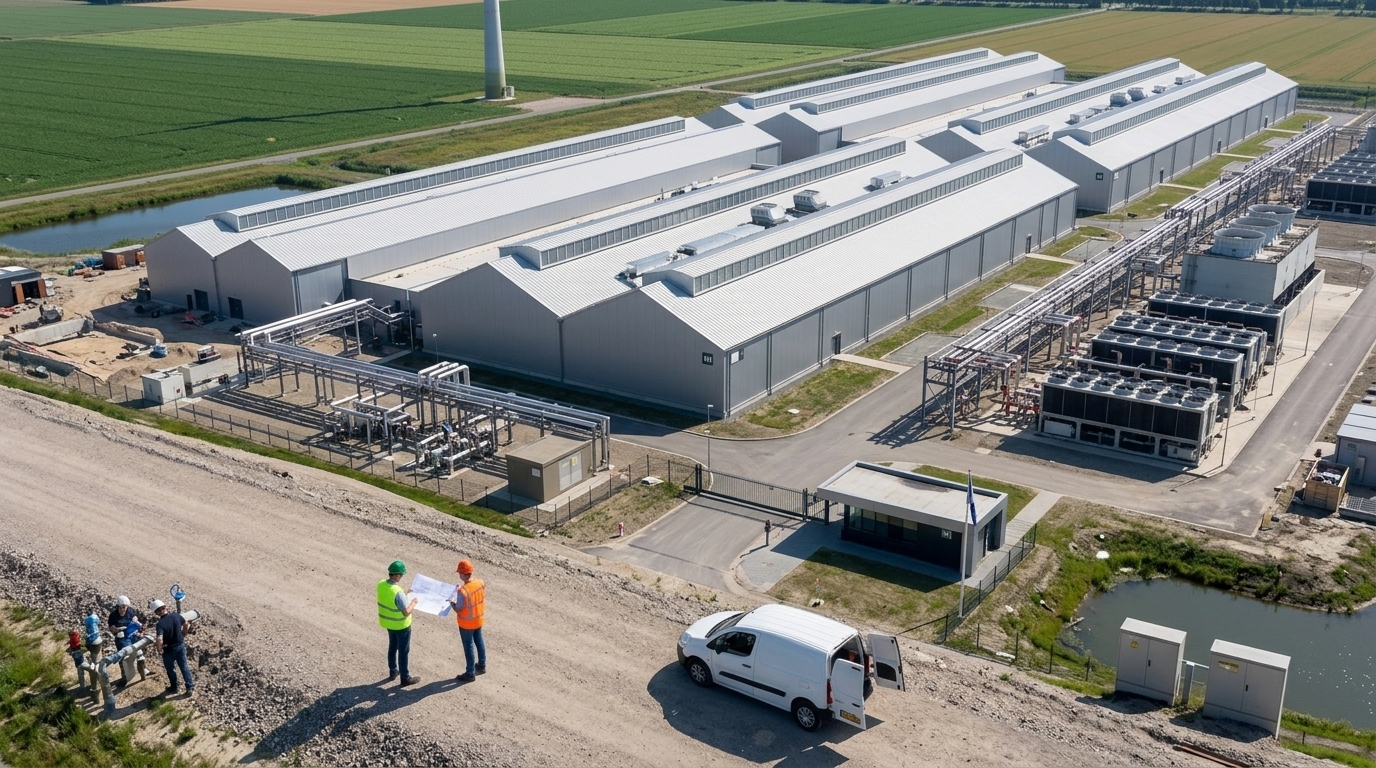
In the heart of Ohio, where industrial plants and farmland once dominated the horizon, a paradoxical transformation is taking place. Meta, the social media giant now rebranding itself as an AI powerhouse, isn't building the imposing, glass-and-concrete data fortresses we've come to expect. Instead, it is adopting an approach that locals and critics have ironically dubbed "chicken coops": temporary, modular, and rapidly assembled structures that resemble industrial warehouses or giant tents more than temples of high technology.
The Strategy of Absolute Speed
This decision doesn't stem from a sudden need for austerity, but from a blunt reality: time is the most precious currency in the age of Generative AI. To train next-generation models like Llama 4 and Llama 5, Meta needs hundreds of thousands of Nvidia's H100 and Blackwell chips running simultaneously. Constructing a traditional data center can take anywhere from three to five years, hampered by bureaucratic red tape, environmental impact studies, and complex construction requirements.
By utilizing these "lightweight" structures, Meta can cut development time by more than half. These "chicken coops" are actually highly sophisticated, pre-fabricated units that allow for the rapid installation of cooling and power delivery systems. It is the physical embodiment of Mark Zuckerberg's old motto, "move fast and break things," except this time, the thing being "broken" is the traditional rulebook of infrastructure architecture.
Ohio as the New Epicenter of Compute
But why Ohio? The state has emerged as an "El Dorado" for tech giants for three main reasons: a stable power supply, low land costs, and generous tax incentives. However, the demand for electricity is so massive that the local grid is struggling to keep up. Meta’s temporary structures allow the company to secure grid capacity and begin server operations long before permanent facilities are completed.
This tactic reveals the level of desperate competition with Google, Microsoft, and OpenAI. In a world where compute power equals geopolitical and economic leverage, waiting for concrete to dry is seen as a strategic failure. Meta no longer cares if its buildings win architectural awards; it only cares if they can house the GPU clusters that will define the future of digital intelligence.
Challenges and the Environmental Cost
Despite their efficiency, these structures raise serious questions. Cooling servers in temporary buildings is significantly more difficult and energy-intensive than in purpose-built, insulated data centers. Meta claims to be using advanced liquid cooling systems, but the strain on local water resources remains a point of contention with local communities.
Furthermore, there is the question of permanence. What happens to these "chicken coops" once chip technology evolves again? Meta’s strategy rests on the assumption that current AI architecture will remain stable long enough to amortize the investment. But in technology, the only constant is change. If tomorrow’s AI requires a different type of interconnect or cooling, these rapid builds could become expensive ruins of an era of excess.
Conclusion: The New Normal of Infrastructure
Meta’s move in Ohio is a signal to the entire market. The era of "data cathedrals" is giving way to the era of "compute factories." Time-to-market now overrides sustainability or aesthetics. For Zuckerberg, the risk of falling behind in the AI race is far greater than the risk of building infrastructure that looks like temporary housing. At the end of the day, a user interacting with a smarter version of Llama won't care if the response came from an architectural gem or a high-tech "tent" in Ohio.