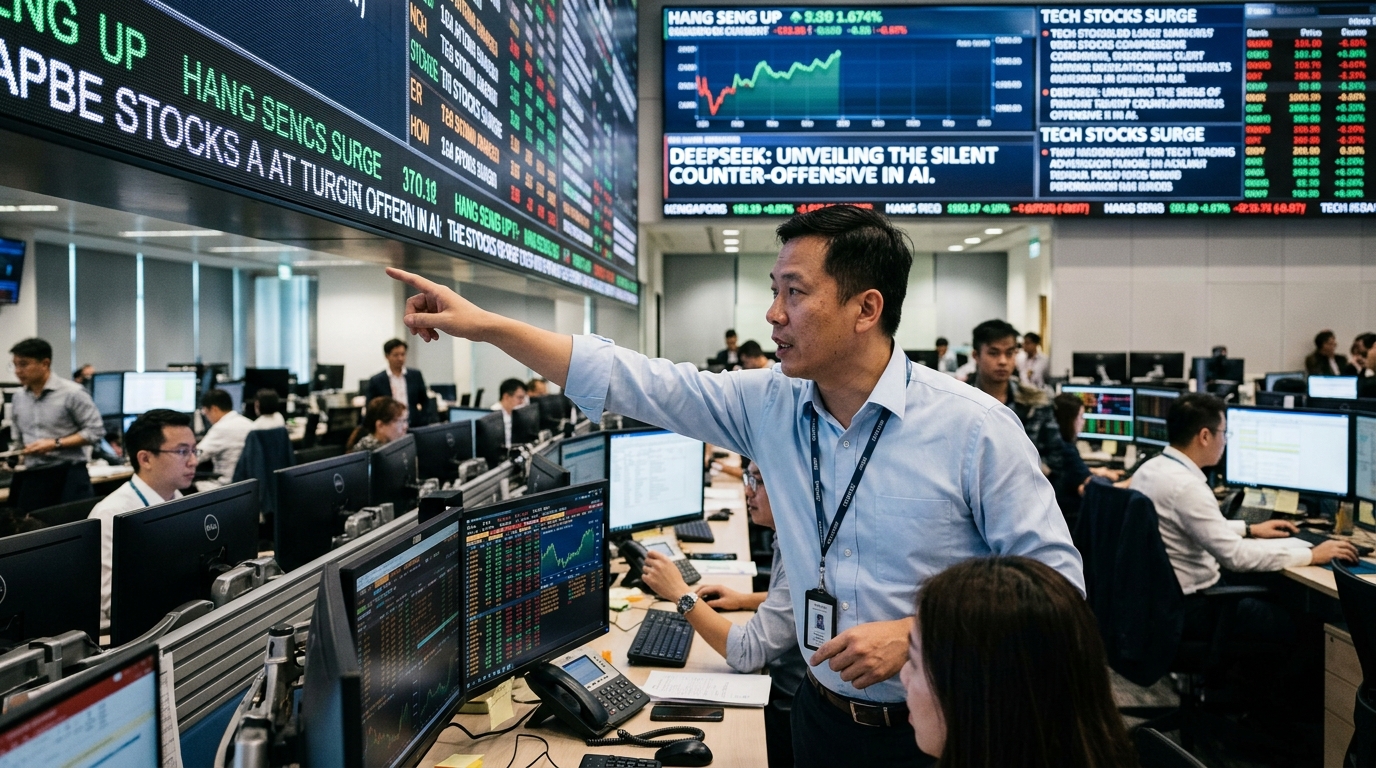
For months, the prevailing narrative in Silicon Valley and Washington was that China had fallen significantly behind in the Artificial Intelligence race. Stringent export controls on Nvidia’s advanced chips and internal censorship mandates were viewed as insurmountable hurdles. However, the sudden emergence of DeepSeek, a Hangzhou-based AI lab, has completely shattered this premise. Chinese AI didn't "go" anywhere; instead, it evolved into a force that prioritizes algorithmic ingenuity over raw computational power.
The Illusion of Superiority and the DeepSeek Shock
The release of DeepSeek-V3 and R1 served as a massive wake-up call for global markets. For the first time, a Chinese open-source model managed to stand toe-to-toe with OpenAI’s GPT-4o and Anthropic’s Claude, achieving comparable performance at a fraction of the training cost. While training American frontier models costs hundreds of millions of dollars and requires tens of thousands of H100 GPUs, DeepSeek claims to have achieved its results with a mere $6 million budget.
This development fundamentally shifts the market dynamics. China, forced to survive with fewer resources due to U.S. sanctions, focused on "algorithmic efficiency." By utilizing techniques such as Mixture of Experts (MoE) and Multi-head Latent Attention, Chinese engineers proved that innovation is not always a function of billions of dollars, but of architectural brilliance. The market, as highlighted by MarketScreener, reacted with volatility, sensing that the monopoly of Nvidia and major U.S. Cloud providers is being challenged by a new, cost-effective alternative.
The Geopolitics of Chips and the Strategy of Survival
U.S. sanctions were designed to starve China of the tools needed for general-purpose AI development. However, history teaches us that constraints often breed inventiveness. China is no longer trying to replicate the Silicon Valley model. Instead, it is building its own ecosystem based on domestic production of less advanced chips and the maximum optimization of existing hardware. The question of "where Chinese AI has gone" is now answered through lines of code that are leaner and more adaptable.
- Algorithmic Dominance: The ability to train high-performing models with limited compute resources.
- Open Source Strategy: China’s tactical decision to release models freely to dominate the global software landscape.
- State-Private Synergy: The alignment of private tech firms with Beijing's national security and economic goals.
China is deploying AI not just as an economic tool, but as a means of power projection in the Global South, offering technology that is affordable and does not require dependence on American infrastructure. This is creating a new "digital iron curtain" where efficiency is the new global currency.
Economic Implications and Market Reaction
The success of DeepSeek sent shockwaves through the stocks of American tech giants. If AI can be made cheap, then the massive capital expenditures (CapEx) of Microsoft, Google, and Meta might not yield the expected returns. From a financial perspective, we are witnessing deflationary pressure in the tech sector. China, with its lower labor costs and high engineering specialization, could turn AI into a commodity, drastically squeezing the profit margins of Western companies.
"DeepSeek is not just a company; it is the proof that controlling chips no longer equates to controlling intelligence," notes a MarketScreener analyst.
In conclusion, Chinese AI never disappeared. It was in a phase of internal reorganization, waiting for the moment to prove that intelligence can flourish even in environments of scarcity. The West is now challenged to compete not just in scale, but in efficiency, in a world where China may now hold the upper hand in the cost-to-performance ratio.