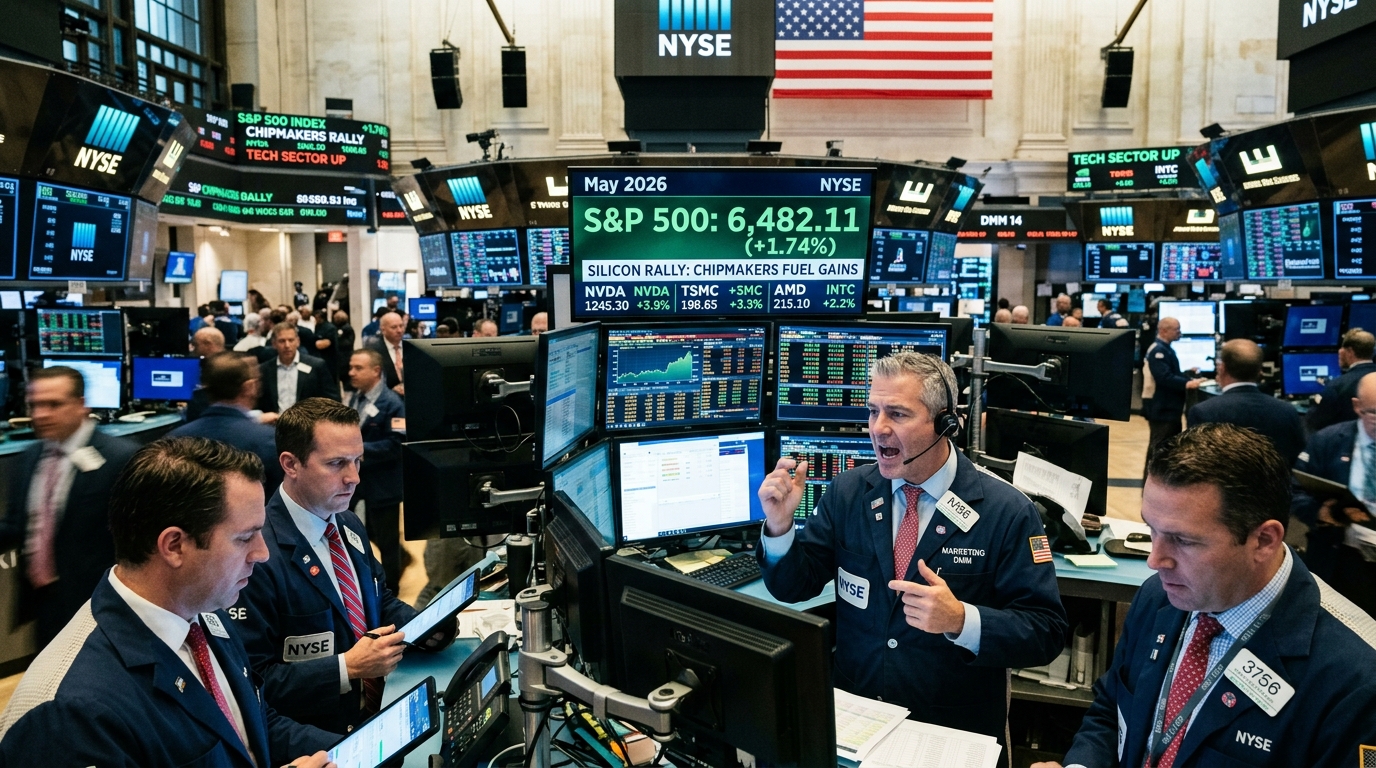
May 11, 2026, will be remembered in market history as the day that confirmed the 'Silicon Revolution' was not a passing bubble but the new structural pillar of the global economy. As the Wall Street session drew to a close, the S&P 500 recorded significant gains, propelled by an impressive surge in the semiconductor sector. This momentum reflects not just the profitability of individual firms, but a broader shift of capital toward infrastructure that supports Artificial Intelligence (AI) at every level of daily life.
Semiconductor Dominance and the Shift to Inference AI
At the heart of the rally were, once again, the chip giants. However, by 2026, the narrative has evolved. While in 2024 and 2025 the market focused on the training of Large Language Models (LLMs), today the emphasis has shifted to 'inference.' Investors are rewarding companies that produce energy-efficient processors capable of running AI applications locally on devices (Edge AI), reducing reliance on the cloud.
The rise in shares of Nvidia, AMD, and Intel is no longer the only topic of discussion. Analysts from Bank of America Securities, led by Jill Carey Hall, point out that we are witnessing a 'broadening of the rally.' Smaller firms specializing in custom ASICs (Application-Specific Integrated Circuits) for the automotive and medical technology sectors are beginning to close the gap with the major players. This diversification suggests that AI technology has begun to permeate horizontally across all sectors of the economy.
The Macro Picture: Inflation and Real Estate
Despite the euphoria in the tech sector, Bess Freedman, CEO of Brown Harris Stevens, provided a more grounded perspective regarding the real economy and the housing market. Speaking on Bloomberg Tech, Freedman emphasized that while tech stock gains are creating new wealth, high interest rates continue to pressure the housing market. The contrast is stark: the 'digital economy' is galloping, while the 'physical economy' of mortgages and construction is struggling to find a new equilibrium point.
BofA’s Jill Carey Hall also noted that capital flows into small-cap stocks remain subdued compared to tech giants. This creates a two-speed market, where the S&P 500 appears strong due to the weighting of Big Tech, but the 'average' American business still faces challenges in borrowing costs. The Fed's strategy for the remainder of 2026 will be decisive in whether this rally gains depth or remains an exclusive celebration for the chip industry.
Healthcare and Services: The Quiet Revolution
Brian Tanquilut of Jefferies brought another critical dimension to the table: the integration of AI into healthcare services. According to his analysis, companies that have managed to reduce their operating costs using automated diagnostic tools and AI patient-flow management saw their stocks outperform. The rise of the S&P 500 is no longer just about hardware, but about how that hardware translates into real-world efficiency.
"We are no longer buying the promise of AI. We are buying the profit margins that AI creates," one of the guests remarked.
This quote encapsulates the sentiment of May 2026. The market has matured. Investors demand proof, and semiconductors are the only ones consistently providing it, powering the data centers that in turn power global productivity. The close on May 11th shows that the road ahead is paved with silicon, but it requires careful navigation between geopolitical tensions and monetary challenges.
Key Takeaways for Investors
- Chip dominance remains the primary growth driver for the S&P 500.
- The shift from Training to Inference AI creates new opportunities for niche manufacturers.
- The real estate market remains a drag due to rates, despite the tech surge.
- Healthcare is emerging as a prime field for AI applications with immediate economic impact.