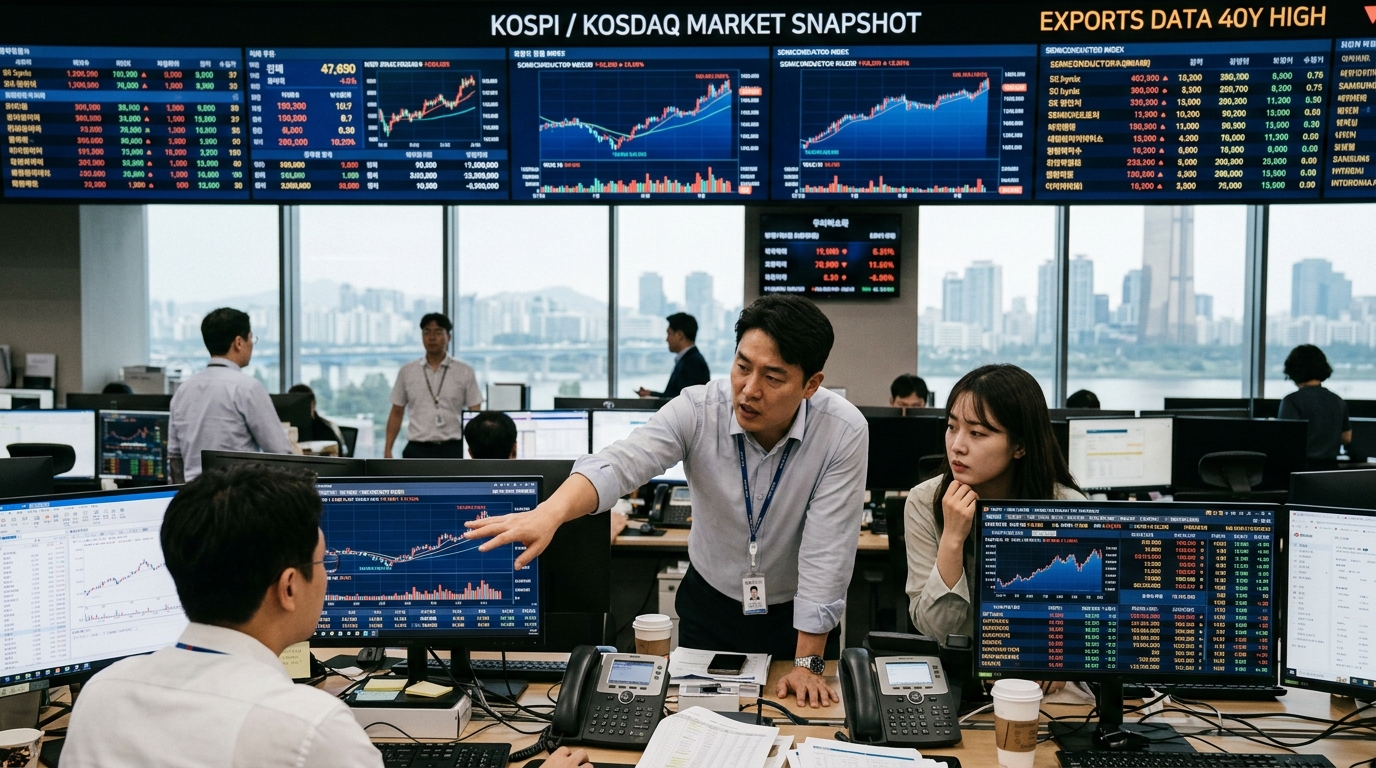
South Korea, Asia's fourth-largest economy, is witnessing a historic economic surge that mirrors the rapid industrialization of the late 20th century. Recent data indicates that the nation's export growth has reached levels unseen in four decades, fueled almost exclusively by the insatiable global demand for high-end semiconductors necessary for Artificial Intelligence (AI) workloads.
The Semiconductor Hegemony and the HBM Revolution
At the center of this economic phenomenon are industry titans Samsung Electronics and SK Hynix. These two giants have effectively cornered the market for High Bandwidth Memory (HBM), a critical component integrated into Nvidia’s high-performance graphics processing units (GPUs). As Silicon Valley’s tech behemoths race to construct massive data centers to power Generative AI models, South Korea has emerged as the indispensable provider of the industry's most vital resource.
Analysts emphasize that this current spike is not merely a cyclical fluctuation but a profound structural shift. Semiconductor exports have surged by more than 50% year-on-year, more than compensating for lackluster demand in traditional consumer electronics. Seoul’s strategic focus on next-generation memory chips has placed it in a dominant position, turning the nation into a primary barometer for the global technology sector's health.
The Geopolitical Tightrope and the China Dilemma
Despite this commercial triumph, South Korea is navigating a complex geopolitical landscape. Washington continues to press Seoul to restrict exports of advanced technology to China, which has historically been South Korea's largest trading partner. The administration of President Yoon Suk-yeol is tasked with balancing vital security alliances with the United States against the economic imperatives of maintaining trade ties with Beijing.
- Reliance on the U.S. market has skyrocketed, with exports to America surpassing those to China for the first time in decades.
- Subsidies from the U.S. CHIPS Act incentivize investment on American soil but raise concerns about the potential hollow-out of domestic manufacturing.
- Meanwhile, China is accelerating its own semiconductor production, posing a long-term threat to South Korea's market share in legacy memory products.
"We are not just witnessing a sales spike; we are seeing the redefinition of national power through silicon," says a leading economist based in Seoul.
Internal Economic Disparities
While the export figures are staggering, South Korea's domestic consumption remains sluggish. Persistent inflation and high interest rates have dampened local purchasing power, creating a two-speed economy. On one side, export-oriented conglomerates are reaping record profits; on the other, small and medium-sized enterprises (SMEs) are struggling to cope with rising costs. The Bank of Korea faces a significant challenge, as robust export performance complicates the case for interest rate cuts, despite domestic pressure for monetary easing.
In conclusion, South Korea is doubling down on its bet on Artificial Intelligence. Should the AI boom continue its upward trajectory, Seoul is poised to maintain its global leadership. However, any cooling in the tech sector could leave the Korean economy vulnerable, highlighting the urgent need for economic diversification beyond the semiconductor industry.