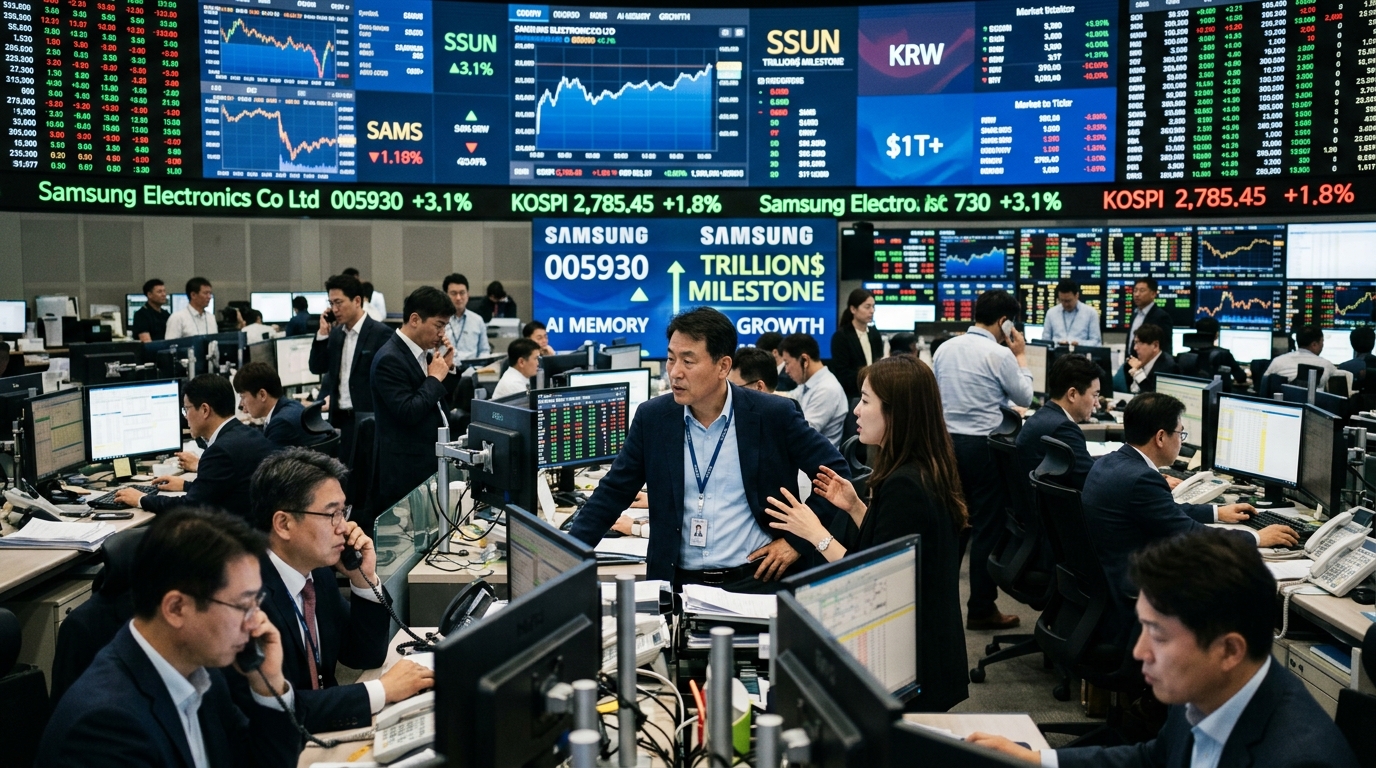
On May 6, 2026, the technological landscape witnessed a watershed moment. Samsung Electronics Co., the South Korean titan that has defined consumer electronics for decades, officially surpassed the $1 trillion market capitalization threshold. This achievement is not merely a financial milestone; it is the ultimate validation of a high-stakes pivot toward artificial intelligence infrastructure that began several years ago.
The surge in Samsung's share price over the past twelve months has been driven almost exclusively by its semiconductor division. While its smartphones and home appliances continue to generate steady cash flow, the true engine of growth is now High Bandwidth Memory (HBM). These specialized memory chips are the essential oxygen for the Graphics Processing Units (GPUs) designed by Nvidia and others, which serve as the neural centers for today’s advanced Large Language Models (LLMs).
The HBM Dominance and the AI Infrastructure Bet
Samsung has successfully closed the gap with its domestic rival, SK Hynix, which had initially taken the lead in the HBM3 generation. By successfully mass-producing HBM4 chips and securing multi-billion dollar contracts with major global cloud providers, Samsung has demonstrated that its manufacturing scale remains unparalleled. The insatiable demand for AI servers has ushered in a 'golden age' for memory makers, transforming a product once viewed as a cyclical commodity into a high-value strategic asset.
Market analysts point out that Samsung's strength lies in its vertical integration. As a company that handles everything from design to foundry services, Samsung can offer 'turnkey' solutions for hyperscalers looking to develop proprietary AI silicon. This structural advantage allows the company to control costs and time-to-market in a way that few competitors can match, making it an indispensable partner in the AI gold rush.
The 2nm Battleground: Challenging TSMC's Hegemony
Despite its memory triumphs, Samsung's greatest challenge remains the foundry business, where Taiwan's TSMC still holds the lion's share of the market. However, the transition to the 2-nanometer (2nm) node appears to be a turning point. Samsung has invested heavily in Gate-All-Around (GAA) transistor architecture, which promises superior power efficiency and performance for next-generation AI processors.
The $1 trillion valuation reflects investor confidence that Samsung can finally chip away at TSMC's dominance. Several Silicon Valley tech giants have already begun diversifying their supply chains, shifting orders to Samsung's advanced nodes to mitigate geopolitical risks associated with over-reliance on a single geographic point of failure. This strategic diversification is a major tailwind for Samsung's long-term valuation.
Geopolitical Stakes and the South Korean Economy
Samsung’s ascent is inextricably linked to South Korea's national security strategy. The Seoul government has designated semiconductors as a 'national strategic asset,' providing massive tax incentives and infrastructure support through the 'K-Chip Act.' Samsung’s trillion-dollar status bolsters the nation’s standing on the global stage, cementing its role as a critical node in the global technology supply chain.
However, this growth comes with complex challenges. Samsung must navigate the intensifying technological rivalry between the United States and China. Balancing U.S. export controls with the need to maintain a presence in the vast Chinese market requires a delicate diplomatic touch. The leadership's ability to manage these geopolitical pressures will be as crucial to the stock price as any technological breakthrough.
Conclusion: A New Era for the Tech Giant
The Samsung of 2026 is no longer just a purveyor of televisions and Galaxy smartphones. It has evolved into the foundational pillar upon which the global AI ecosystem is being built. With a $1 trillion market cap, the company enters a new phase of maturity where semiconductor innovation is the primary metric of success. The question is no longer whether Samsung can compete, but rather how the global economy would function without its massive industrial output.