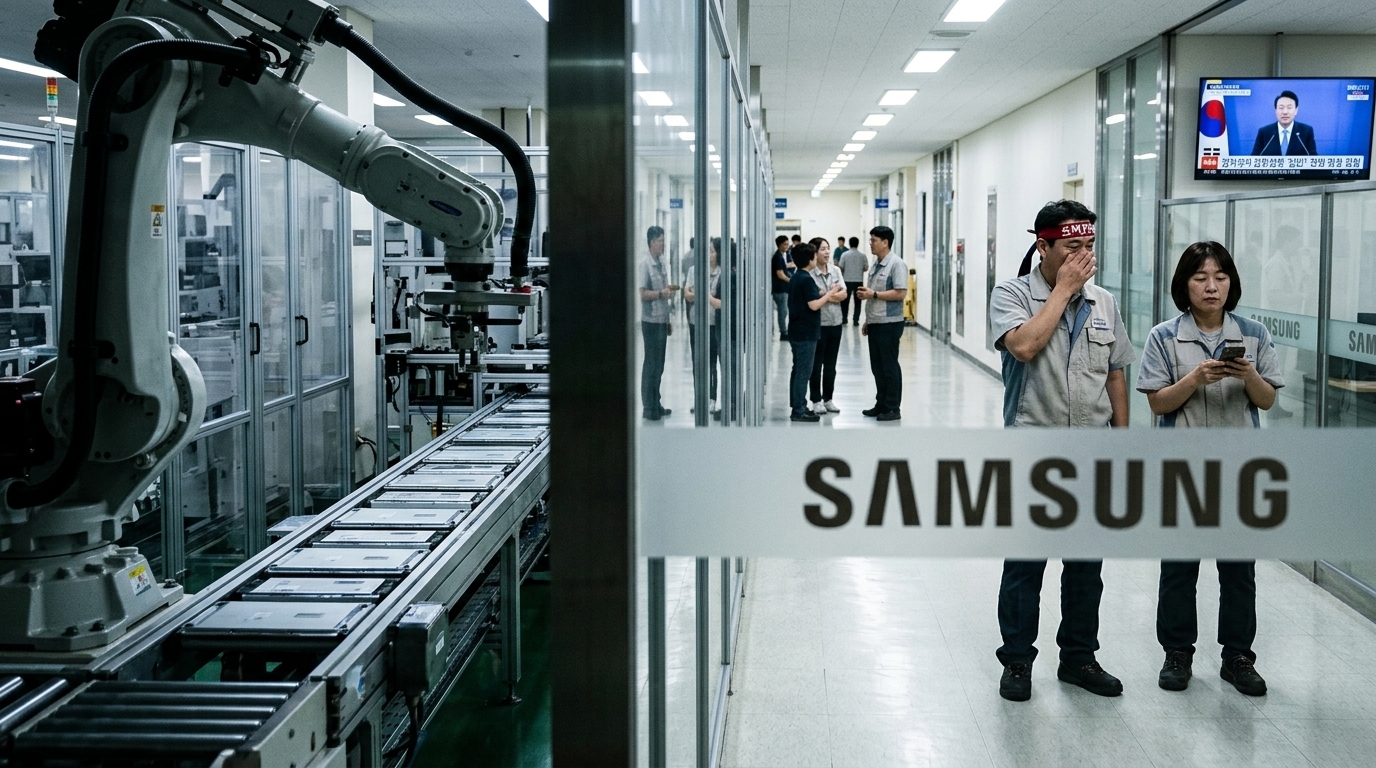
In a move that has sent shockwaves through the global technological ecosystem, the South Korean government has aggressively intervened to halt the escalation of a historic strike by 47,000 workers at Samsung Electronics. The crisis, which threatened to paralyze the world's largest memory chip maker, is not merely a labor dispute; it is an existential clash over the future of the South Korean economic model and the stability of the global AI supply chain.
The Specter of Economic Paralysis
Seoul's warning was both clear and dramatic: a prolonged strike at Samsung could cause damages amounting to $73 billion. For a country where the Samsung Group accounts for approximately 20% of the GDP, halting production is not an option. The administration of President Yoon Suk-yeol, citing reasons of "national economic security," applied stifling pressure on both management and the National Samsung Electronics Union (NSEU) to find a compromise, however temporary.
The stakes are astronomical. Samsung is the primary global supplier of DRAM and NAND flash memory. At a time when demand for High Bandwidth Memory (HBM) for training AI models is at its zenith, any delay would grant a significant lead to competitors like SK Hynix and Micron. Analysts point out that the government's intervention aims to protect the country's competitiveness in the critical semiconductor sector, which serves as the backbone of South Korea's exports.
The Thorny Issue of Bonuses and Transparency
At the heart of the conflict lies the reward system. Workers are demanding a more transparent and fair system for calculating bonuses, specifically the Overall Performance Incentive (OPI). Despite the record profits the company is posting due to the AI boom, many employees feel that the fruits of this success are not being distributed equitably. Samsung management, on the other hand, argues that wage increases must remain at sustainable levels as the company invests billions into new production facilities and R&D to close the gap in the AI chip market.
- Demand for a 6.5% wage increase.
- Transparency in the calculation of annual bonuses based on operating profits.
- An additional day of leave to celebrate the union's founding.
- Guarantees for the protection of union freedoms in a historically "union-free" corporate environment.
The workers' stance marks a historic turning point. For decades, Samsung followed a "no-union" policy. The emergence of the NSEU as a powerful voice representing nearly a quarter of the company's workforce in Korea shows that the old model of absolute corporate discipline is collapsing under the pressure of younger generations demanding work-life balance and fair treatment.
Geopolitics and the Risk of Over-Concentration
The government's intervention also highlights the dangerous risk of over-concentration. When a single company is so critical to the national and global economy, any internal crisis automatically becomes a geopolitical issue. Washington and Brussels are closely monitoring developments, as the "de-risking" strategy from China has made South Korea a central pillar of Western technological security.
"Samsung is no longer just a company; it is vital infrastructure for the 21st century. A strike here has the same impact that an oil embargo would have had in the 1970s," noted a semiconductor market analyst.
The remaining question is whether the government's intervention will lead to a permanent solution or if it merely postpones the conflict. Workers appear determined, and the suppression of their rights under the pretext of the economy could lead to further radicalization. Samsung management is now called upon to prove it can modernize its administrative model, transitioning from the authoritarianism of the past to a culture of dialogue without sacrificing operational efficiency.
Conclusion: A Fragile Balance
The crisis at Samsung serves as a lesson in how technological progress and labor reality collide in an era of great change. Artificial intelligence may promise automation and profits, but the production of the hardware that supports it remains a deeply human process. Seoul achieved a temporary truce, but the fire of discontent at Samsung remains lit, reminding everyone that the "heart" of the digital revolution beats in the factories, not just in the algorithms.