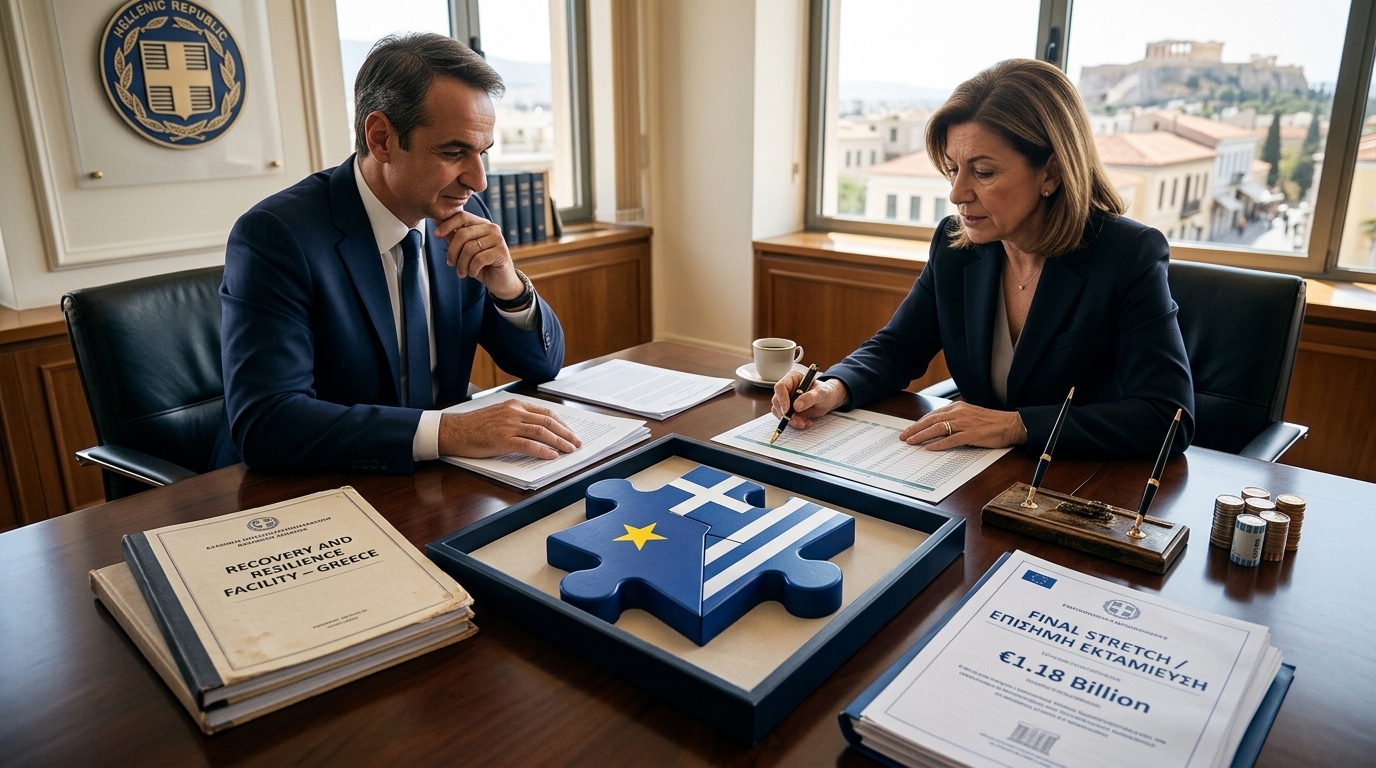
In a pivotal moment for the Greek economy, the European Commission has disbursed €1.18 billion to Greece under the Recovery and Resilience Facility (RRF). This latest move brings the total funds received by the country to €24.6 billion, representing 68.5% of the total budget allocated to the "Greece 2.0" national recovery plan. This news is not merely a technical accounting update but a significant vote of confidence in the country's ability to meet complex milestones amid global economic volatility.
Disbursement Architecture and Key Milestones
This installment is linked to the achievement of specific targets covering both investments and structural reforms. According to the Commission's report, Greece has made substantial progress in areas such as state digitalization, energy efficiency upgrades for buildings, and the acceleration of the judicial system. Particular emphasis was placed on promoting Renewable Energy Sources (RES) and the electrical interconnection of the islands with the mainland grid—projects considered strategic for the country's energy autonomy.
However, bureaucratic complexity remains one of the government's biggest challenges. While the absorption of funds at the central administration level is rapid, the challenge is now shifting to project implementation on the ground. Absorption does not always equate to spending in the real economy, and this is where the program's success will ultimately be judged. Businesses, particularly small and medium-sized enterprises (SMEs), continue to voice concerns regarding access to the RRF's loan component, which requires high banking eligibility criteria.
The 2026 Stakes: The Clock is Ticking
As we reach April 2026, Greece is entering the most demanding phase of the Recovery Fund. The RRF has a strict expiration date: December 31, 2026. Any project not completed or any milestone not met by then risks losing its funding. This creates a "race against time" for ministries and contractors of major infrastructure projects.
- Digital Transformation: Completing the National Land Registry (Ktimatologio) and digitalizing hospital records remain top priorities.
- Green Transition: Expanding the electric vehicle charging network and the transition of Western Macedonia away from lignite require faster paces.
- Social Cohesion: Training and upskilling programs must reach thousands of workers to address the shortage of specialized personnel.
"The Recovery Fund is the last great 'modernizer' of the Greek economy. If we fail to channel these resources into the productive base, we will have missed a historic opportunity that will not be repeated," says a senior official from the economic cabinet.
Macroeconomic Outlook and Investment Grade
The flow of RRF capital acts as a strong buffer against inflationary pressures and the broader slowdown of the European economy. For Greece, maintaining high growth rates—above the Eurozone average—relies heavily on the investments triggered by the Fund. International rating agencies are closely monitoring the disbursement progress, as it is directly linked to debt sustainability and fiscal discipline.
The question now being raised is what happens after 2026. The Greek economy risks facing a "fiscal cliff" if it fails to create a self-sustaining growth model that does not depend solely on European subsidies. Judicial reform and the reduction of red tape are the "intangible" benefits that could attract Foreign Direct Investment (FDI) in the long run, offsetting the end of RRF funding.
In conclusion, the disbursement of €1.18 billion is positive news, but it comes with the responsibility of effective management. The government must balance speed and project quality, ensuring that "Greece 2.0" is not just a title in a presentation but a tangible reality for citizens and businesses alike.