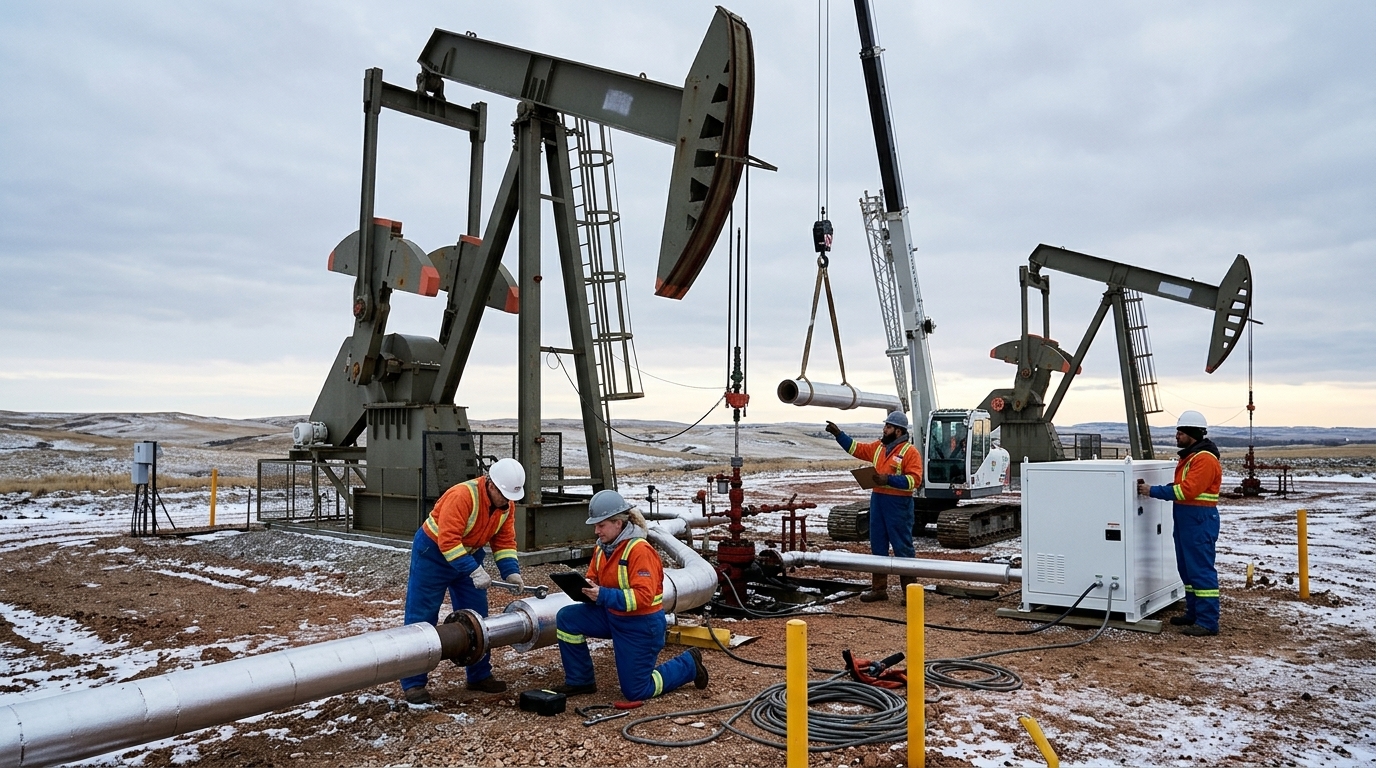
The legacy of the fossil fuel era is often visible as rusted derricks and capped holes in the ground. However, beneath the surface, these industrial scars hide an untapped opportunity. As the world searches for ways to accelerate the energy transition, a new generation of engineers and investors is looking at millions of abandoned oil and gas wells, not to extract more carbon, but to harness the Earth's heat and storage capacity.
Turning an Environmental Liability into an Energy Asset
In the United States alone, there are an estimated two million "orphaned" or abandoned wells. These structures are frequently sources of methane leaks—a greenhouse gas far more potent than carbon dioxide. The traditional solution has been to simply plug them with cement, an expensive process that offers no economic return. Today, however, the paradigm is shifting. Instead of being viewed as waste, these wells are being treated as pre-built infrastructure that has already pierced the Earth's crust, saving millions of dollars in drilling costs.
The most promising application is geothermal energy. These wells often reach depths where temperatures are high enough to generate electricity or provide heat for industrial processes. By installing closed-loop systems—where a fluid circulates within the well, picks up heat from the rock, and returns to the surface—old oil wells are transformed into perpetual clean energy generators. The advantage is twofold: the infrastructure exists, and the geological profile of the area is well-documented from decades of extraction data.
Energy Storage and the Hydrogen Frontier
Beyond geothermal power, old wells offer solutions to the greatest challenge of renewables: storage. Compressed Air Energy Storage (CAES) and the use of underground formations for green hydrogen storage are gaining traction. Depleted reservoirs can act as massive "subsurface batteries," balancing the grid when the sun isn't shining or the wind isn't blowing.
- Geothermal Conversion: Utilizing existing heat for continuous baseload power production.
- Hydrogen Storage: Leveraging airtight geological structures to store the fuel of the future.
- Carbon Capture and Storage (CCS): Re-injecting CO2 into depleted reservoirs for permanent sequestration.
- Economic Revitalization: Creating high-paying jobs for the existing fossil fuel workforce.
This transition also has a profound social dimension. Communities dependent on fossil fuels are seeing traditional jobs disappear. Repurposing wells allows drillers and geologists to apply their specialized skills to a climate-friendly industry. This is a "Just Transition" in practice, where the expertise of the past builds the infrastructure of the future.
Challenges and Economic Hurdles
Despite the potential, the path forward is not without obstacles. The integrity of old wells is often questionable. Corrosion of casings and poor quality of original cement can lead to leaks, making repurposing risky or unprofitable. Furthermore, the legal framework surrounding subsurface rights is complex. Who owns the heat beneath the ground? Is it the same entity that owns the mineral rights?
Economically, the industry requires incentives to scale. In the US, the Inflation Reduction Act (IRA) provides significant tax credits for such projects, but in Europe, the conversation is still in its infancy. Utilizing depleted fields in the Mediterranean, for instance, could serve as a regional model, combining energy production with carbon sequestration. Investing in the "recycling" of this infrastructure is not just environmentally sound; it is an economic imperative that reduces the capital expenditure and risk associated with greenfield projects.