The era of Artificial Intelligence does not just demand code and semiconductors; it demands, above all, raw electrical power. As the tech world collides with the reality of aging energy grids, NRG Energy, one of the largest power providers in the U.S., has announced a strategic pivot under the new leadership of Robert Gaudette. Gaudette, a seasoned industry veteran, steps into the CEO role at a critical juncture, promising to transform NRG from a traditional utility into an agile partner of the AI ecosystem.
The AI Power Hunger and the ‘BYOP’ Model
The rapid expansion of Large Language Models (LLMs) has created an insatiable thirst for energy. Data centers housing Nvidia GPUs and servers for Google and Microsoft now consume amounts of power comparable to entire cities. The problem, however, is not just generation, but distribution. Existing grids were not designed to carry such massive loads to specific points at the speed the market requires.
Gaudette’s answer is the “Bring Your Own Power” (BYOP) model. Instead of tech companies waiting years to connect to the public grid, NRG proposes co-locating power generation directly at data center sites. This could involve Small Modular Reactors (SMRs), large-scale natural gas plants with carbon capture, or massive battery arrays. In this way, tech giants “bring their own power,” reducing pressure on the public grid and accelerating their infrastructure deployment.
Virtual Power Plants: The Solution for the Consumer
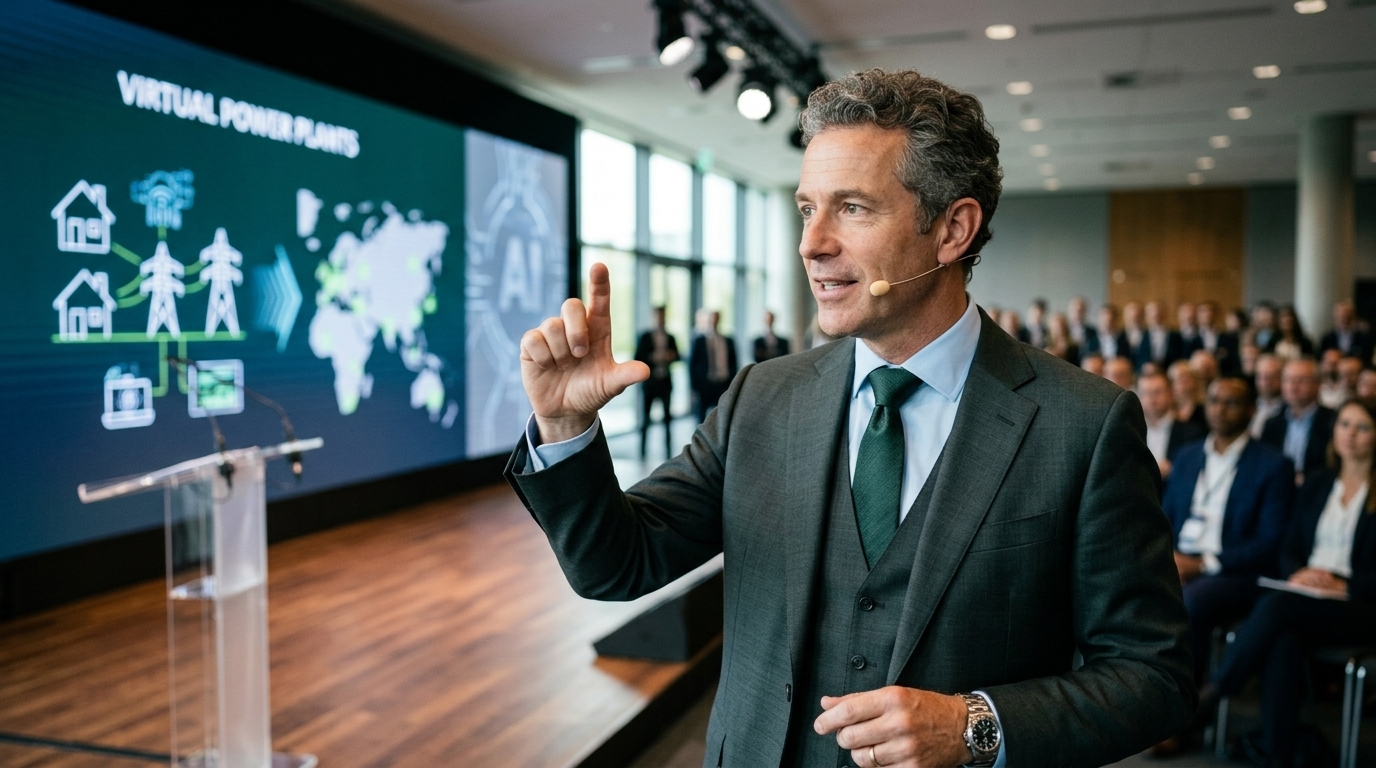
While AI is in the spotlight, Gaudette is not neglecting the everyday consumer, who is facing rising electricity bills. The solution NRG proposes is based on “Virtual Power Plants” (VPPs). These are networks of decentralized energy resources—such as Tesla Powerwalls, smart thermostats, and electric vehicles—coordinated via software to act as a single power plant.
During peak periods, instead of the company ramping up expensive and polluting peaker plants, it “draws” energy from its customers' batteries or automatically reduces AC consumption for a few minutes. Consumers are compensated for this participation, seeing their bills decrease, while the grid remains stable. “It’s not just about generating more power, but about smarter management of what we already have,” Gaudette stated in his first interview as CEO.
Growth Strategy and Economic Risk
The market welcomed the announcements with enthusiasm, as NRG appears to be positioning itself as the bridge between “old” energy and “new” technology. However, challenges remain. Building BYOP infrastructure requires massive capital and long-term contracts with companies that, despite their current strength, operate in a highly volatile sector. Furthermore, regulatory compliance in the U.S. remains a labyrinth, with different rules for every state.
Gaudette is betting that NRG can leverage its existing portfolio of power plants, converting old units into AI hubs. This infrastructure recycling reduces costs and environmental footprints while providing the reliability that data center customers demand. This strategy is not just about survival, but about dominance in a new economy where electricity is the most valuable currency.
- NRG focuses on co-locating power generation next to data centers to bypass grid delays.
- VPPs promise cost reductions for residential consumers through smart demand management.
- Robert Gaudette brings a “solutions-oriented” approach rather than just selling kilowatt-hours.
- Partnerships with Big Tech are seen as the key to future profitability and stability.
In conclusion, NRG Energy under Gaudette is attempting to solve the paradox of the modern era: how to fuel the future of digital intelligence without collapsing the grid of the present. If the BYOP model and VPPs succeed, NRG will have created a new blueprint for energy companies worldwide.