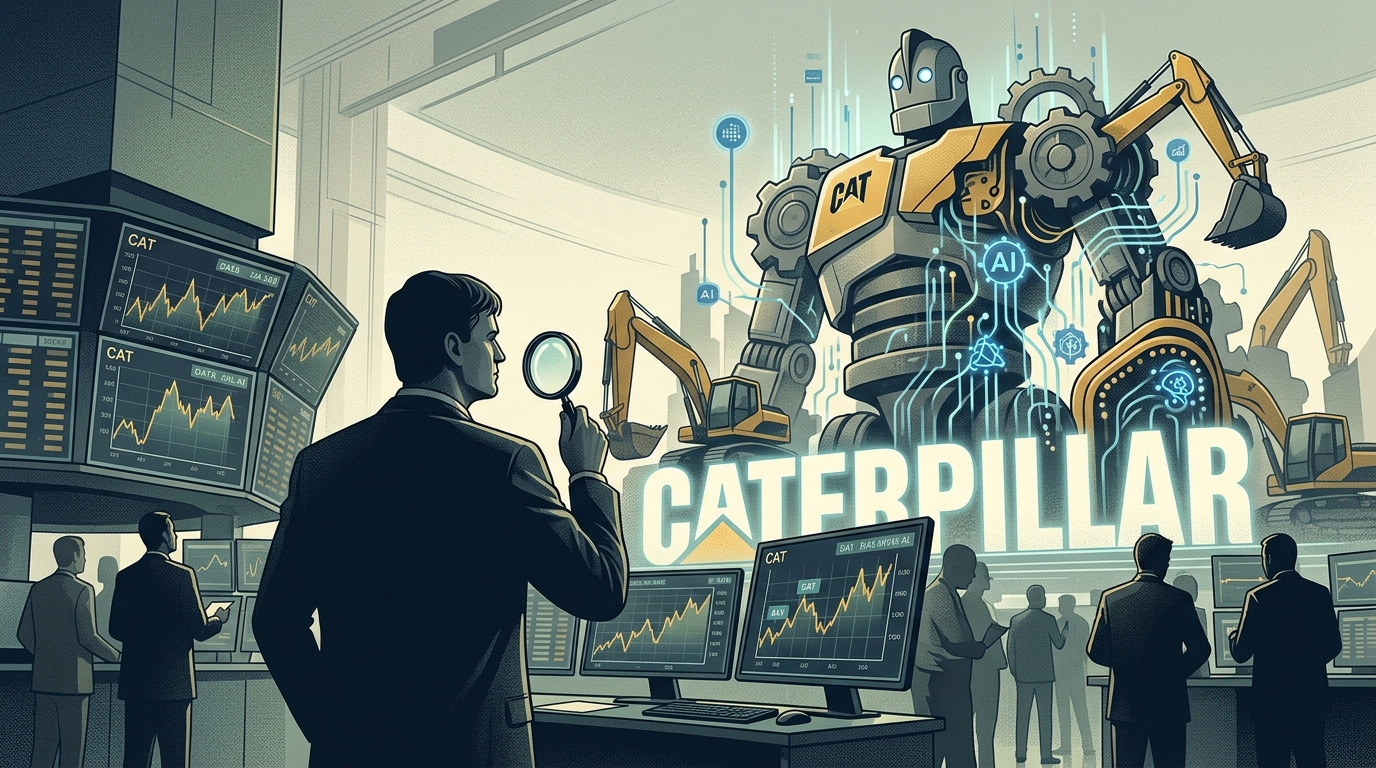
The history of financial markets is replete with instances where reality collides with expectation. On July 2, 2026, we find ourselves at the center of such an epic confrontation. Michael Burry, the man who became a legend by predicting the 2008 housing market collapse, has turned his sights on an unexpected target: Caterpillar Inc. Despite a staggering 172% rally driven by the Artificial Intelligence (AI) infrastructure boom, Burry is betting on its downfall, labeling it a classic case of market irrational exuberance.
The Transformation of an Industrial Giant into an AI Darling
For decades, Caterpillar was synonymous with excavators, yellow trucks, and heavy construction equipment. However, over the past two years, the narrative has shifted radically. The company is no longer viewed as a mere machinery manufacturer but as the "iron backbone" of the AI revolution. The reason? Data centers. The explosive growth of Large Language Models (LLMs) requires an unprecedented amount of power and cooling. Caterpillar, through its Energy & Transportation segment, provides the generators and power systems that keep these digital behemoths running.
The market responded with euphoria, pushing CAT’s market capitalization to levels traditionally reserved for high-growth software companies. Investors see Caterpillar as the ultimate "picks and shovels" play of our era: if Nvidia is the brain of AI, Caterpillar is the muscular system and the heart providing the electrical lifeblood. But for Burry, this comparison is both misleading and dangerous.
Burry’s Bear Case: The Valuation Trap
Michael Burry, through Scion Asset Management, argues that the market has ignored Caterpillar's inherent cyclicality. In his analysis, he points out that the current valuation assumes perpetual growth that is inconsistent with the historical trajectory of industrial firms. Burry believes the 172% rally is based on a "scarcity illusion" regarding power equipment, which will evaporate once supply chains fully normalize and capacity catches up.
"Caterpillar remains a capital-intensive business with significant exposure to global economic slowdowns. Pricing it like a SaaS (Software as a Service) company is the ultimate sign of an infrastructure bubble," sources close to Scion suggest.
Furthermore, Burry is betting that Big Tech companies are beginning to seek alternative paths for energy autonomy, including Small Modular Reactors (SMRs). This shift could potentially reduce long-term reliance on Caterpillar’s traditional diesel and natural gas reciprocating engines.
The Rebuttal: A Structural, Not Cyclical, Shift
Conversely, many Wall Street analysts believe Burry’s bet will fail precisely because he underestimates the depth of the AI-induced energy crisis. One prominent analyst argued that Caterpillar's rise isn't a fleeting bubble but a reflection of a structural shift in the global economy. The need for on-site power generation at data centers isn't optional; it is a matter of national and economic security.
- Backup Power Systems: Data centers require 100% uptime. Caterpillar holds nearly 40% of the global market for large-scale backup generators.
- Energy Transition: CAT is investing heavily in hydrogen-capable generators, positioning itself at the heart of the green transition for tech giants.
- Order Backlog: Orders for power systems now extend into 2028, offering revenue visibility rarely seen in industrial sectors.
According to this view, Caterpillar is now an "AI infrastructure company" rather than a simple industrial. The convergence of the physical and digital worlds requires massive amounts of steel and internal combustion engines, a reality that Burry might be discounting by focusing solely on P/E multiples.
Geopolitical Implications and the Path Ahead
We cannot ignore the geopolitical dimension. As the U.S. and Europe strive to reshore semiconductor manufacturing and data storage, Caterpillar becomes the de facto partner for every new construction site. Burry’s critique focuses on "how expensive" the stock is today, but CAT bulls focus on "how essential" it will be tomorrow.
The remaining question is whether Caterpillar can maintain its margins as competition intensifies and raw material prices remain volatile. If Burry is right, the correction will be violent, dragging down the entire AI industrial complex. If he is wrong, it will serve as another reminder that in the age of Artificial Intelligence, the old rules of value and cyclicality may require a radical rewrite. For now, the "Big Short" is facing off against the "Iron Giant," and the stakes couldn't be higher.