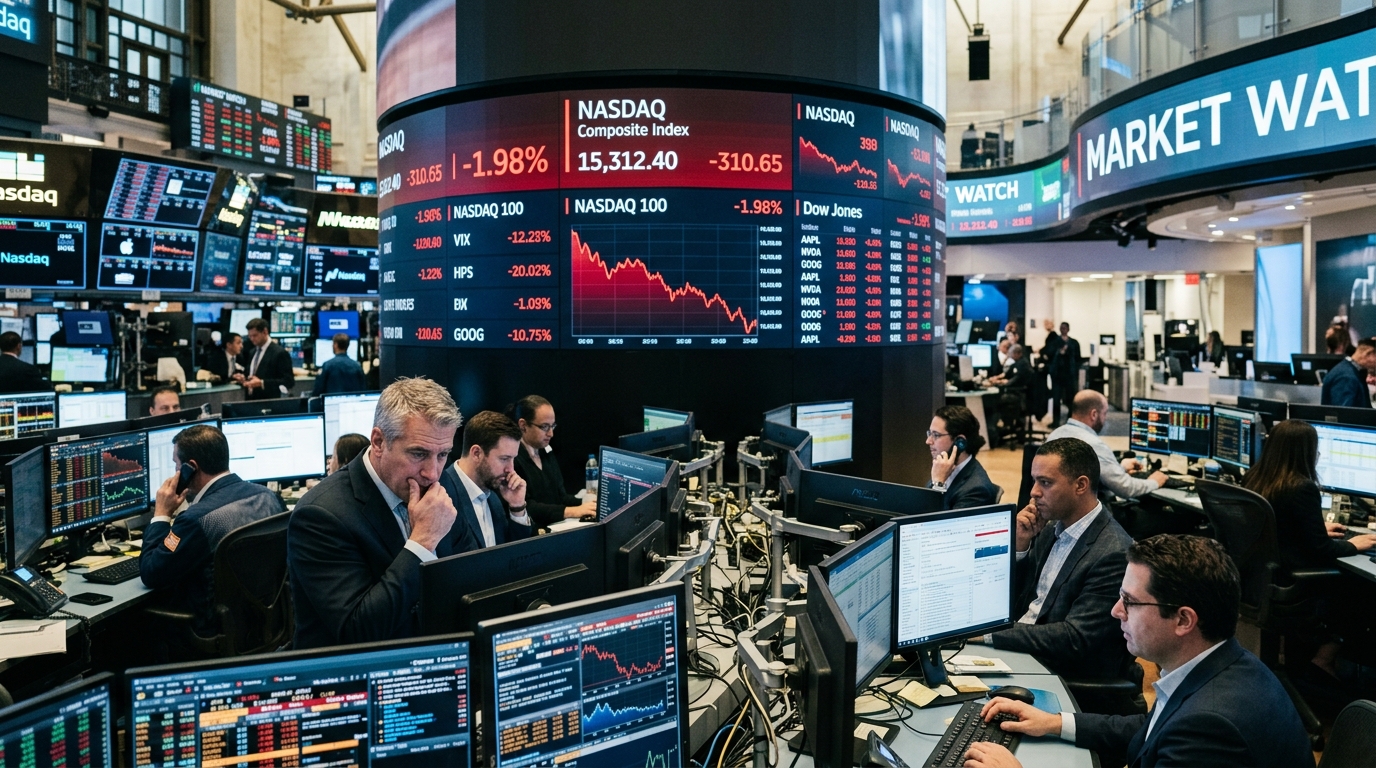
Wall Street faced a familiar yet increasingly complex puzzle on Thursday, as the Nasdaq led a decline in U.S. equities. The catalyst was the latest batch of labor market data, which pointed to a clear softening in employment trends. In an environment where investors have been desperately searching for signs that would allow the Federal Reserve to pivot toward interest rate cuts, the 'bad news' for the economy was not met with the usual cheers. Instead, a growing fear took hold: that the slowdown might be sharper and more painful than initially anticipated.
The Labor Market at a Crossroads
The data released showed that private sector hiring has slowed significantly, while initial jobless claims saw a concerning uptick. For months, the U.S. labor market had displayed a remarkable resilience, acting as a bulwark against the pressures of high interest rates. However, the current picture suggests that businesses, particularly in the technology and services sectors, are beginning to tighten their belts. Hiring freezes and strategic realignments are becoming the new norm as corporate leaders brace for a more frugal consumer environment.
This weakening is a double-edged sword. On one hand, it dampens inflationary pressures stemming from wage growth, providing the Fed with the necessary justification to loosen monetary policy. On the other hand, it raises existential questions about consumer spending—the backbone of the U.S. economy. If workers feel less secure in their roles, the demand for everything from cloud services to high-end hardware will inevitably wane. The market is now grappling with the reality that a rate cut born out of economic necessity is far less attractive than one born out of controlled success.
Tech Sector Vulnerability and Valuation Realities
The Nasdaq Composite, dominated by growth-oriented companies and tech giants, is hyper-sensitive to shifts in macroeconomic expectations. Despite the recent euphoria surrounding Artificial Intelligence (AI), the valuations of many sector leaders remain at historic highs, requiring a 'Goldilocks' economic scenario to remain sustainable. Any hint that earnings growth might stall due to a broader economic downturn prompts immediate profit-taking from institutional investors.
Analysts emphasize that we are entering a phase of rigorous reassessment. "It's no longer just about the Fed's terminal rate," noted one prominent Wall Street strategist. "It's about the quality of growth. If the Fed cuts rates because the economy is fracturing, that's not a bullish signal for equities." Big Tech firms, which were previously viewed as safe havens due to their massive cash reserves, are seeing their margins squeezed by the cumulative effect of past rate hikes and a potential dip in enterprise spending.
The Fed's High-Stakes Balancing Act
All eyes are now fixed on the Federal Reserve's upcoming policy meeting. The challenge for Chair Jerome Powell and his colleagues is to navigate the elusive 'soft landing'—curbing inflation without tipping the nation into a deep recession. The labor data suggests that time is of the essence. Delaying rate cuts could transform a controlled deceleration into a disorderly contraction of economic activity.
- The Nasdaq's retreat reflects deep-seated uncertainty regarding future corporate earnings.
- Treasury yields fell as investors sought the safety of bonds and priced in a more aggressive easing cycle.
- The AI narrative is shifting from speculative hype to a demand for tangible ROI and revenue contributions.
In conclusion, the current market correction is more than just a technical pullback. It is a reflection of a transition to a new economic reality where liquidity is no longer cheap and growth is no longer guaranteed. Investors are being forced to navigate a landscape where geopolitical instability, technological disruption, and shifting monetary sands create a highly volatile environment.
"The labor market is no longer the engine it once was; it's becoming the anchor that many feared," an analyst told Reuters.
As we move further into 2026, the resilience of the global economy will be tested. The decoupling of tech performance from broader economic health appears to be ending, suggesting that the next phase of the market cycle will require a much more discerning approach to investment, focusing on fundamental value rather than purely on momentum and hype.