The global investment community is facing a harsh reality: the period of 'blind' euphoria for Artificial Intelligence appears to be giving way to a painful process of reassessment. Markets, from Asia to the heart of New York, are experiencing a wave of liquidations that does not resemble a simple technical correction, but rather a structural challenge to the growth model that has dominated the last two years.
The End of the Honeymoon for Big Tech
For many months, rising indices were based on a simple equation: more AI equals higher valuations. However, recent earnings announcements from giants like Microsoft, Alphabet, and Meta have begun to illuminate the 'dark side' of this equation. The massive cost of capital expenditures (CAPEX) for building AI infrastructure — now measured in hundreds of billions of dollars — is not yet accompanied by a corresponding increase in revenue from end-users.
Investors are now openly asking: When will there be a Return on Investment (ROI)? NVIDIA, previously considered the market's 'bulletproof' stock, has seen its market capitalization come under heavy pressure as concerns about saturation in demand for H100 and Blackwell chips have begun to mount. The market no longer fears a chip shortage, but a shortage of viable applications that would justify their continuous purchase.
Geopolitical Instability and the Supply Chain
Beyond balance sheet numbers, the climate is burdened by the geopolitical landscape. Stricter U.S. restrictions on technology exports to China have created a climate of uncertainty regarding future semiconductor sales. The dependence of global production on TSMC in Taiwan remains an 'Achilles' heel' that markets can no longer ignore, especially during a period of increased tension in the straits.
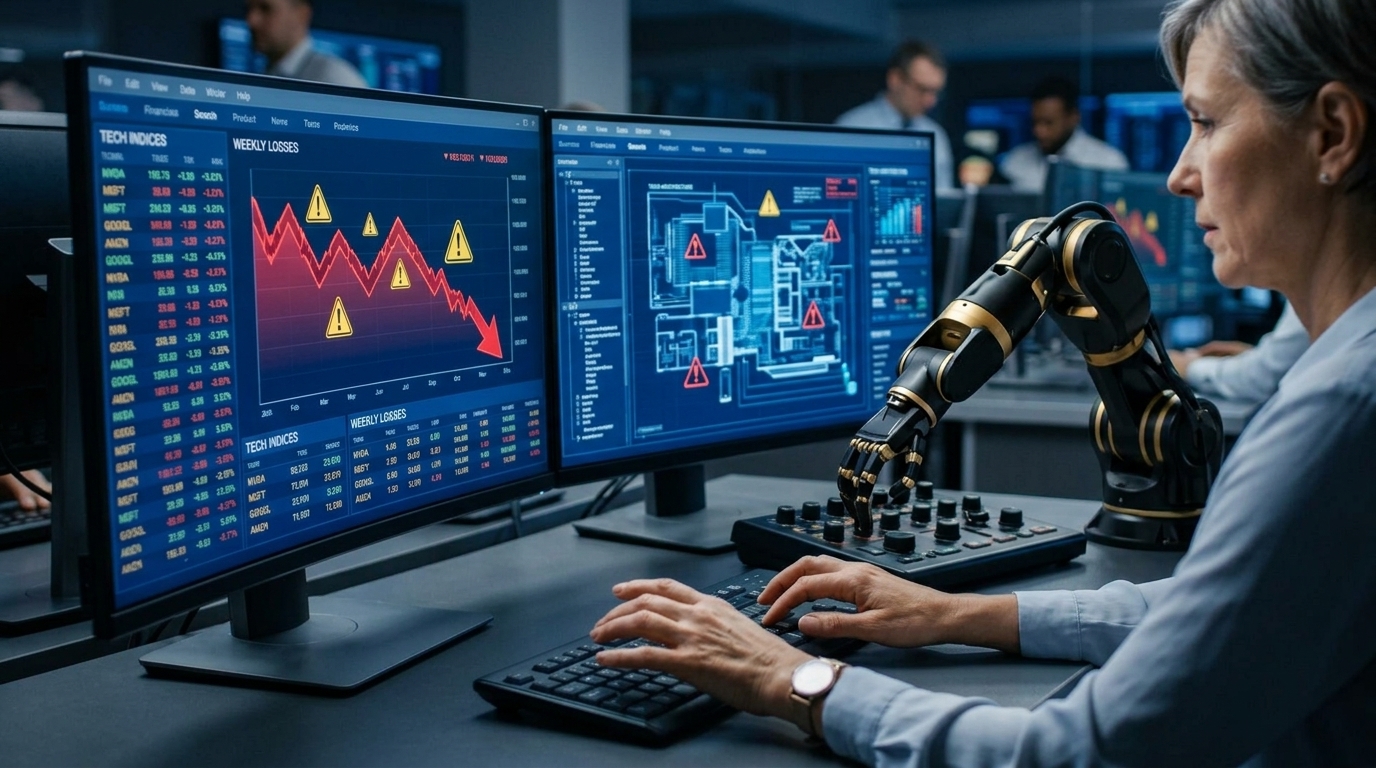
- The decline of the Nikkei and Kospi reflects nervousness in the Asian supply chain.
- Liquidations in tech ETFs have reached record levels for 2026.
- A rotation toward defensive stocks (utilities, consumer staples) suggests preparation for a slowdown.
The Ghost of Dot-com and the Energy Challenge
Comparisons to the dot-com bubble of 2000 are returning to the forefront. While today's technology is undoubtedly more mature and companies possess real cash reserves, mass psychology follows similar patterns. Additionally, a new obstacle is emerging: energy. The massive power consumption of data centers has begun to strain electrical grids globally, increasing operating costs and creating environmental backlash that delays infrastructure expansion.
"We are not facing the end of AI, but the end of the 'free ride' growth. From now on, the market will reward only those who present real profits, not just PowerPoint presentations," says a senior analyst at a major investment bank in London.
In conclusion, markets are searching for a bottom in an environment where interest rates remain high and investor patience is wearing thin. The next phase of the market will be determined by the ability of software to capitalize on the hardware that has already been installed. Until then, volatility will remain the only certain companion for investors.