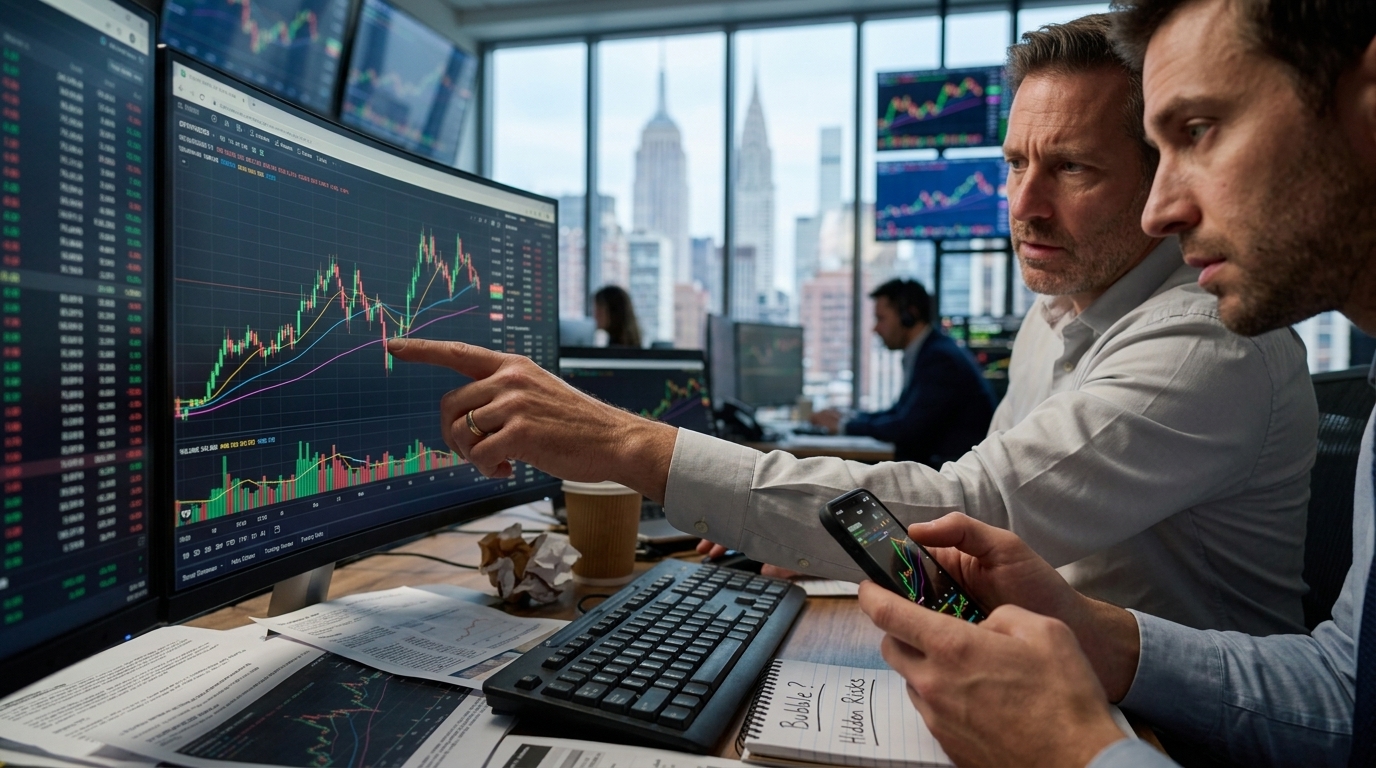
The landscape of international markets in the summer of 2026 bears a striking resemblance to the eve of major historical corrections, despite the euphoria currently prevailing on Wall Street trading floors. While the S&P 500 and the Nasdaq continue to shatter record after record, leading analysts and bankers, such as JPMorgan’s Jamie Dimon and economist Dambisa Moyo, are sounding the alarm. The current rally is not merely a reflection of economic strength, but the result of a dangerous convergence of factors that could lead to a hard landing.
The Concentration Trap: AI as a One-Way Street
The first and perhaps most obvious risk concerns extreme market concentration. Never before in the history of US stock markets has the trajectory of an entire index depended so heavily on a handful of technology companies. The Artificial Intelligence (AI) revolution has created an investment monoculture. Companies leading in semiconductors and cloud infrastructure have seen their valuations skyrocket to levels that presuppose perfect execution and uninterrupted growth for the next decade.
Dambisa Moyo points out that this concentration creates an illusion of safety. When the S&P 500 rises because five companies are overperforming while the majority of listed stocks remain stagnant or decline, the market becomes extremely vulnerable. Any disappointment in the earnings of these "titans" or a delay in realizing the profitability promises of AI could trigger a systemic collapse that would drag down entire portfolios.
Private Credit: The 'Invisible' Leverage
The second risk, which Jamie Dimon characterizes as a "time bomb," is the explosive rise of private credit. Following the tightening of the regulatory framework for traditional banks, a massive portion of lending has shifted to the shadow banking system. Private equity funds now lend directly to businesses, often with less transparency and lower oversight standards than banks.
The problem with private credit is that it is not "marked-to-market" in the same way public bonds are. This means that losses can be swept under the rug for long periods. In an environment where interest rates remain higher for longer than expected, the ability of these companies to service their debt is called into question. A chain of defaults in the private credit sector could trigger a liquidity crisis that central banks would struggle to control, as they lack direct oversight of these private agreements.
Geopolitical Instability and Fiscal Irresponsibility
The third risk is the combination of geopolitical tensions with burgeoning sovereign deficits. Jamie Dimon has repeatedly emphasized that the world is traversing its most dangerous period in decades. Conflicts in Ukraine and the Middle East, combined with US-China competition, are reshaping supply chains and fueling inflation.
At the same time, the United States and many European countries continue to spend funds they do not have. The US fiscal deficit is at historic highs for a period of peace and economic growth. This forces governments to constantly issue new debt, pushing bond yields upward. If investors begin to doubt the sustainability of this debt, the "safe haven" of government bonds could transform into a source of instability, upsetting the balance across all asset classes.
"We cannot ignore the laws of economic gravity indefinitely. Leverage and concentration are two sides of the same coin called crisis," Moyo notes characteristically.
In conclusion, while technological progress offers valid hopes for increased productivity in the future, current valuations and hidden risks in the financial system demand heightened vigilance. History has taught us that "bubbles" burst when confidence turns into complacency. For investors in 2026, the challenge is not just to find the next big opportunity, but to protect themselves from the invisible erosion of market foundations.