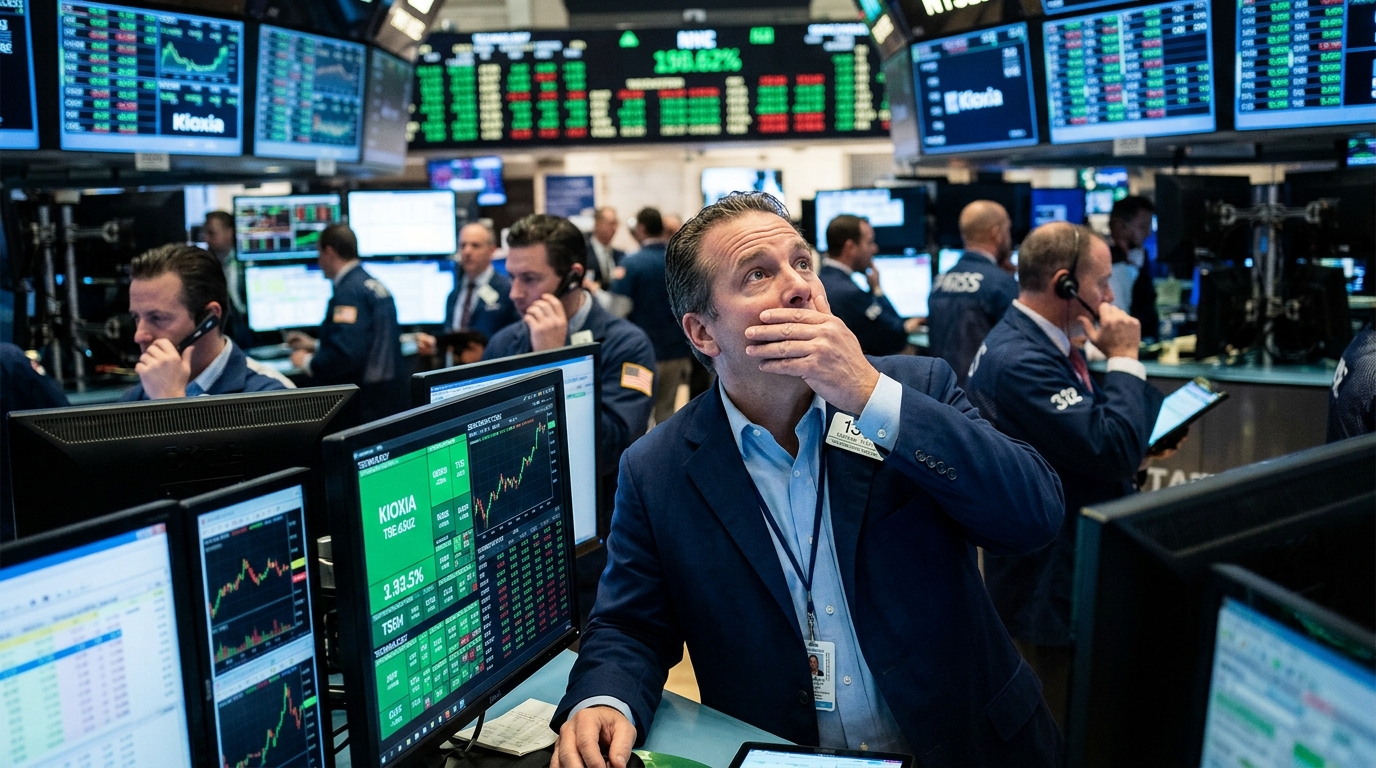
Monday, May 18, 2026, will be remembered in the Japanese stock market as the day Kioxia Holdings Corp. solidified its dominance in the burgeoning AI ecosystem. Shares of the Japanese NAND flash memory giant remained untraded at the opening bell, not due to a lack of interest, but because of a massive glut of buy orders that triggered a market imbalance. The catalyst? A financial report that shattered analyst expectations, fueled by the insatiable hunger of AI data centers for high-speed storage solutions.
The Revenge of Memory: Beyond Pure Compute
While the past two years saw investor attention focused almost exclusively on processor and GPU manufacturers like Nvidia, 2026 is emerging as the year of storage infrastructure. Training Large Language Models (LLMs) now requires datasets measuring in the petabytes, and Kioxia sits at the epicenter of this demand. The company reported operating profits that didn't just recover from past cyclical downturns but set new historical records.
According to the report by Bloomberg Tech, Kioxia is reaping the rewards of its strategic pivot toward enterprise-grade Solid State Drives (SSDs). These units, built on high-density NAND flash technology, are essential for feeding data to GPUs at lightning speeds. Without Kioxia’s high-performance memory, the expensive processors from Nvidia and AMD would sit idle, waiting for data to be retrieved from slower, legacy architectures.
"This isn't just a cyclical recovery. It's a structural shift in how the world stores and retrieves information in the era of generative AI," noted a senior technology analyst in Tokyo.
Staggering Financials and Bullish Outlooks
The numbers presented by Kioxia’s management are nothing short of spectacular. Net income rose by 45% compared to the previous quarter, while profit margins expanded significantly due to a global rise in memory chip prices. Furthermore, the company projected that demand will remain robust through at least late 2027, as hyperscalers like Microsoft, Google, and Amazon continue to build out AI infrastructure globally.
- Revenue increased by 38% year-over-year.
- Record order backlog for the latest generation of BiCS FLASH™ 3D memory.
- Significant debt reduction, strengthening the case for a potential IPO.
The market responded with euphoria. the flood of buy orders suggests that institutional investors view Kioxia as the last "undervalued" play in the AI hardware sector, especially following the explosive rallies of SK Hynix and Samsung in South Korea.
The Geopolitical Chessboard and the Road Ahead
Kioxia’s resurgence is not just a corporate success story; it is a victory for Japanese industrial policy. The Japanese government has funneled billions of yen into supporting domestic semiconductor manufacturing, wary of over-reliance on Taiwan and China. Kioxia, as Japan’s primary champion in flash memory, serves as the cornerstone of this strategy.
However, challenges remain. Merger talks with U.S.-based Western Digital, which have stalled repeatedly in the past, are once again a topic of speculation. With Kioxia’s valuation soaring, the terms of any such deal have shifted dramatically. The company now appears capable of charting an independent course, aiming for the top spot in global rankings. Artificial Intelligence hasn't just changed how we write code or generate images; it has fundamentally rewritten the balance sheets of the companies building the physical substrate of these digital minds.