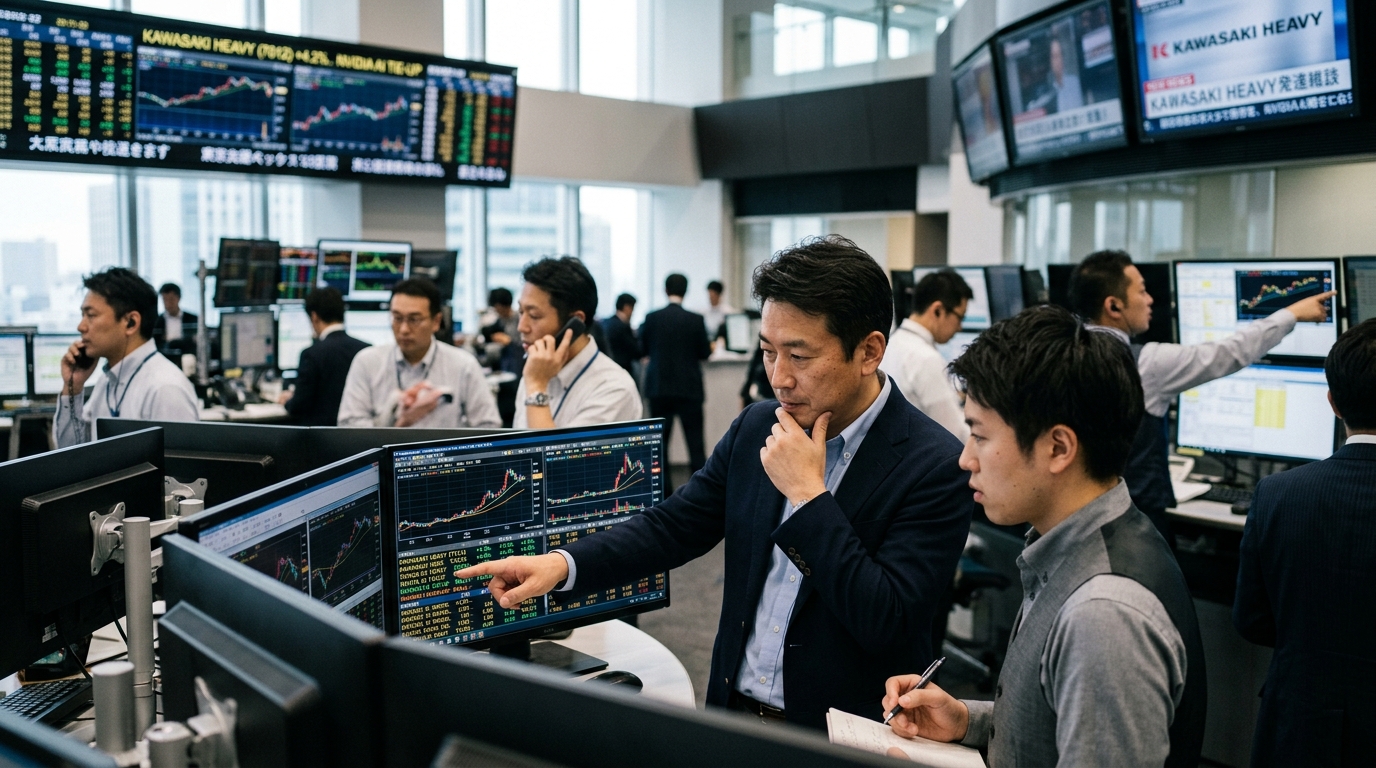
May 22, 2026, marks a pivotal moment for the Japanese industrial landscape. Kawasaki Heavy Industries Ltd., a conglomerate traditionally synonymous with shipbuilding, aerospace, and high-performance motorcycles, saw its shares surge by 12% in Tokyo trading. The catalyst for this market euphoria was not a breakthrough in turbine efficiency or a new defense contract, but a strategic alliance with Nvidia Corp. to pioneer the field of "Physical AI."
The Convergence of Hardware and Intelligence
Physical AI—often referred to as Embodied AI—represents the frontier where generative artificial intelligence meets the physical world. Unlike Large Language Models that exist solely in the digital realm, Physical AI enables machines to perceive, reason, and act within complex, unpredictable environments. The partnership aims to integrate Nvidia’s Blackwell architecture and the Omniverse platform directly into Kawasaki’s extensive robotics lineup.
Kawasaki plans to utilize NVIDIA Isaac, an end-to-end platform for the development and deployment of AI-powered robots. This shift signifies a departure from traditional industrial automation, where robots followed rigid, pre-programmed paths. By leveraging Isaac and Omniverse, Kawasaki’s robots will undergo training in high-fidelity digital twins, learning to navigate factory floors and handle delicate materials through reinforcement learning before a single motor is activated in the real world.
Economic Implications and the Japanese Context
The 12% rally, the sharpest since early February, reflects investor confidence in Kawasaki’s ability to pivot from legacy manufacturing to high-tech leadership. Japan is currently grappling with a severe demographic crisis and a shrinking workforce. For the nation's industrial leaders, Physical AI is not just a luxury—it is a demographic necessity.
- Enhanced productivity in manufacturing without the need for constant human supervision.
- Reduced R&D costs by utilizing digital twins for stress testing and training.
- A shift toward high-margin software-as-a-service (SaaS) models within heavy industry.
"This isn't just about automation; it's about industrial autonomy," noted a senior market analyst in Tokyo. "Kawasaki is providing the physical 'body'—the heavy-duty hardware—while Nvidia provides the 'brain.' It is a formidable combination that challenges the status quo of global manufacturing."
Nvidia's Strategic Expansion into the Factory Floor
For Nvidia, this tie-up is a cornerstone of its strategy to dominate the next wave of AI. CEO Jensen Huang has frequently stated that the next major evolution of AI will be in robotics. By partnering with a giant like Kawasaki, Nvidia gains access to decades of mechanical engineering expertise and real-world industrial data.
The use of the Nvidia Omniverse is particularly critical. It allows Kawasaki to simulate entire production lines with photorealistic accuracy. This "simulation-first" approach allows for the training of autonomous agents at a scale impossible in the physical world, drastically shortening the time-to-market for new robotic solutions. Furthermore, Kawasaki intends to apply these AI capabilities across its diverse portfolio, including heavy machinery, energy systems, and even urban infrastructure.
Challenges and the Global Competitive Landscape
Despite the optimistic market reaction, the path forward is fraught with technical and geopolitical hurdles. Implementing AI in heavy machinery requires unprecedented levels of reliability; a software glitch in a multi-ton robotic arm poses significantly higher risks than a hallucinating chatbot. There is also the question of energy consumption, as the computational power required for real-time Physical AI is immense.
Geopolitically, the deal strengthens the tech bridge between the US and Japan, a move seen as a counterweight to China’s rapid advancements in industrial robotics. However, it also increases Japan’s reliance on American silicon, a strategic vulnerability that some Japanese policymakers view with caution. Nevertheless, for now, the markets are focused on the transformative potential of this alliance, as Kawasaki Heavy positions itself as a 21st-century powerhouse at the intersection of atoms and bits.