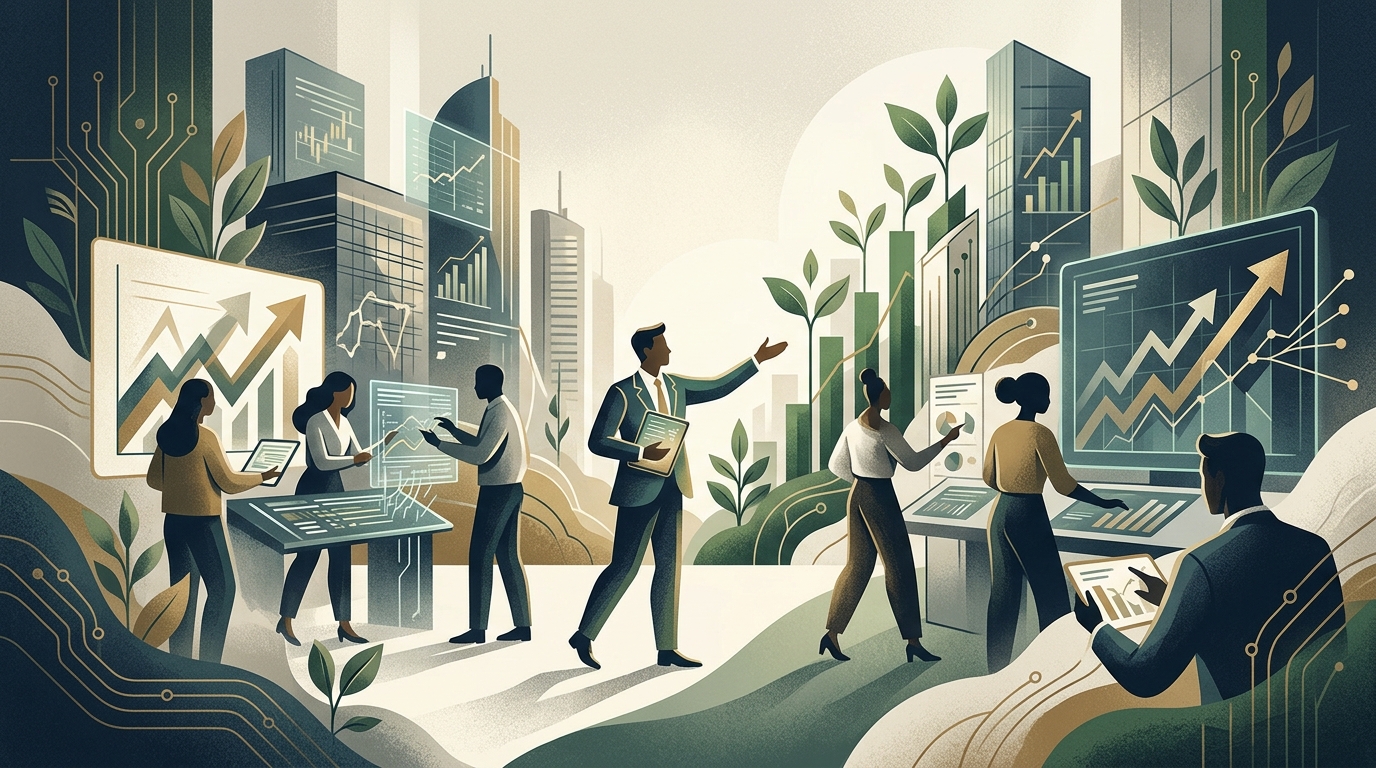
At the center of the global technological stage, Jensen Huang, the visionary leader of NVIDIA, continues to shape the narrative regarding the future of work. While economic doomsayers warn of a looming "job apocalypse" driven by automation, Huang presents a radically different perspective. According to him, we are on the cusp of a new "Industrial Revolution," where Artificial Intelligence (AI) will not replace humans but will serve as the ultimate power multiplier, creating new jobs and enhancing corporate prosperity.
Huang’s argument is not based on naive optimism but on a deep understanding of historical technological evolution. He contends that every major technological advancement—from the steam engine to the internet—initially sparked fears of job loss, yet ultimately led to the creation of entire new industries that were previously unimaginable. For Huang, AI is the tool that will allow companies to expand into sectors that were hitherto economically or technically inaccessible, thereby requiring more "human hands" to manage this new complexity.
The Concept of the 'AI Agent' as a Co-worker
One of the most compelling points in Huang’s analysis is the introduction of "AI Agents." Instead of viewing AI as an autonomous system that displaces workers, he describes it as a fleet of specialized assistants. These agents will take over repetitive and energy-intensive tasks, freeing humans to focus on strategic thinking, creativity, and complex problem-solving.
"When a company becomes more productive thanks to AI, it doesn't fire people; it expands," Huang often emphasizes. This expansion creates a chain reaction in the economy. For instance, a software developer using AI might write code ten times faster. This doesn't mean the company needs fewer developers; it means it can now execute ten times more projects, which in turn requires more managers, designers, and marketing experts to bring those products to market.
Democratizing Innovation and Expertise
Huang also argues that AI will bridge the "skills gap." In the past, the ability to communicate with computers required years of learning complex programming languages. Today, natural language—the language we speak every day—is becoming the new programming language. This means billions of people who were previously excluded from technological creation can now become "creators."
This shift offers immense opportunities for global labor markets. The ability to build complex applications and services with minimal infrastructure costs can lead to a new generation of startups. Huang believes that AI will enable "companies of one" to possess the productive power of large multinationals, shifting the balance of power in the global labor market. The democratization of expertise means that the barrier to entry for high-value roles is lower than ever before.
Challenges and the Necessity of Reskilling
Despite his optimism, the NVIDIA CEO does not ignore the challenges. The transition will not be painless for everyone. Jobs that rely solely on data processing without critical thinking are indeed at risk. The solution, according to Huang, is not to halt technological progress but to invest aggressively in education and reskilling.
Governments and educational institutions must adapt faster than ever. The requirement is no longer the memorization of facts but the ability to collaborate with AI. The worker of the future will be an "orchestrator" of intelligent systems. In conclusion, Jensen Huang invites us to see AI not as a competitor in the arena of survival, but as the most powerful tool humanity has ever built to unlock its potential. History will show whether his prediction of a golden age of employment will come to pass, or if the structural shifts in the economy will demand a completely new social contract.