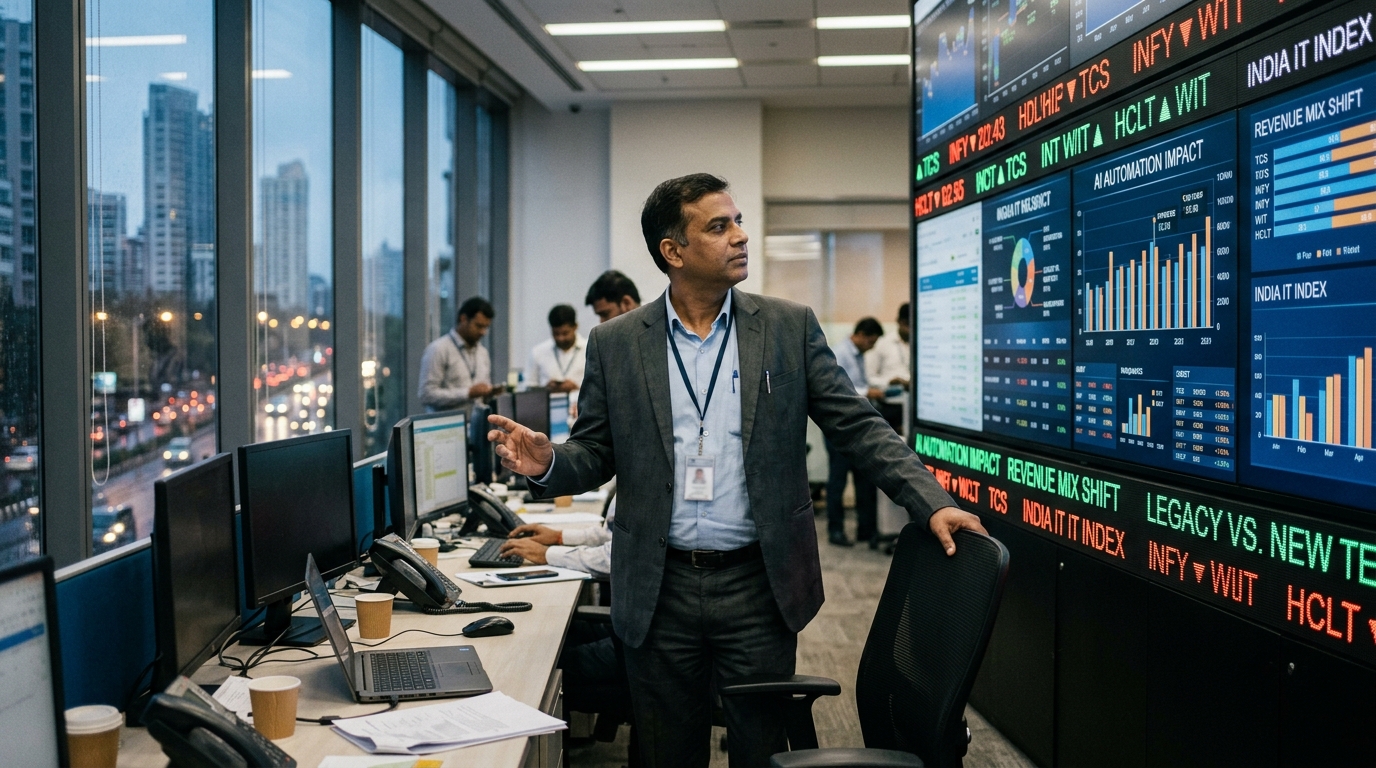
India’s IT services industry, for decades the backbone of global digital infrastructure, is currently facing an existential challenge. The sector's giants—Tata Consultancy Services (TCS), Infosys, Wipro, and Tech Mahindra—are witnessing their traditional business model, built on labor arbitrage and the employment of hundreds of thousands of developers, being disrupted by the advent of Generative AI (GenAI). As we approach fiscal year 2027 (FY27), market signals are mixed, causing intense reflection among investors and analysts alike.
The End of the 'Headcount' Era
For nearly thirty years, the recipe for success for Indian IT firms was straightforward: hire large numbers of fresh graduates, train them in basic programming skills, and provide services to Western corporations at a fraction of the cost. However, GenAI has fundamentally changed the rules of the game. Tools like GitHub Copilot and specialized AI models can now perform coding, testing, and software maintenance tasks in a fraction of the time, significantly reducing the need for human hands at the junior level.
This automation creates a paradoxical situation. While it increases the internal productivity of these firms, it simultaneously threatens their revenue, which has historically been directly linked to the number of billable hours charged to clients. If a task that once required 100 hours can now be completed in 20, IT companies must find new ways to demonstrate value and maintain their profit margins.
Strategic Realigning Towards FY27
Projections for FY27 indicate a clear shift from quantity to quality. TCS has already begun retraining over 350,000 of its employees in AI, while Infosys launched Topaz, a suite of services focused exclusively on artificial intelligence. Tech Mahindra, under new leadership, is attempting to reorganize around 'intelligent' telecommunications and automation.
However, the transition is not without its hurdles. Analysts point out that clients in the West, amid economic uncertainty, are now demanding 'more for less.' The mega-deals that once characterized the industry now include strict clauses regarding AI utilization, which compresses revenue from traditional services. The big bet for 2027 is whether new revenue streams from AI consulting and the development of custom models can compensate for the losses in legacy system maintenance.
Social and Geopolitical Implications
This shift also carries a profound social dimension. India relies on the IT sector to create millions of jobs for its youth. If the demand for junior developers permanently decreases, the social contract fueling the Indian middle class risks being disrupted. Furthermore, competition no longer comes solely from other low-cost labor countries but from the software itself.
"We are not just in a technological upgrade; we are in a structural shift of how humanity produces digital value," a senior industry executive noted.
In conclusion, FY27 will serve as a landmark year. Companies that manage to transform from 'staffing providers' to 'intelligence providers' will dominate the new era. For TCS, Infosys, Wipro, and Tech Mahindra, the road to the future is paved with the necessity for radical innovation, leaving the security of the past behind.