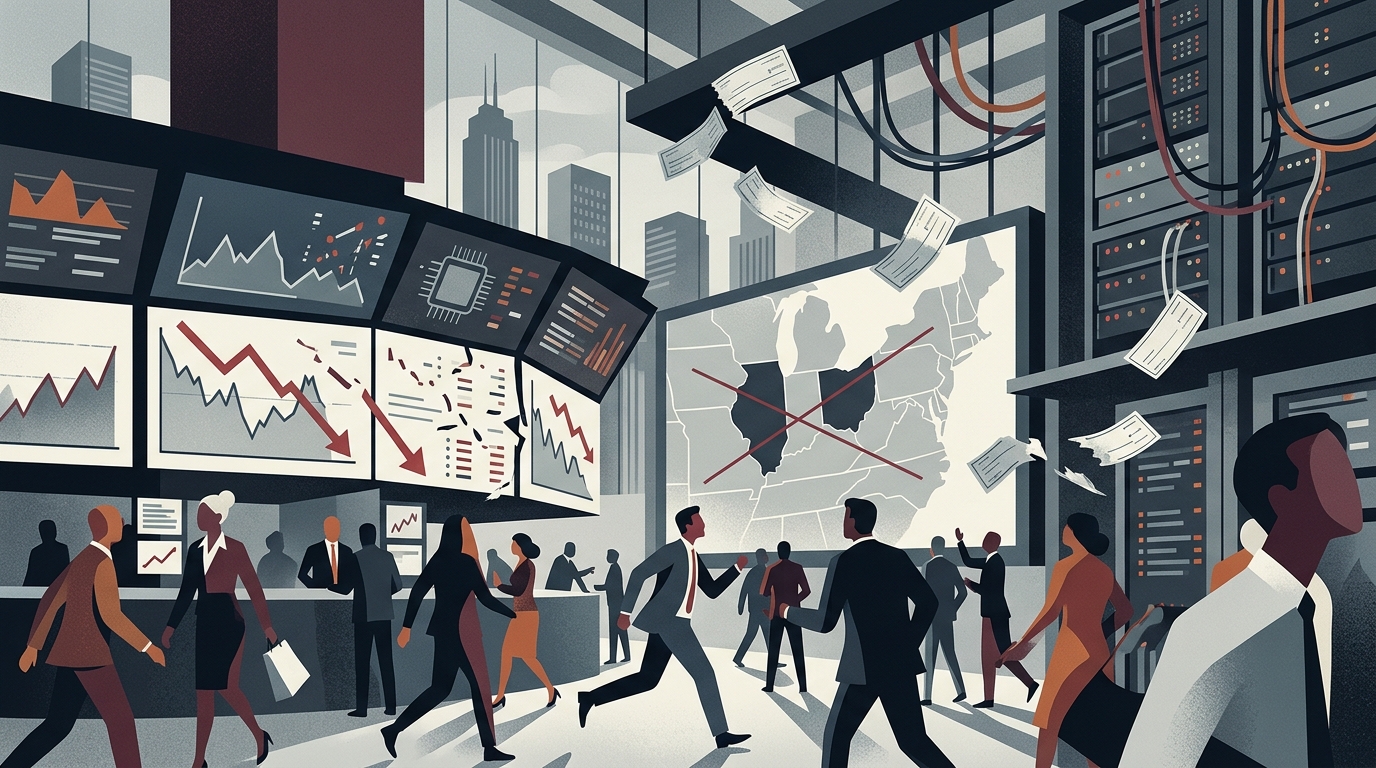
The golden era of unchecked data center expansion in the United States appears to be hitting a hard ceiling. In a move that has sent shockwaves through Silicon Valley, Illinois Governor J.B. Pritzker and Ohio Governor Mike DeWine have simultaneously announced a pause on tax incentive programs for the construction of new cloud and AI infrastructure. This decision is not merely a budgetary adjustment; it is a loud warning that physical resources—electricity and clean water—are no longer guaranteed handouts for tech giants.
The Collision of Digital Ambition and Physical Limits
For years, Midwestern states vied with one another to offer the most enticing tax breaks, hoping to transform themselves into technological hubs. However, the explosion of Generative AI has fundamentally shifted the math. Modern data centers now require up to five times more energy than traditional data storage facilities, driven by the intense power demands of Nvidia's H100s and other specialized AI chips.
In Illinois, the strain on the ComEd grid has reached a critical juncture. Authorities fear that the continuous addition of massive loads will force utility companies to hike rates for ordinary consumers to fund multi-billion dollar infrastructure upgrades. "We cannot allow our citizens to subsidize Big Tech's profitability through their monthly utility bills," a source close to Governor Pritzker’s office noted, highlighting the growing political toxicity of these subsidies.
The Water Crisis and Local Resistance
Beyond energy, water is emerging as a primary flashpoint. Data center cooling systems consume millions of gallons daily, often drawn from aquifers that serve local agriculture and residential needs. In Ohio, residents in areas slated for new developments have begun to organize, expressing legitimate fears about water depletion during drought cycles.
"Data centers are asking just too much for too little in return, whether it’s electricity or clean water," the Fortune AI report states, echoing the sentiment now prevalent in state capitals.
The employment paradox is also a major factor in this policy shift. While the construction of a data center provides temporary jobs for the building trades, their day-to-day operation requires a skeleton crew—often fewer than 50 permanent staff for facilities worth billions of dollars. This stark disproportion between resource consumption and long-term local economic contribution makes tax breaks increasingly indefensible to the voting public.
Market Implications and the Future of AI Scaling
This regulatory pivot is expected to force companies like Microsoft, Google, and Amazon to rethink their expansion strategies. We are already seeing a trend toward relocating data centers to regions with energy surpluses or to nations with more lenient environmental regulations. However, Illinois and Ohio are strategic locations due to their proximity to major population centers and existing fiber backbones.
- Contract Renegotiation: Future agreements will likely require tech firms to bring their own power sources, such as small modular nuclear reactors (SMRs) or dedicated renewable farms.
- Technological Innovation: The push for more efficient cooling methods, such as direct-to-chip liquid cooling, has moved from a luxury to a necessity.
- Political Domino Effect: Other data center hubs, most notably Northern Virginia, are closely watching this move and may implement similar restrictions.
In conclusion, the decision by Illinois and Ohio marks a transition from the era of "tech evangelism" to an era of "tech realism." The growth of Artificial Intelligence cannot proceed at the expense of the basic living infrastructure of the citizenry. Silicon Valley is now challenged to prove that it can be as sustainable as it is innovative.