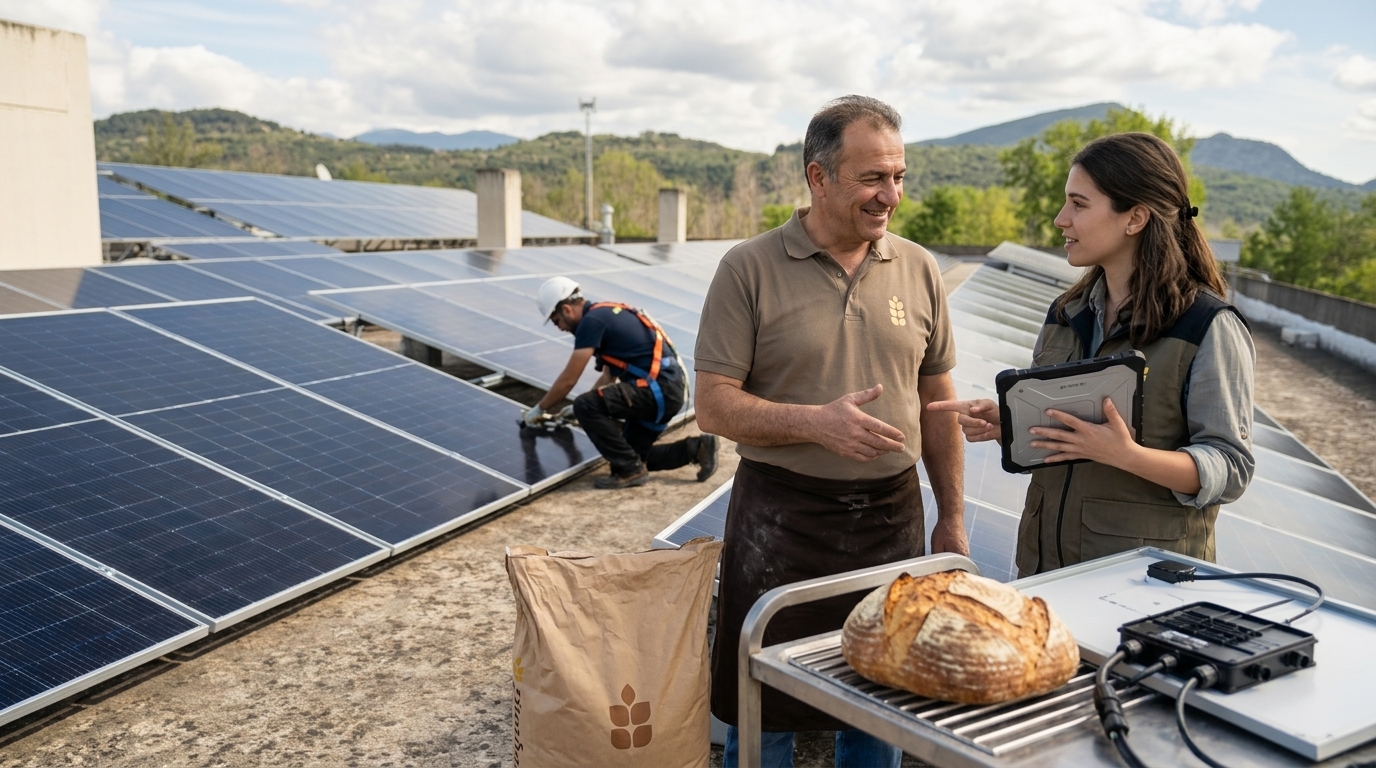
In an era where energy costs have become the "invisible enemy" of Greek manufacturing and retail, the shift toward self-production is no longer a luxury but a necessity for survival. The recent partnership between Greenvolt Next, a leader in decentralized energy solutions, and the well-known bakery chain "Gioldasis Bakery," serves as a prime example of how traditional Greek entrepreneurship can be shielded against global energy volatility. The project, based on the Solar EPC - Risk Free model, promises to transform the company's financial outlook by reducing operational expenses by €19,500 annually.
A Strategy for Energy Shielding
The baking industry is characterized by exceptionally high energy demands. Ovens, refrigeration units, and production lines operate on a near 24-hour basis, making electricity one of the most significant cost factors. Greenvolt Next, leveraging the expertise of the Portuguese Greenvolt Group, provided Gioldasis Bakery with a turnkey solution. The Solar EPC (Engineering, Procurement, Construction) - Risk Free model allows the business to acquire a state-of-the-art photovoltaic installation without bearing the risks of design, licensing, or construction failures.
The installation is designed to cover a substantial portion of the production facility's needs, enabling the simultaneous self-consumption of generated energy. This means the business consumes the energy it produces in real-time, drastically reducing its dependence on the grid and price fluctuations in the wholesale market. In a country like Greece, which boasts the highest solar radiation in Europe, the failure to exploit solar potential for industrial use was for years a missed opportunity that is now finally being seized.
Economic Benefits and Sustainability in Practice
The figure that stands out is €19,500. This is the estimated annual saving that Gioldasis Bakery will realize. Over a decade, these savings exceed €200,000—a sum that can be reinvested in modernizing equipment, developing new products, or improving staff wages. However, the benefit is not merely accounting-based. The installation contributes to the reduction of carbon dioxide (CO2) emissions, aligning the company with international ESG (Environmental, Social, and Governance) standards.
Consumers today are more environmentally conscious than ever. Knowing that the bread they purchase is produced with the help of the sun adds an intangible but significant value to the company's brand. Greenvolt Next understands this dynamic and does not just offer panels, but a comprehensive energy identity. The choice of Gioldasis Bakery to trust an international player underscores the need for reliability and long-term support in projects with a lifespan of at least 25 years.
The Future of Decentralized Production in Greece
The Gioldasis case is not an isolated incident. It is part of a broader wave of "energy democratization," where businesses cease to be passive consumers and become active producers (prosumers). The Greek government and the EU are promoting Net Metering and Net Billing models, although bureaucratic hurdles and limited grid capacity remain challenges. Greenvolt Next manages to navigate this complex environment, offering solutions that bypass common obstacles through design optimization.
- Immediate reduction in operational costs from day one of operation.
- Protection against future energy price spikes.
- Enhancement of corporate social responsibility and green profile.
- Utilization of the Risk Free model ensuring investment performance.
In conclusion, the implementation of this project by Greenvolt Next for Gioldasis Bakery sends a strong message to the market: the green transition is the only path to ensuring competitiveness. When tradition meets cutting-edge technology, the result is a sustainable business that can look to the future with greater optimism, regardless of how high the price per megawatt-hour climbs on the international energy exchange.