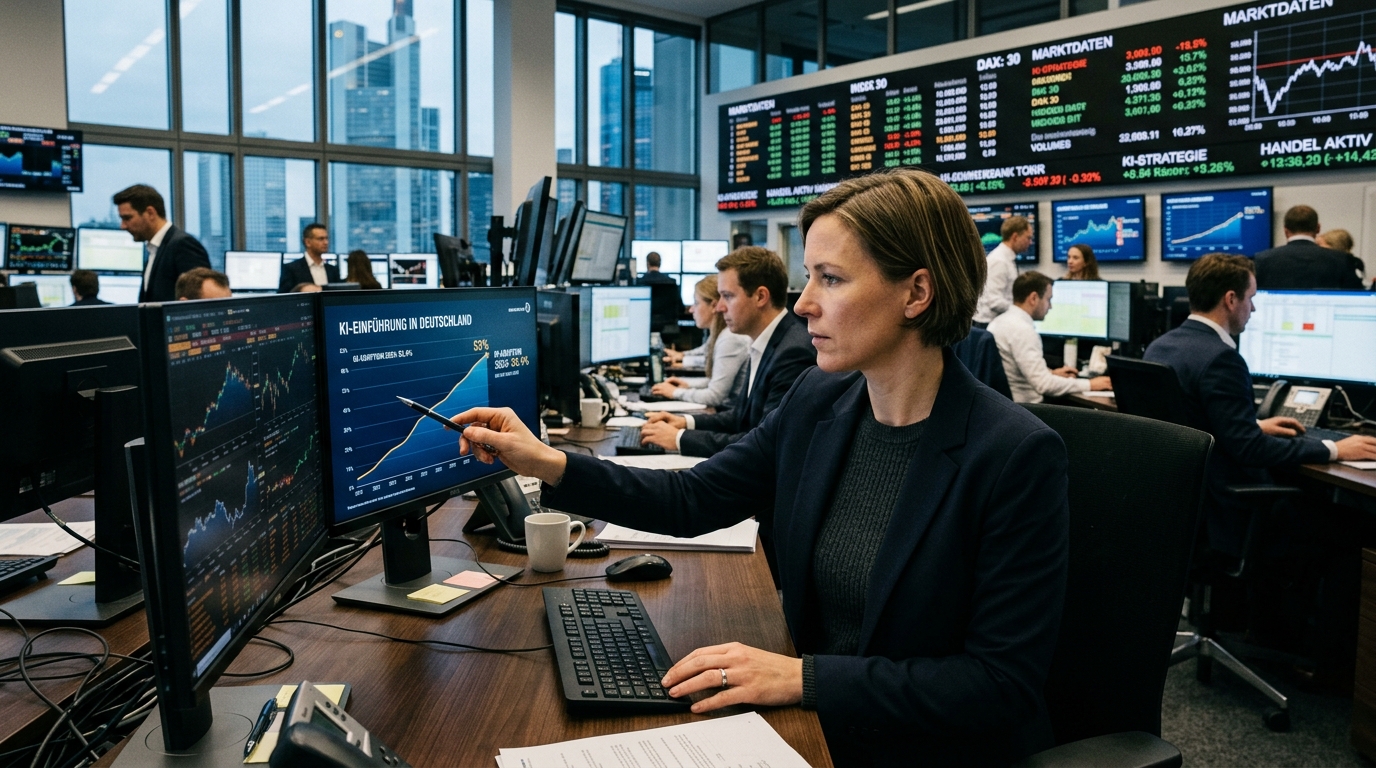
For decades, the image of German business was inextricably linked to mechanical perfection, but also to a persistent, almost anachronistic attachment to traditional methods of management and communication—the notorious love for the fax machine remained a subject of ridicule in Silicon Valley’s digital circles. However, the latest data from Berlin and the major industrial hubs of Bavaria and Baden-Württemberg suggest a tectonic shift. According to recent reports highlighted by Reporter.gr, more than half of German companies (52%) now actively use Artificial Intelligence (AI) in their daily operations, marking the end of an era of digital hesitation.
This development is not merely a technological upgrade; it is a strategic necessity. Germany, Europe’s largest economy, faces a dual crisis: an acute shortage of skilled labor due to demographic decline and high energy costs hitting its heavy industry. In this environment, Artificial Intelligence is no longer viewed as a futuristic luxury but as the essential tool for maintaining the competitiveness of the 'Made in Germany' brand.
The Driving Force: From Fear to Implementation
The pivot toward AI in Germany is characterized by a transition from theoretical concern to practical application. While three years ago discussions were dominated by data protection (GDPR) risks and the ethics of algorithmic decision-making, today the focus has shifted squarely to productivity. German businesses, from DAX giants to the medium-sized enterprises of the 'Mittelstand,' are investing heavily in Generative AI to automate bureaucracy, optimize supply chains, and implement predictive maintenance in industrial production.
Of particular interest is the stance of small and medium-sized enterprises (SMEs). The Mittelstand, which forms the backbone of the German economy, has traditionally been conservative regarding high-risk investments. However, the ease of access to Large Language Models (LLMs) and the development of specialized European solutions, such as those from Aleph Alpha, have lowered the barrier to entry. AI is now used for drafting technical manuals, providing customer service in multiple languages, and analyzing vast amounts of sensor data from factories, allowing smaller teams to produce output that previously required much larger workforces.
The Regulatory Landscape and the EU's Role
The surge in AI usage in Germany coincides with the implementation of the EU AI Act. Despite initial fears that strict regulation could stifle innovation, many German CEOs now see this framework as an advantage. It provides the necessary legal certainty that German business culture demands before proceeding with large-scale investments. 'Regulated innovation' appears to be the new dogma, with Berlin pushing for a balance between protecting citizens' rights and strengthening Europe's digital sovereignty.
- Office Automation: Over 60% of new AI users focus on reducing administrative burdens.
- Industry 4.0: Integrating AI into production systems increases efficiency by an average of 15-20%.
- Staff Training: 40% of companies have already launched upskilling programs for AI tool usage.
However, challenges remain. The lack of domestic computing power infrastructure forces many companies to rely on American cloud providers, raising concerns about long-term digital dependence. Furthermore, integrating AI requires a cultural shift within companies, where hierarchy and strict adherence to procedures often clash with the agile and experimental nature of machine learning.
Conclusion: A New Economic Identity
The news that over half of German businesses now use AI serves as a powerful signal to international markets. Germany is no longer the 'sick man of Europe' regarding digitalization, but a player attempting to redefine its industrial prowess through algorithms. If this trend continues, the German economy may succeed not only in overcoming its demographic stagnation but also in leading the creation of an 'Ethical AI' that combines efficiency with European values. The stakes are high, but for the first time in years, Germany seems to be looking at the future with digital confidence.