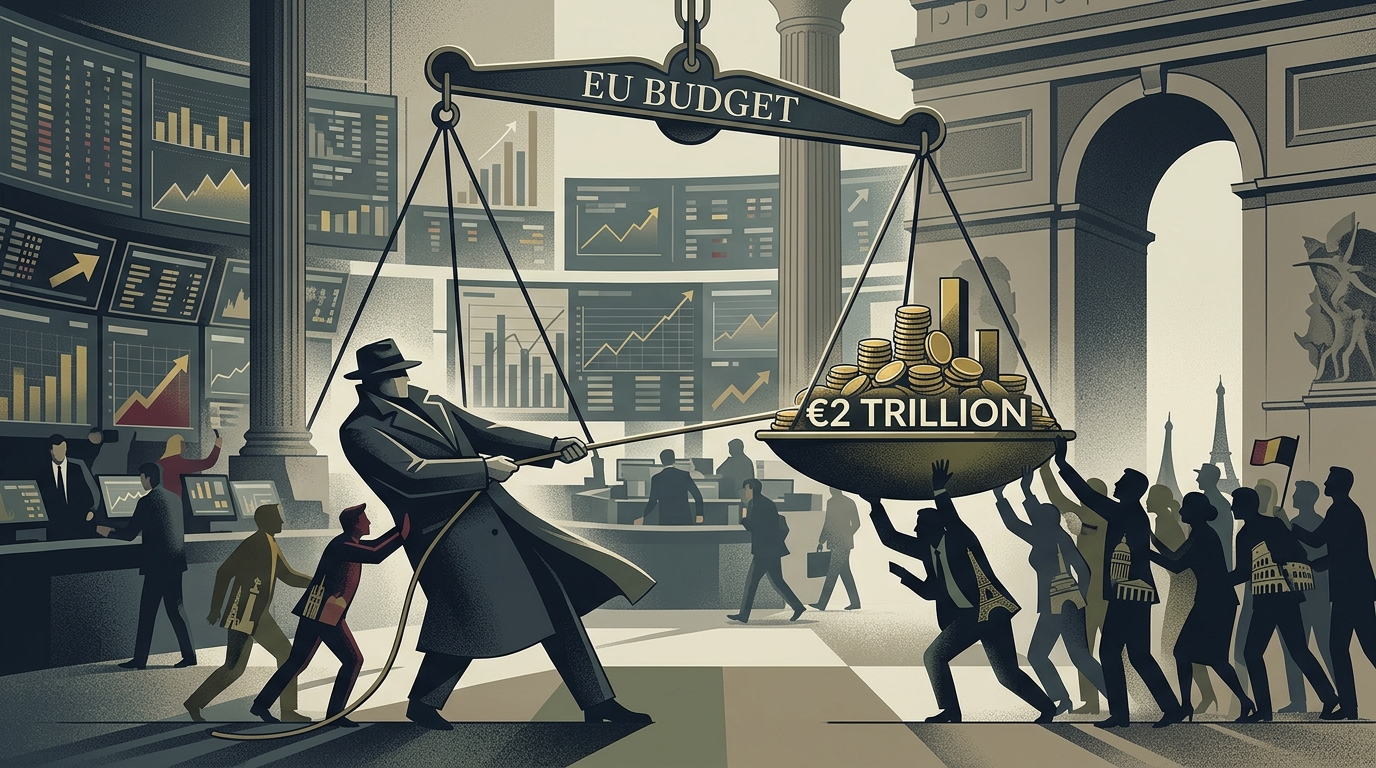
In the heart of the European Union, an old but ever-relevant conflict is reigniting with unprecedented intensity. Germany, the traditional 'engine' and the largest net contributor to the EU budget, has erected a wall of fiscal discipline against the ambitions of the European Commission. The stakes are nothing less than the Multiannual Financial Framework (MFF) for the 2028-2034 period, which the Commission envisions reaching an astronomical €2 trillion. However, Berlin, grappling with its own internal economic ghosts, is demanding a drastic cut of €400 billion.
Berlin in a Fiscal Tailspin
Germany's move is no bolt from the blue for those closely watching the country's internal developments. The German economy, long the gold standard of stability, is undergoing a period of stagnation. With the 'debt brake' (Schuldenbremse) as a constitutional mandate and the coalition government under pressure from rising populism, Finance Minister Christian Lindner and Chancellor Olaf Scholz find themselves in an extremely difficult position. The demand for cuts in the EU budget is, to a large extent, an attempt to appease a German electorate that sees its purchasing power dwindling while funds flow toward Brussels.
The German side argues that the EU must learn to 'live within its means.' In an informal position paper, Berlin emphasizes that increasing national contributions to cover a €2 trillion budget is 'politically and economically unsustainable.' This stance brings back to the fore the divide between the 'frugal' Northern states and the Southern and Eastern countries that rely on cohesion funds for their development.
Brussels' Ambitions at Risk
On the other hand, Ursula von der Leyen and her team at the Commission argue that the challenges facing Europe require unprecedented resources. The Green Deal, digital sovereignty, strengthening European defense following the invasion of Ukraine, and the need for an industrial policy to compete with the US and China all require capital. The €2 trillion proposal is not just a number, but the economic footprint of a Europe that wants to remain a global player.
- Defense: The need for joint procurement and modernization of military forces requires billions.
- Climate Change: The transition to a net-zero economy cannot be achieved without bold subsidies and infrastructure investments.
- Enlargement: The potential accession of Ukraine and the Western Balkans will upset the balance in agricultural subsidies and cohesion funds.
German insistence on a €400 billion 'trim' means that many of these goals will have to be scaled back or abandoned. Brussels warns that austerity at this level will lead to a 'two-speed Europe' and weaken its geopolitical power.
The Geopolitical and Economic Fallout
For countries like Greece or Poland, this dispute has existential significance. Structural funds and the Common Agricultural Policy (CAP) form the backbone of public investment in the periphery. If Germany succeeds in imposing its cuts, it is almost certain that cohesion funds will be the first to suffer. Athens, along with Madrid and Rome, is expected to form a resistance front, arguing that fiscal tightening at this moment would stifle the eurozone's fragile recovery.
"We cannot ask Europe to do more with less money," a senior Commission official stated, characterizing the German stance as "short-sighted."
The negotiation is expected to be long and arduous. Germany is not alone; traditional allies like the Netherlands and Denmark are expected to join the call for restraint. However, the intensity of the German demand suggests a deeper identity crisis at the heart of the EU: Is the Union a tool for collective progress or merely an accounting burden for its wealthiest members?
Conclusion: A Hard-Fought Compromise
The history of the EU is a history of last-minute compromises. It is likely that the final figure will land somewhere in the middle, around €1.6 to €1.7 trillion. However, the 'damage' to European unity is already beginning to show. Germany, in its attempt to solve its own fiscal problems, risks undermining the shared European future. The coming months will reveal whether the logic of growth will prevail over the fear of deficits.