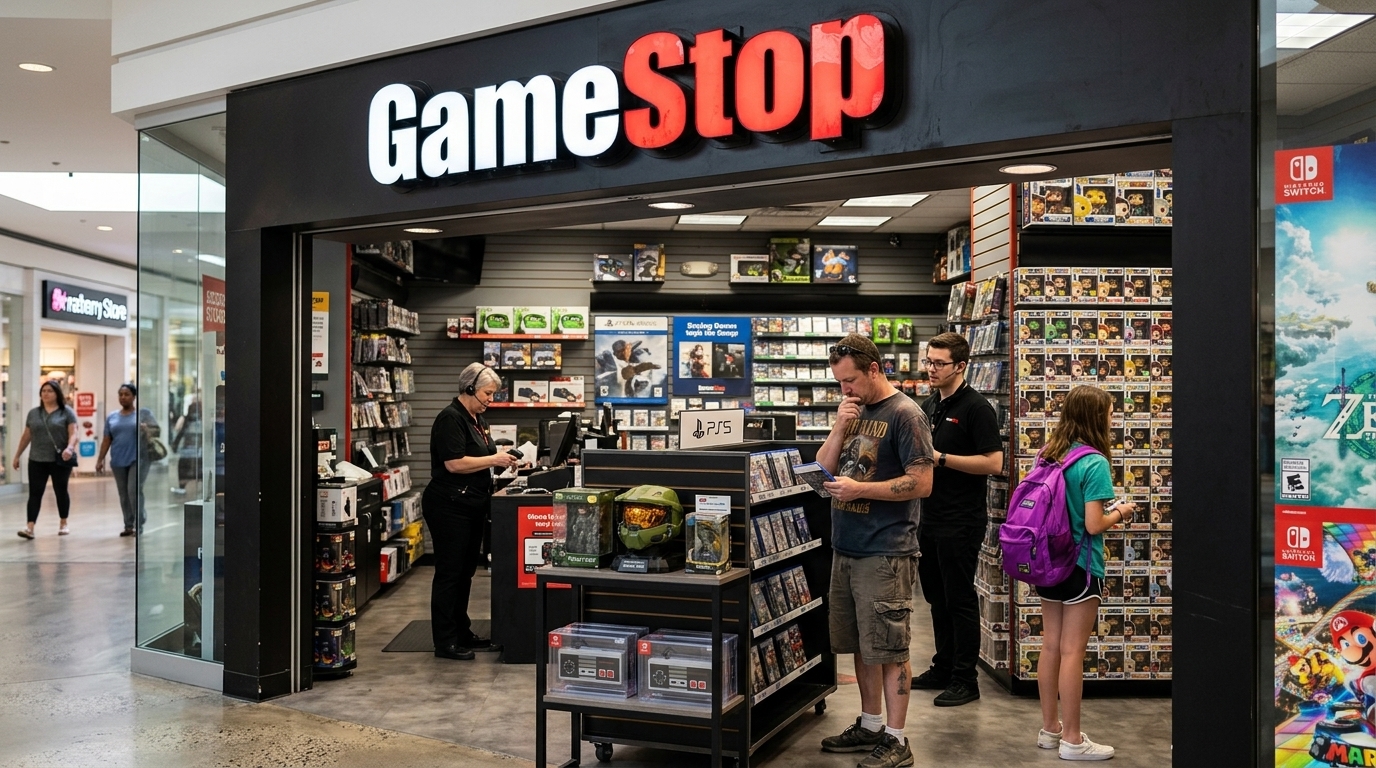
In the high-stakes theater of global finance, history rarely repeats itself verbatim, but it often rhymes with a haunting familiarity. The recent news that GameStop—the retail chain that became the face of the 'meme stock' revolution—has launched an audacious bid to acquire e-commerce pioneer eBay has sent shockwaves through Wall Street. Beyond the sheer scale of the proposal, the deal carries an eerie resemblance to one of the most catastrophic corporate mergers in history: the AOL-Time Warner union of 2000.
The Illusion of Inflated Currency
To understand why this move is triggering alarms, one must look past the headlines and into the mechanics of valuation. GameStop, despite various turnaround attempts led by Ryan Cohen, remains a business tethered to the declining world of physical media and brick-and-mortar retail. Yet, its stock price continues to trade at levels disconnected from traditional financial metrics, sustained by a fervent community of retail investors. Just as AOL leveraged its hyper-inflated dot-com bubble valuation to swallow a legacy media giant like Time Warner, GameStop appears to be attempting to 'solidify' its meme-driven market cap into tangible, cash-generating assets.
eBay, by contrast, is a mature entity with robust cash flows, a massive logistics infrastructure, and a stable, if unglamorous, user base. GameStop’s bid is essentially an attempt to purchase legitimacy and longevity using a currency—its stock—that many analysts believe is built on shifting sands. If the deal proceeds as a stock-swap, eBay shareholders would be trading proven equity for one of the most volatile assets in the market.
A Cultural and Operational Mismatch
The AOL-Time Warner disaster was not just a financial failure; it was a cultural bloodbath. The aggressive, fast-moving culture of the internet upstart clashed violently with the buttoned-down, institutional ethos of Time Warner. A GameStop-eBay merger faces a similar, perhaps even more radical, divide. GameStop is currently managed with a mindset that caters to Reddit forums and social media sentiment. eBay, while a tech company, operates on the traditional principles of a global marketplace and logistics provider.
- Integrating two such disparate platforms would likely result in billions of dollars in restructuring costs and operational friction.
- There is a significant risk of a 'brain drain' as top-tier eBay engineers and executives flee toward more stable competitors like Amazon or Shopify.
- The inherent volatility of GME stock makes any long-term strategic planning for the combined entity nearly impossible.
"When a company with a questionable future uses a bloated valuation to acquire a profitable enterprise, it isn't a growth strategy—it's an exit strategy for the acquirer's management at the expense of the target's shareholders," notes a senior market strategist.
The 'Hail Mary' of the Meme Era
Why is GameStop taking this gamble now? The answer lies in the urgent need for a pivot. Ryan Cohen understands that the window for physical game retail is closing rapidly. By acquiring eBay, GameStop would instantly transform from a struggling retailer into the world's premier destination for the resale economy. It is a 'Hail Mary' pass intended to secure the company’s relevance for the next two decades.
However, the cost of this transformation could be the destruction of eBay’s intrinsic value. If the market perceives this merger as a way for GameStop insiders to offload their risk onto a stable company, the combined entity's stock could crater. Investors should remember that in the wake of the AOL deal, the combined company's value plummeted by nearly $100 billion in a matter of months. The parallels are too sharp to ignore.
Conclusion: A Lesson in Hubris
GameStop’s play for eBay is the ultimate test of corporate governance in 2026. Will the eBay board permit a takeover fueled by 'meme-logic,' or will they protect their investors from a 21st-century repeat of the AOL debacle? History teaches us that when 'new money' built on hype attempts to buy 'old money' built on earnings, the result is often a catastrophic loss of value. GameStop may aspire to be the next eBay, but it risks becoming the next AOL, dragging one of the internet's most enduring institutions down with it.