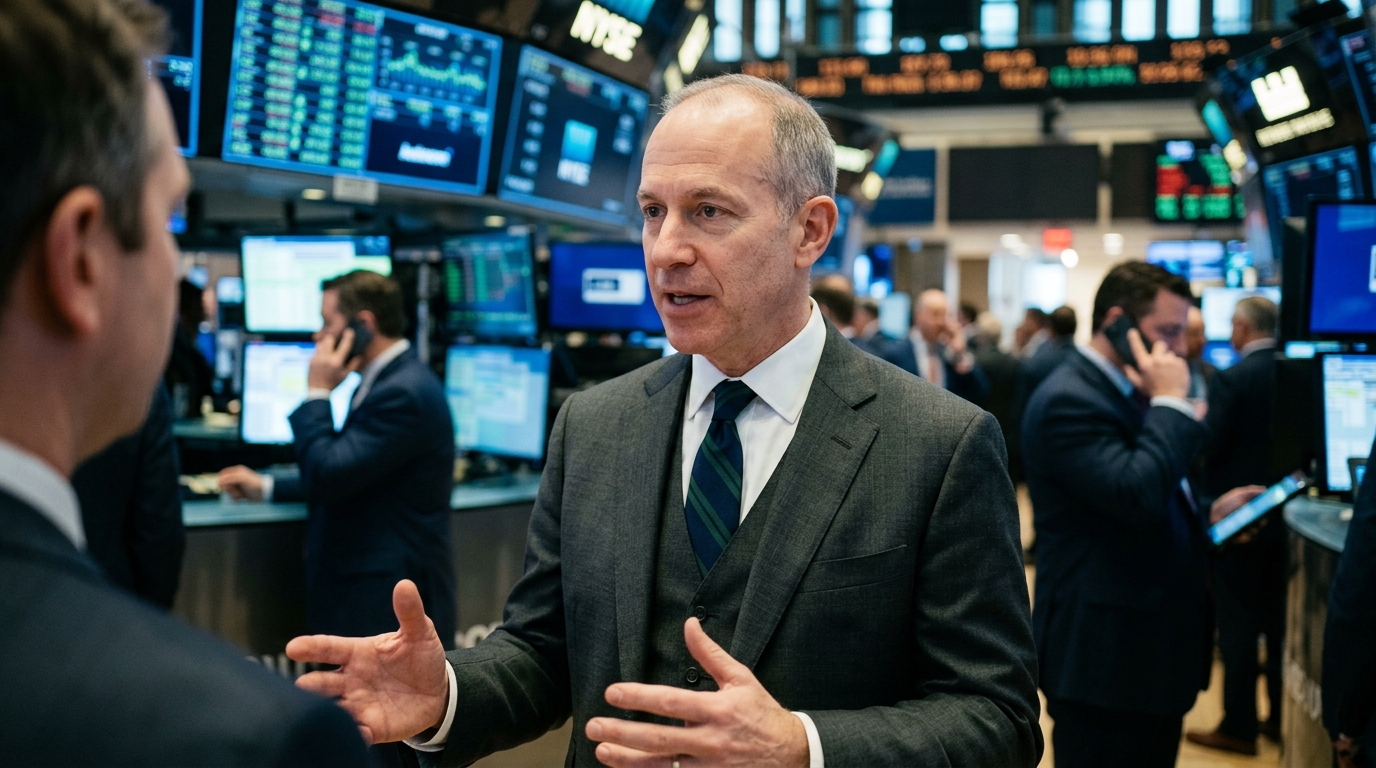
As the global investment elite gathers in Beverly Hills for the 2026 Milken Institute Global Conference, the dominant narrative has shifted from the theoretical potential of large language models to the physical infrastructure that sustains them. Tony Minella, Co-Founder and President of Eldridge Industries, in a revealing interview with Bloomberg Tech, made it clear that the explosion in data center demand is not a transient bubble, but a structural shift in the global economy.
The Physicality of the Digital World
For many observers, Artificial Intelligence remains an abstract concept residing in 'the cloud.' However, for investment giants like Eldridge, AI is primarily a matter of real estate, energy, and hardware. Minella emphasized that data center demand is 'not going away,' despite concerns about market saturation. His reasoning is simple yet profound: AI is no longer an experiment; it is an 'enabler' being integrated into every facet of business operations.
Eldridge, which manages a diverse portfolio ranging from technology to sports (including Chelsea FC), views data centers as the modern equivalent of 19th-century railroads or oil refineries. Without them, the flow of information stops. The 'lean into AI' strategy described by Minella is not about chasing the next chatbot app, but about providing the bedrock upon which the entire generative AI ecosystem will be built.
The Energy and Scale Challenge
One of the most critical points in Minella's analysis concerns the energy footprint. As AI models become more complex, the need for electricity increases exponentially. This transforms data centers from mere buildings into critical nodes of energy management. The Eldridge President pointed out that a company's ability to secure access to stable power and land with the right specifications is now the primary 'moat' in the industry.
According to Eldridge, the market is still in the early stages of a multi-year investment cycle. Tech giants (hyperscalers) like Microsoft, Google, and Amazon continue to pour billions into capital expenditures (CAPEX), confirming the belief that infrastructure is the safest bet in the current market. Minella argued that the resilience of equity markets, despite high interest rates, is partly due to the recognition that AI will drive massive productivity gains, justifying current valuations.
AI as a Productivity Catalyst
Rather than focusing on worker replacement, Minella promotes the idea of AI as an augmentation tool. Across Eldridge’s portfolio, technology is used to optimize processes, from data analytics in sports to risk management in insurance services. This 'operational AI' is what fuels the continuous need for computing power.
- Strategic Positioning: Eldridge invests in companies providing the necessary infrastructure, avoiding the volatility of individual software applications.
- Market Resilience: Minella observes an 'undeniable strength' in the markets, underpinned by robust corporate earnings and business adaptability to the new tech environment.
- Long-term Horizon: Data center demand is structural, not cyclical, as the volume of globally generated data continues to grow geometrically.
In conclusion, Tony Minella’s stance reflects a broader consensus among institutional investors in 2026: the AI revolution is only as strong as the infrastructure supporting it. For Eldridge, the future is not just code; it is concrete, fiber-optic cables, and uninterrupted power supply. The challenge is no longer whether demand exists, but whether supply can keep pace with the velocity of innovation.