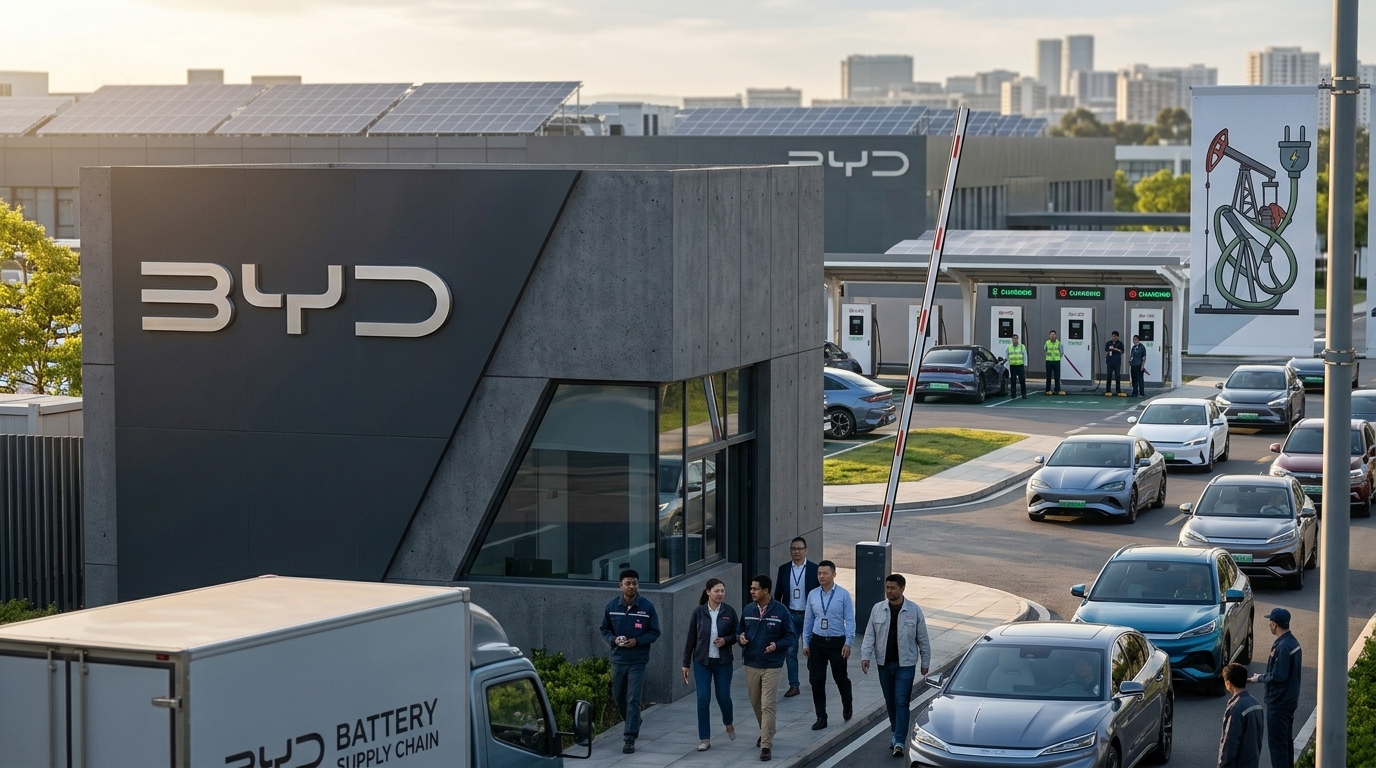
As we navigate the spring of 2026, the global energy landscape is being reshaped by a perfect storm. Prolonged instability in the oil-producing regions of the Middle East has driven crude prices to levels unseen since the 2022 crisis, making the cost of internal combustion travel unsustainable for the average household. Against this backdrop, Chinese giant BYD (Build Your Dreams) hasn’t just found an opportunity; it has established a new status quo, turning the energy shock into a catalyst for the definitive triumph of electric mobility.
The Strategy of Vertical Omnipotence
BYD is not a traditional automaker. In reality, it is a battery technology company that happens to manufacture vehicles. This distinction is vital to understanding how it managed to absorb the supply chain shocks that brought European and American competitors to their knees. With full vertical integration—from lithium mining to manufacturing its own semiconductors and the renowned "Blade Batteries"—BYD controls its costs with surgical precision.
While Tesla grapples with stock market volatility and delays in new model launches, BYD is flooding markets in Southeast Asia, Latin America, and now Europe with models catering to every income bracket. The "oil shock" has served as the ultimate salesperson for its budget-friendly models, such as the Seagull, which in 2026 is widely regarded as the "Volkswagen Beetle" of the electric era.
“We aren’t just selling cars; we are selling independence from a geopolitically volatile fuel,” a company executive recently stated at the Shanghai Auto Show.
The Geopolitics of Batteries vs. Oil
The Chinese counter-offensive has deep political implications. For decades, the global economy was tethered to the "petrodollar" and the delicate balances of the Gulf. Today, China is attempting to replace this dependency with "battery diplomacy." BYD is the spearhead of this strategy. By establishing factories in Hungary and Turkey, the company bypasses European Union tariffs, positioning its products in the heart of the continent as "locally produced."
Data analysis from the first quarter of 2026 shows that in markets where gasoline prices rose by more than 25%, sales of BYD’s Plug-in Hybrids (PHEV) and Battery Electric Vehicles (BEV) surged by 40%. The company’s ability to offer vehicles with ranges exceeding 600 kilometers at prices below €30,000 makes it largely immune to Western protectionist efforts.
Protectionism vs. Reality
Brussels and Washington face a grueling dilemma. On one hand, they seek to protect their domestic industries (VW, Stellantis, Ford) from what they characterize as unfair competition fueled by Chinese subsidies. On the other hand, climate neutrality targets and consumer pressure for affordable transportation amid an energy crisis make Chinese EVs indispensable.
- Supply Chain Logistics: BYD operates its own fleet of car carrier vessels, reducing logistics costs by 15% compared to competitors.
- Technological Edge: BYD’s Lithium Iron Phosphate (LFP) batteries have become the industry standard for safety and longevity.
- Energy Convergence: The company is investing heavily in home energy storage, creating an ecosystem where the car is a component of the "smart home."
The conclusion is clear: China is not just winning the sales battle; it is winning the energy transition battle. BYD capitalized on the vacuum left by traditional players who were slow to invest in battery infrastructure. As oil prices remain elevated, the "Chinese counter-offensive" is evolving into a permanent dominance that will force the West to redefine its industrial strategy from the ground up.