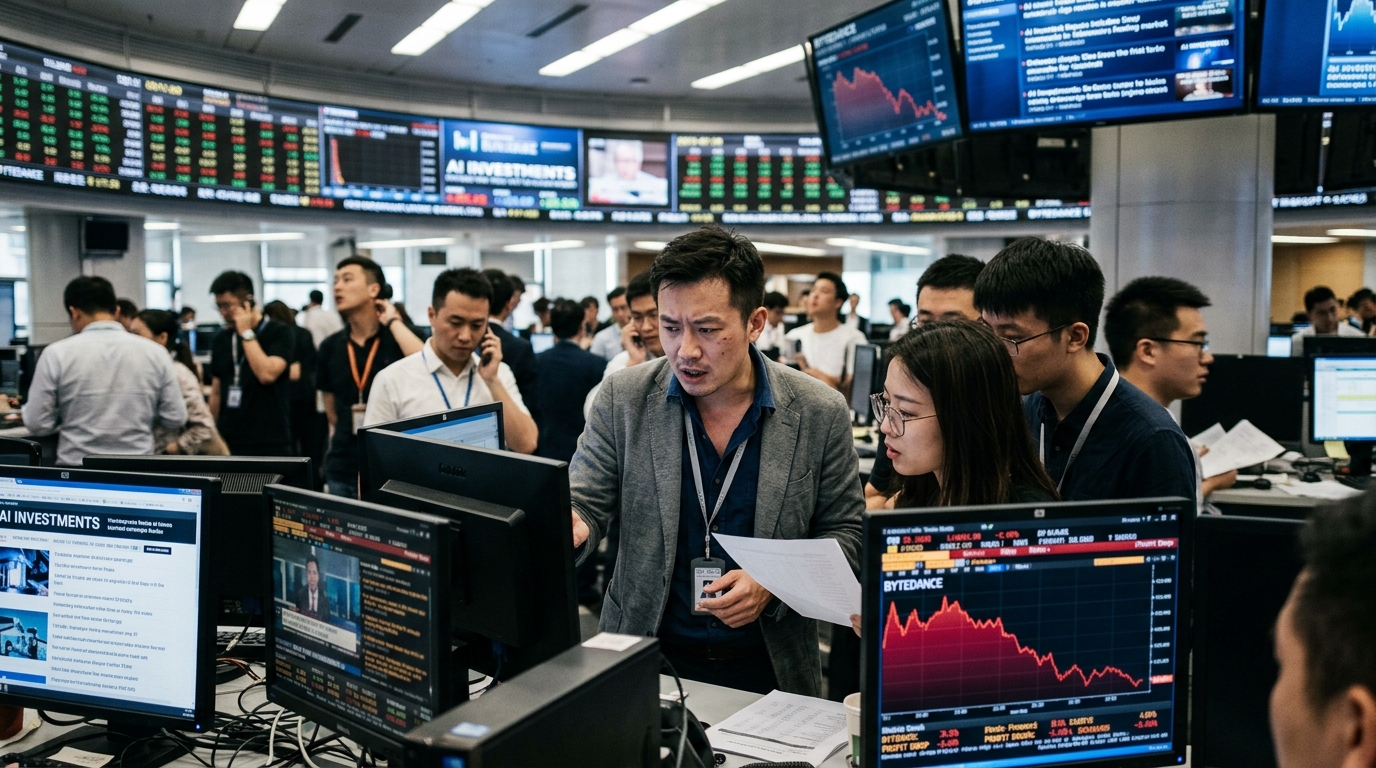
In a move that has sent ripples through international markets and highlighted the staggering cost of technological supremacy, ByteDance, the parent company of TikTok, has reported a stunning 70% drop in operating profits. This development is not a sign of decline, but rather the result of a deliberate and aggressive strategy: a total pivot toward Artificial Intelligence (AI). While revenue continues to climb, expenditures on research, development, and, most critically, the acquisition of massive computing power have surged to unprecedented levels.
The 'Absorption' Strategy: Why ByteDance is Sacrificing Today
ByteDance finds itself at a critical crossroads. On one hand, TikTok remains the dominant force in global social media; on the other, the company faces existential threats from regulators, particularly in the United States. In this environment, the company's leadership has decided that the only path to long-term survival and avoiding stagnation is transforming from a recommendation algorithm company into a global leader in Generative AI.
The profit slump is primarily driven by massive infrastructure investments. ByteDance has poured billions of dollars into specialized chips (GPUs), despite U.S.-led export restrictions on high-end hardware to China. Simultaneously, the development of its proprietary large language model (LLM), named 'Doubao,' has proven incredibly capital-intensive. Doubao has already surpassed many competitors in the Chinese market in terms of active users, but maintaining and training such models requires capital reserves that would strain even nation-states.
"We do not view this decrease as a loss, but as the entry price for the new era of computing," sources close to the company's management stated.
The Cost of Intelligence: Chips, Cloud, and Competition
The AI race is not just a matter of code; it is a matter of hardware. ByteDance was forced to stockpile Nvidia chips before bans took full effect, while simultaneously funding the development of domestic solutions within China. This dual strategy has caused capital expenditures (CapEx) to skyrocket. Furthermore, the company is expanding its data centers in Southeast Asia and Europe, attempting to diversify its geographical footprint and allay data security concerns.
Within the Chinese domestic market, ByteDance is facing intense pressure from giants like Tencent and Alibaba, who are also investing billions into AI. A 'price war' in cloud services and AI model APIs has squeezed profit margins across the industry. ByteDance chose to offer Doubao at extremely low prices to capture market share—a tactic reminiscent of the early days of Uber or Amazon, where profitability was sacrificed at the altar of market dominance.
The Geopolitical Minefield: TikTok and Washington
One cannot analyze ByteDance's financials without considering political pressure. The potential ban of TikTok in the U.S. acts as a Sword of Damocles over the company's valuation. Legal expenses for fighting battles in Washington are immense, but even greater is the cost of uncertainty. Investors are demanding that ByteDance prove it can thrive even if it loses the American market, and AI is the answer to that demand.
- Investments in Generative AI video tools that will revolutionize content creation.
- Development of autonomous AI Agents for e-commerce (TikTok Shop).
- Enhancement of safety algorithms to detect deepfakes and misinformation.
The Road Ahead: From Scrolling to Creating
ByteDance is betting that the future of the internet will not be passive content consumption (scrolling), but active creation through AI. If they can successfully integrate video and image generation tools directly into their platforms, they will create an ecosystem that users never need to leave. This vision requires massive computational power and, consequently, massive spending.
In conclusion, the 70% profit drop is a warning shot regarding what is required to remain a front-line player in the age of AI. ByteDance is not afraid to burn cash, betting that whoever controls AI infrastructure today will control the global economy tomorrow. History will tell if this bold move leads to absolute dominance or a costly overextension.