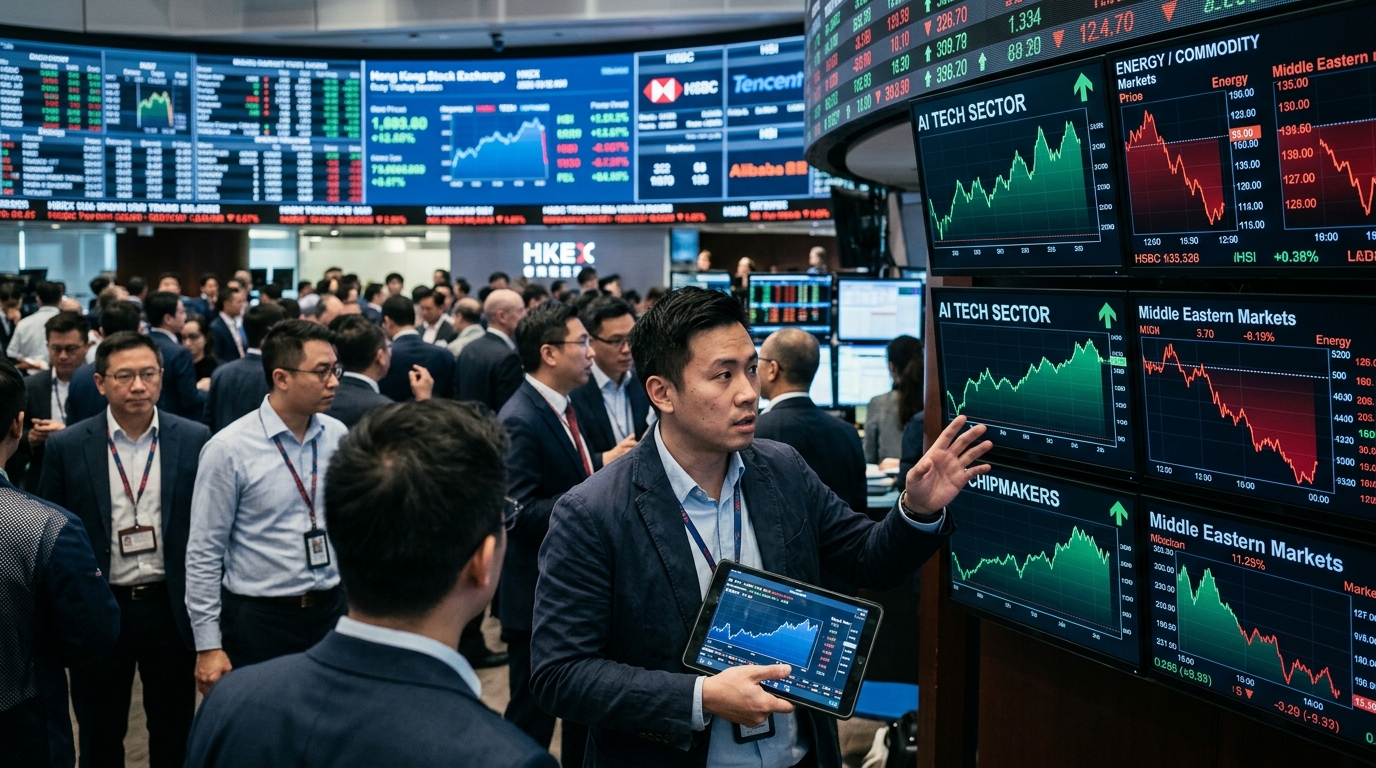
As we navigate the first half of 2026, the global economic landscape stands at a critical juncture where geopolitical instability collides with the relentless march of technological innovation. Asian stock markets, traditionally sensitive to energy price fluctuations due to their heavy reliance on oil imports, are finding an unexpected anchor: the Artificial Intelligence (AI) boom. According to recent market analyses, the demand for AI infrastructure is acting as a 'firewall' against risks emanating from the Gulf region.
The Strategic Primacy of Semiconductors in Asia
Taiwan and South Korea, the twin pillars of global semiconductor manufacturing, are at the heart of this dynamic. Taiwan Semiconductor Manufacturing Company (TSMC) and SK Hynix have seen their shares defy broader market downturns, as the global thirst for high-performance chips shows no signs of quenching. In 2026, AI is no longer a future promise but the primary driver of corporate profitability. Investors appear to be choosing the safety of technological fundamentals over the volatility of energy supply chains.
This shift is not accidental. With the expansion of large language models and the integration of AI into every facet of industrial production, companies that control the hardware—the 'physical body' of AI—are gaining near-monopolistic power. This allows indices like the Nikkei 225 and the KOSPI to maintain momentum even as war clouds gather in the Middle East, threatening to drive up logistics and production costs.
Gulf Risks and the Energy Dependency Trap
However, AI optimism cannot entirely erase existential fears. The risks in the Gulf remain a significant threat to Asian economies. A potential disruption in the Strait of Hormuz could send crude oil prices soaring above $120 per barrel, triggering inflationary pressures that no technological innovation can immediately absorb. Analysts warn that while AI provides growth, energy dictates the base cost of living and manufacturing.
- Japan and India remain the most exposed to oil price volatility.
- China is attempting to balance domestic AI growth with strategic alliances in the Gulf.
- Investors are pivoting toward equity baskets that combine tech with renewable energy hedges.
"The market is betting that the productivity gains offered by AI will outpace the increased cost of energy inputs," says a senior financial analyst in Tokyo.
The Dawn of a New Investment Hierarchy
In this environment, we are witnessing a major reshuffling of investment portfolios. The traditional model, where Asian stocks moved inversely to oil prices, is beginning to decouple. The 'Silicon Shield' now protects not only the national sovereignty of nations like Taiwan but also the market capitalization of entire regions. AI is functioning as a deflationary force in a world threatened by resource-driven inflation.
In conclusion, the trajectory of Asian markets in 2026 will depend on the speed at which AI translates into real-world gains for the broader economy. If the tech boom continues at its current pace, geopolitical risks may prove to be mere speed bumps on a long-term upward path. Nevertheless, the balance remains delicate, and the reliance on 'black gold' continues to be the Achilles' heel of a continent dreaming of a digital-first future.