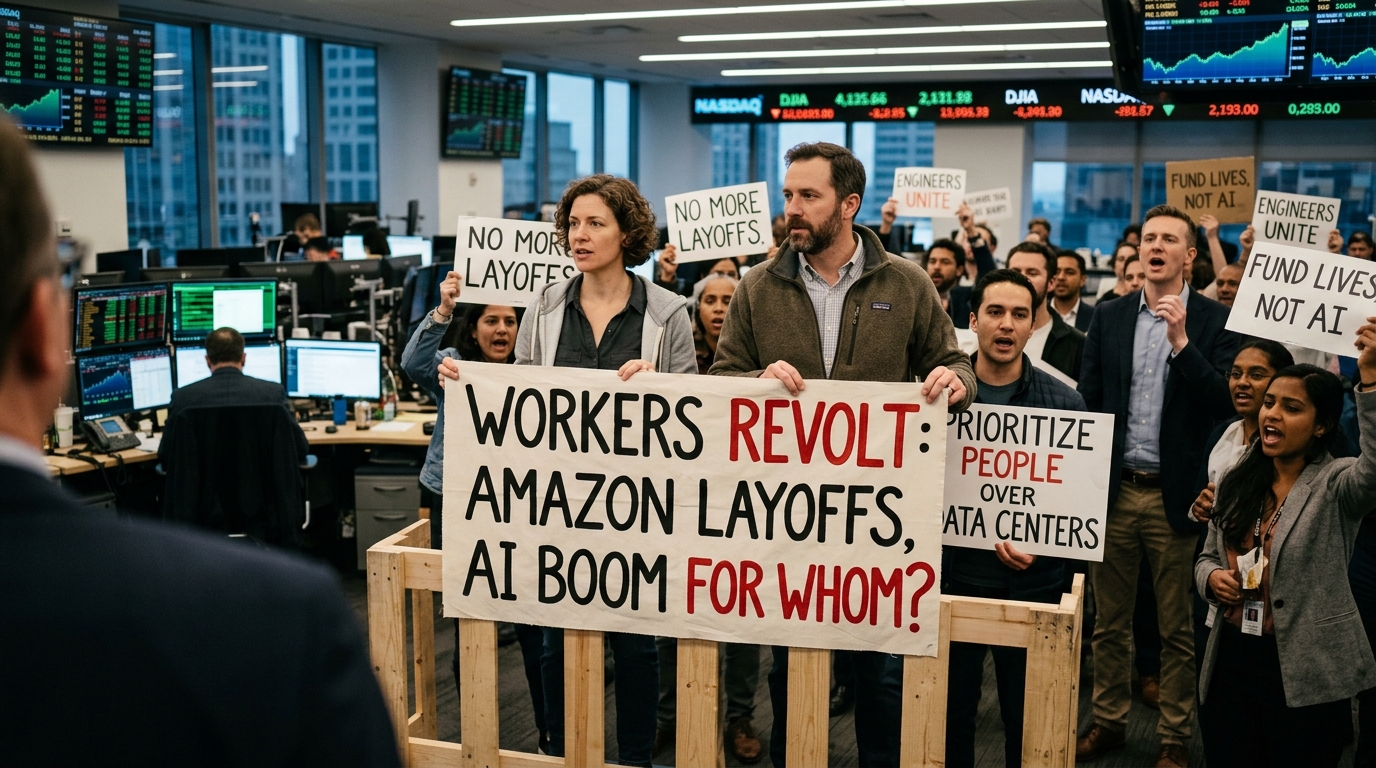
In the heart of Seattle, where Amazon’s glass-domed spheres stand as monuments to digital dominance, a profound rift is opening within the company’s workforce. Software engineers, data scientists, and long-term managers are raising their voices against a strategy they describe as "morally bankrupt": the aggressive funding of Artificial Intelligence (AI) data centers while 30,000 of their colleagues have been shown the door over the past 18 months.
The Great Reallocation: From Humans to Silicon
The criticism leveled at Andy Jassy’s leadership isn't just about the layoffs, which have gutted departments ranging from Alexa to AWS. It is about a jarring shift in priorities. According to internal documents and reports first highlighted by CNBC, Amazon plans to invest over $150 billion in the next decade to build and operate data centers. To the workforce, the message is clear: capital is abundant for machines, but scarce for people.
"We are told to tighten our belts to stay competitive, yet we are buying nuclear reactors to power Nvidia GPUs," wrote one senior engineer on an internal message board, garnering thousands of supportive reactions. The contrast is indeed striking. While the company reports record profits, the internal "Day 1" culture—Jeff Bezos’s famous philosophy of constant innovation and startup-like energy—seems to be evolving into a cold, calculated management of resources.
The AI Trap and the Cost of Infrastructure
Amazon is locked in an existential arms race with Microsoft and Google. The dominance of AWS (Amazon Web Services) in the cloud computing market is under threat if it cannot provide the massive compute power required for Large Language Models (LLMs). However, this infrastructure requires staggering amounts of capital, which the company appears to be harvesting through the "optimization" of its headcount.
- The layoff of 30,000 staffers is estimated to save the company roughly $3-4 billion annually.
- The cost of a single new data center complex can exceed $10 billion.
- Employee resentment is fueled by the perception that AI is not being used to augment their work, but to justify their removal.
The situation is exacerbated by the strict return-to-office mandate, which many employees view as a form of "quiet firing"—a tactic to induce resignations and avoid severance costs. The connection between these cost-cutting measures and the massive AI CapEx (Capital Expenditure) is, for many in Seattle, undeniable.
Social and Political Implications
The protest from Amazon’s engineers is not an isolated incident. It reflects a broader crisis across Silicon Valley, where the promise of technological advancement is clashing with social stability. If the most highly skilled and well-compensated workers in the world feel disposable in the face of AI, what does that portend for the rest of the global economy?
"We aren't building the future of technology; we are building a fortress for capital while dismantling the lives of those who built it," reads another internal complaint.
Amazon maintains that its AI investments are essential for long-term viability and that the layoffs were a necessary correction to pandemic-era over-hiring. However, the timing and scale of the hardware-over-human investment suggest a permanent shift in the company’s DNA. The battle in Seattle is merely the opening chapter of a global debate on how the dividends of automation should be distributed.