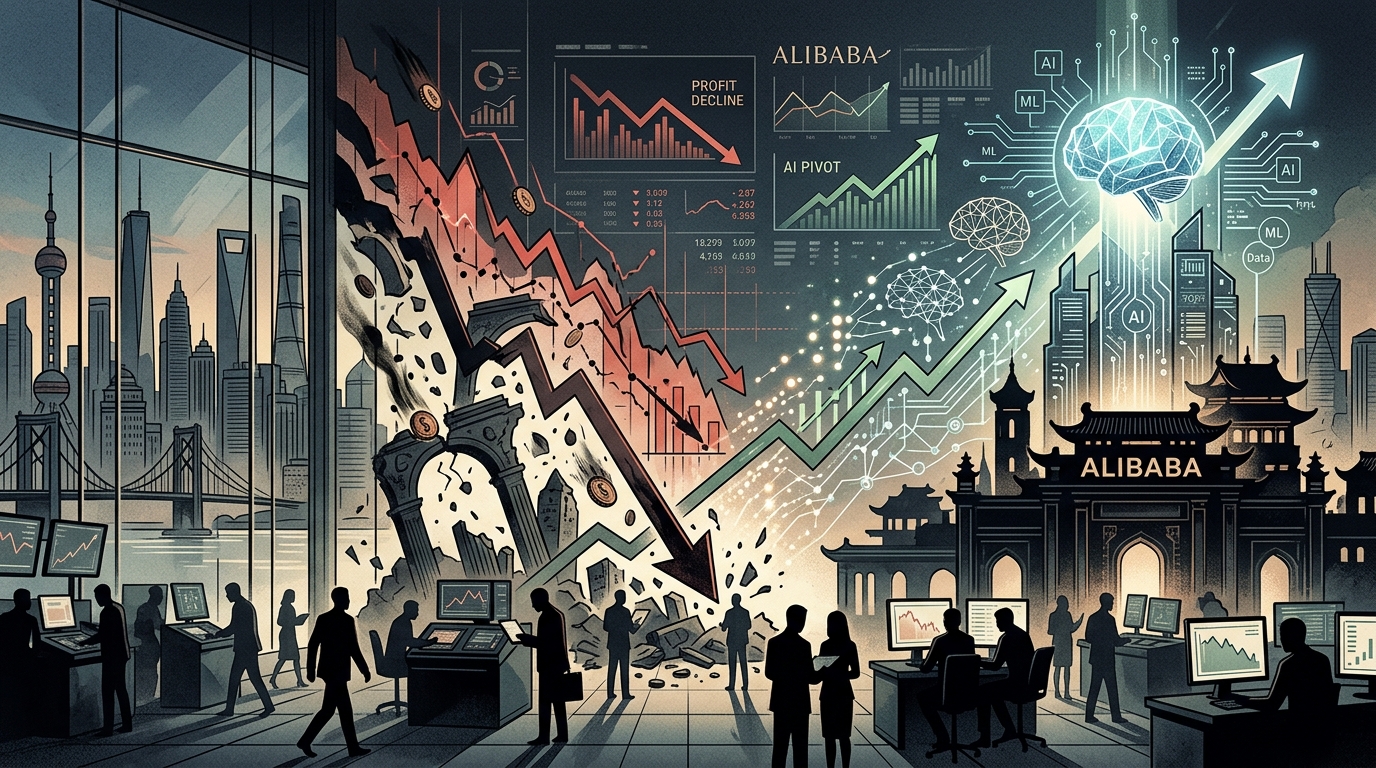
Alibaba Group Holding Ltd’s latest earnings report was not just a cold shower for investors; it was a loud confirmation of the profound metamorphosis the Chinese tech giant is undergoing. Reporting an 86% drop in net income is a figure that would trigger panic in almost any other publicly traded company. However, beneath the surface of these numbers lies a conscious, albeit painful, strategic choice: a complete reorganization of the company centered on Artificial Intelligence (AI) and Cloud services.
The Strategy of 'Creative Destruction'
Alibaba, which once held undisputed dominance over China’s e-commerce landscape, now finds itself at a critical crossroads. The rise of competitors like PDD Holdings (Pinduoduo) and ByteDance has eroded its market share in traditional retail platforms. The response from new CEO Eddie Wu is radical. Instead of trying to salvage old territories with half-measures, the company is accelerating its investments in the infrastructure that will power the next generation of the internet.
The profit collapse is largely attributed to losses from investments in publicly traded companies, as well as massive spending on the development of Large Language Models (LLMs), such as Tongyi Qianwen. Alibaba is betting that the future no longer lies in simple sales intermediation, but in providing the computing power and AI tools that all other businesses globally will utilize.
Cloud and AI: The New Pillars
The company's Cloud Intelligence Group, while showing modest single-digit revenue growth, saw an explosive rise in revenue directly related to AI. This is the 'holy grail' for Alibaba’s management. The 'AI-First' strategy means that every product, from Taobao to Cainiao logistics, is now integrating AI capabilities to personalize user experience and optimize operations.
However, this path is fraught with obstacles. US export restrictions on advanced semiconductors from Nvidia pose a constant threat to China's AI ambitions. Alibaba is forced to develop its own solutions or rely on less efficient domestic hardware, which increases costs and slows development. Meanwhile, domestic competition in China is relentless, with Tencent and Baidu also vying for leadership in the AI revolution.
Market Reaction and the Path Ahead
Investors remain skeptical. The company's decision to increase its share buyback program by billions of dollars is an attempt to appease Wall Street and Hong Kong, demonstrating that it still possesses robust liquidity. But the question remains: can a behemoth the size of Alibaba pivot as quickly as the AI era demands?
Analysis of the data suggests that Alibaba is transforming from a retail-centric company into a technology infrastructure provider. This transition requires time and, crucially, tolerance for earnings volatility. The 'collapse' seen in recent results may not be the end of an era, but the labor pains of a new one, where Alibaba will be less the 'Amazon of China' and more a combination of Microsoft and AWS for the Asian continent.
Conclusion
Alibaba is in a race against time and competition. The accelerated push into Cloud and AI is the only logical escape from e-commerce saturation. If it succeeds, it will have redefined itself for decades to come. If it fails, it will remain a giant of the past that failed to adapt to the speed of silicon. 2026 will be the year that determines whether the sacrifice of today's profits will bear the fruits of tomorrow.