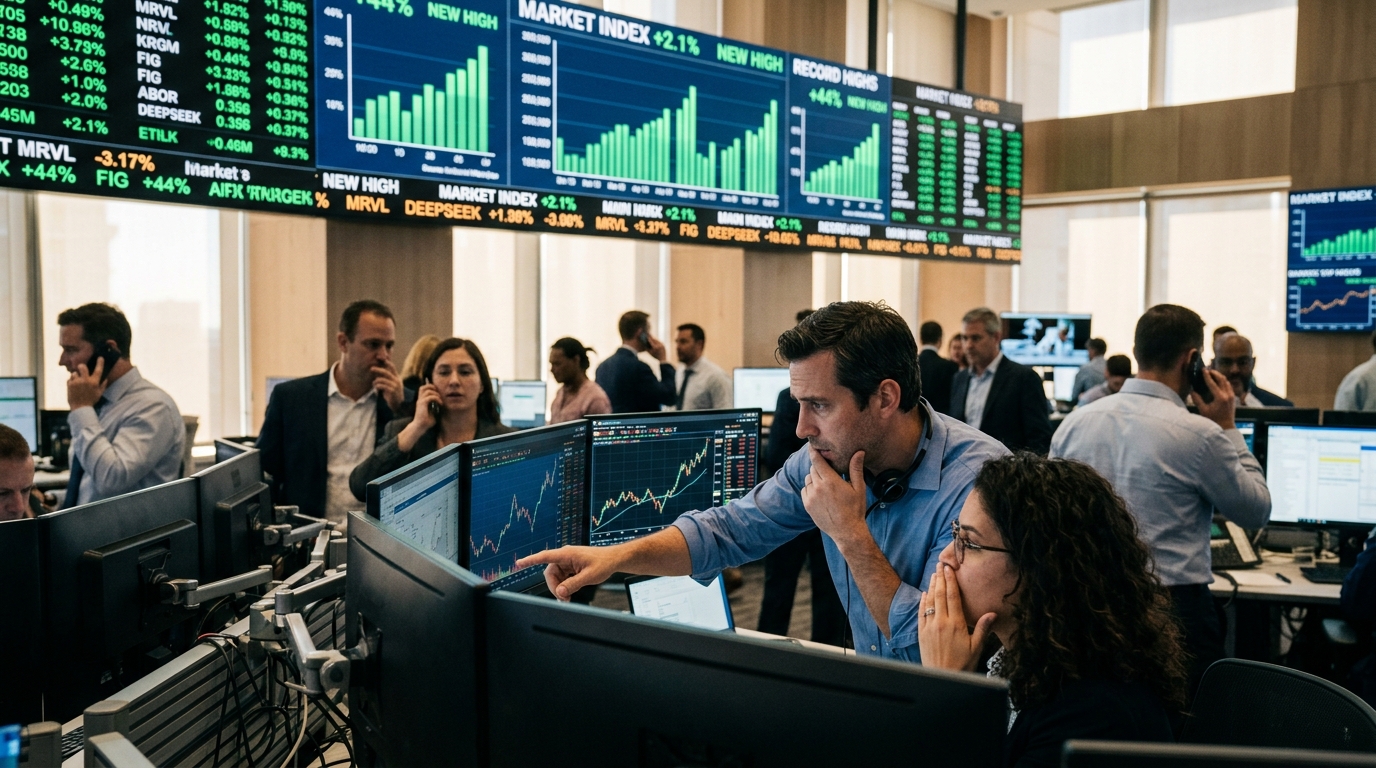
As we navigate the first half of 2026, the global Artificial Intelligence (AI) economy shows no signs of fatigue. On the contrary, we are witnessing a strategic shift of capital from mere theoretical promise to operational scaling. The news that Chinese AI firm DeepSeek is seeking a $7 billion valuation, combined with Marvell Technology’s all-time highs (ATH) and Figma’s impressive 44% growth, underscores a fundamental truth: the AI sector is reshaping the global financial landscape at speeds exceeding any previous technological cycle.
DeepSeek: Efficiency as a Geopolitical Weapon
DeepSeek is not just another Large Language Model (LLM) startup. It is China’s sophisticated answer to the dominance of OpenAI and Anthropic. The recent push for a $7 billion valuation comes at a time when the U.S. is intensifying export restrictions on high-end semiconductors. DeepSeek has managed to earn the respect of the global developer community not through raw computational power, but through algorithmic efficiency.
The release of DeepSeek-V3 and later R1 demonstrated that clever architecture can compensate for a lack of access to Nvidia’s latest GPUs. This 'efficiency doctrine' makes the company an extremely attractive target for investors who fear that the training costs of Silicon Valley models will become unsustainable. DeepSeek’s success suggests that the next phase of AI will be less about who has the most chips and more about who can do more with less.
Marvell Technology: The Backbone of Infrastructure
While software companies grab the headlines, Marvell Technology has quietly reached record highs in the stock market. Marvell has become the critical player in data networking and custom Application-Specific Integrated Circuits (ASICs) required to interconnect AI clusters. The market now recognizes that training models like GPT-5 or Claude 4 requires not just processors, but a sophisticated data transport infrastructure that only a few companies in the world can provide.
"Marvell’s rise is not a speculative bubble, but a reflection of the physical necessity for faster interconnectivity in data centers," Wall Street analysts noted.
The company's strategy to focus on custom solutions for major cloud providers (hyperscalers) is paying off. As Google, Amazon, and Meta develop their own internal chips to reduce reliance on Nvidia, Marvell is the partner that turns those designs into reality. This business model provides a level of stability often missing from the more volatile software startups in the sector.
Figma: The Renaissance After the Adobe Collapse
The case of Figma is perhaps the most interesting recovery story of recent years. After its $20 billion acquisition by Adobe was blocked by regulators, many predicted its decline. Instead, the company announced a 44% revenue surge, proving that the "AI-first design" model is highly profitable.
Figma integrated generative AI tools that allow designers to create prototypes in seconds, turning the threat of automation into a competitive advantage. Its ability to maintain high growth rates as an independent entity sends a loud message: AI does not replace creativity; it accelerates it. The market now values it as one of the healthiest SaaS (Software as a Service) companies globally, with many anticipating one of the largest IPOs of the next 12 months.
Conclusions and Outlook
The flow of capital we are observing is not accidental. It is the confirmation that Artificial Intelligence has moved from the stage of experimentation to the stage of industrial production. DeepSeek brings competition from the East, Marvell builds the highways of this new economy, and Figma shows how the end product can become indispensable for every professional. Investors are no longer buying hope; they are buying infrastructure, efficiency, and market share.