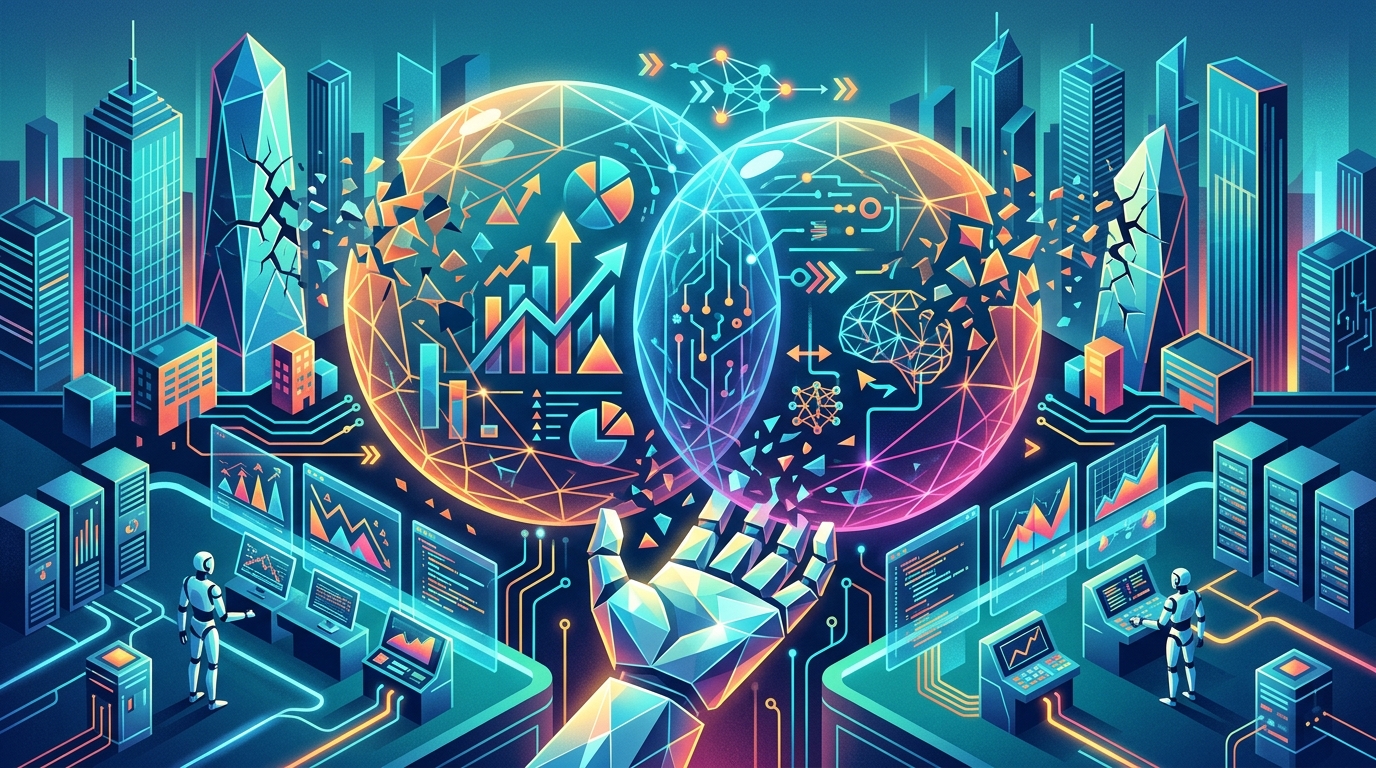
For decades, middle managers have been the connective tissue of large organizations. They were the individuals who translated senior leadership's vision into daily actions, oversaw workflows, and ensured that information flowed seamlessly from the bottom to the top. Today, this role is under direct threat. The advent of Artificial Intelligence (AI) is no longer limited to automating manual tasks; it is aggressively entering the realm of decision-making and coordination, leading to what analysts call "The Great Flattening."
The Great Flattening: Why the Middle is Disappearing
The core function of a middle manager is the collection, processing, and distribution of information. In a traditional setting, this required countless hours of meetings, report writing, and constant monitoring of subordinate performance. However, modern AI systems can now perform these tasks with a speed and precision that far exceeds human capabilities. From generating automated progress reports to optimizing schedules, AI is stripping away the "administrative burden" that once justified multiple layers of hierarchy.
Companies, in their quest for agility and cost reduction, are discovering that they can manage thousands of employees with significantly fewer intermediaries. Direct communication channels between leadership and production teams, facilitated by digital tools, make middle layers of management appear anachronistic. According to recent analyses, the sector of "human resource management and coordination" is among the most exposed to Generative AI.
From Coordinator to Data Orchestrator
The survival of middle managers in this new landscape depends not on resisting change, but on adapting to it. AI does not necessarily "erase" the human element; rather, it fundamentally alters the content of the work. The managers who survive will be those who transform from "controllers" to "orchestrators" of technology. Instead of spending time on attendance checks or document drafting, they are called upon to use AI to extract deep insights from data and focus on strategic guidance.
"AI will not replace the manager, but the manager who uses AI will replace the one who doesn't," industry leaders often remark.
However, this transition is painful. Many mid-career professionals are finding that the skills that brought them to their current positions—such as organizational ability and discipline—are now easily substitutable. The new era demands emotional intelligence, complex problem-solving skills, and, above all, high-level technological literacy.
The Mentorship Crisis: Who Trains the Next Generation?
The disappearance of middle management carries risks that are often overlooked by efficiency advocates. One of the most significant is the loss of mentorship. Middle managers are the ones who train the next generation of leaders. Without this "intermediate school," young employees may find themselves in a vacuum, with no clear path for professional development. Furthermore, an over-reliance on AI for management can lead to an impersonal, "algorithmic" culture where human intuition and empathy are sacrificed for the sake of metrics.
This structural shift also creates a "career gap." If the middle rungs of the corporate ladder are removed, how does a junior employee ascend to the C-suite? The hollowing out of the middle class within corporations could mirror the hollowing out of the middle class in society, leading to a polarized workforce of high-level strategists and low-level task-executors, with nothing in between.
Economic Imperative vs. Human Capital
From an economic standpoint, the removal of middle management is a logical step toward maximizing EBITDA and shareholder value. Middle managers often represent a significant portion of a company's payroll. By replacing these roles with AI-driven software-as-a-service (SaaS) solutions, companies can significantly improve their margins. However, this short-term gain might come at the cost of long-term institutional knowledge.
In conclusion, the "disappearance" of middle managers is not the end of management, but its rebirth into a more demanding form. AI takes over the mundane, theoretically freeing humans for more creative and meaningful activities. The question remains whether our economies and educational systems can prepare workers for this abrupt transition. The efficiency promised by AI is attractive to shareholders, but the long-term sustainability of a company requires something algorithms do not yet possess: judgment, ethics, and vision.