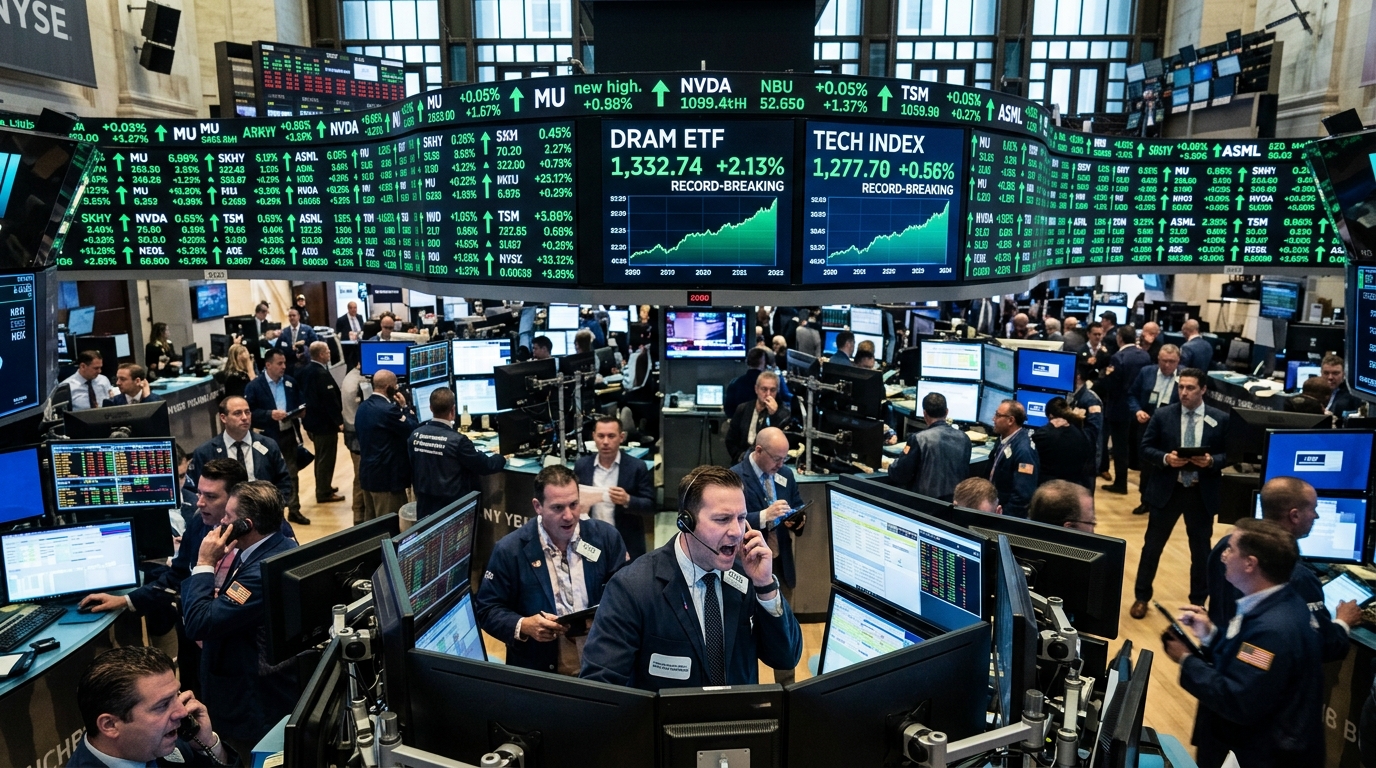
May 18, 2026, will likely be recorded in the annals of Wall Street as the day memory ceased to be viewed as a mere commodity and was recognized as the ultimate arbiter of the digital economy. According to the latest data from Bloomberg ETF IQ, the Roundhill Memory ETF, known by its ticker DRAM, is charting one of the most explosive paths in the history of thematic funds. Since its launch on April 2nd, the ETF has amassed nearly $10 billion in assets, a performance reflecting the market's desperate hunger for the infrastructure required to power the next generation of Artificial Intelligence.
Bloomberg's Isabelle Lee and Vildana Hajric, speaking with Scarlet Fu and Eric Balchunas, analyzed how DRAM managed to exceed all expectations. The explanation lies not just in the rise of NVIDIA or AMD, but in the critical realization that the world's fastest processors are useless without corresponding memory capable of feeding them data in real-time. High Bandwidth Memory (HBM) has become the bottleneck that dictates the training speed of Large Language Models (LLMs).
The Shift from Capacity to Velocity
For decades, the DRAM (Dynamic Random Access Memory) industry was characterized by intense cyclicity. Prices soared during shortages and collapsed when production outpaced demand for PCs and smartphones. However, the AI era has rewritten the rules. Today, demand is not driven by the consumer but by the hyperscalers of Big Tech. The need for HBM3e and the upcoming HBM4 has created an environment where supply is pre-booked for the next two years.
The three dominant players—SK Hynix, Samsung Electronics, and Micron Technology—form the core of the DRAM ETF. SK Hynix, in particular, has secured a significant lead as the primary supplier for NVIDIA, seeing its market capitalization skyrocket. Micron, on the other hand, benefits from geopolitical balancing acts, as the US seeks to bolster domestic memory production via the CHIPS Act, making the company a strategic pillar for American technological sovereignty.
The Thematic ETF Phenomenon and Market Psychology
Eric Balchunas pointed out that the speed at which the DRAM ETF gathered $10 billion is rare for such a niche product. This suggests a shift in investor psychology: investors are no longer looking for broad exposure to 'tech' but are targeting the specific components that serve as the building blocks of the AI revolution. The DRAM ETF offers pure-play exposure to what many analysts call 'the next stage of the AI trade.'
However, this concentration of capital is not without risks. Semiconductor history is littered with periods of oversupply that led to sharp corrections. If AI growth rates slow down or if companies find ways to optimize memory usage—reducing their hardware dependence—the fall could be as spectacular as the rise. For now, though, the market seems to ignore these warnings, focusing on immediate profitability and the impressive margins offered by HBM products.
Geopolitics and Memory as National Interest
It is not just profits driving the rise of DRAM. Memory has become a matter of national security. China is desperately trying to develop its own HBM industry to bypass US restrictions, while South Korea and Japan are investing billions to maintain their technological edge. The DRAM ETF essentially functions as an index of global power in the semiconductor sector.
In conclusion, the success of the Roundhill Memory ETF is the clearest evidence that the AI revolution is entering a phase of maturity where the focus shifts from software to physical infrastructure. Memory is no longer the 'poor cousin' of processors but the heart that allows digital intelligence to beat. For investors, the question is no longer whether AI is a bubble, but who holds the keys to the storage and movement of the data that fuels it.