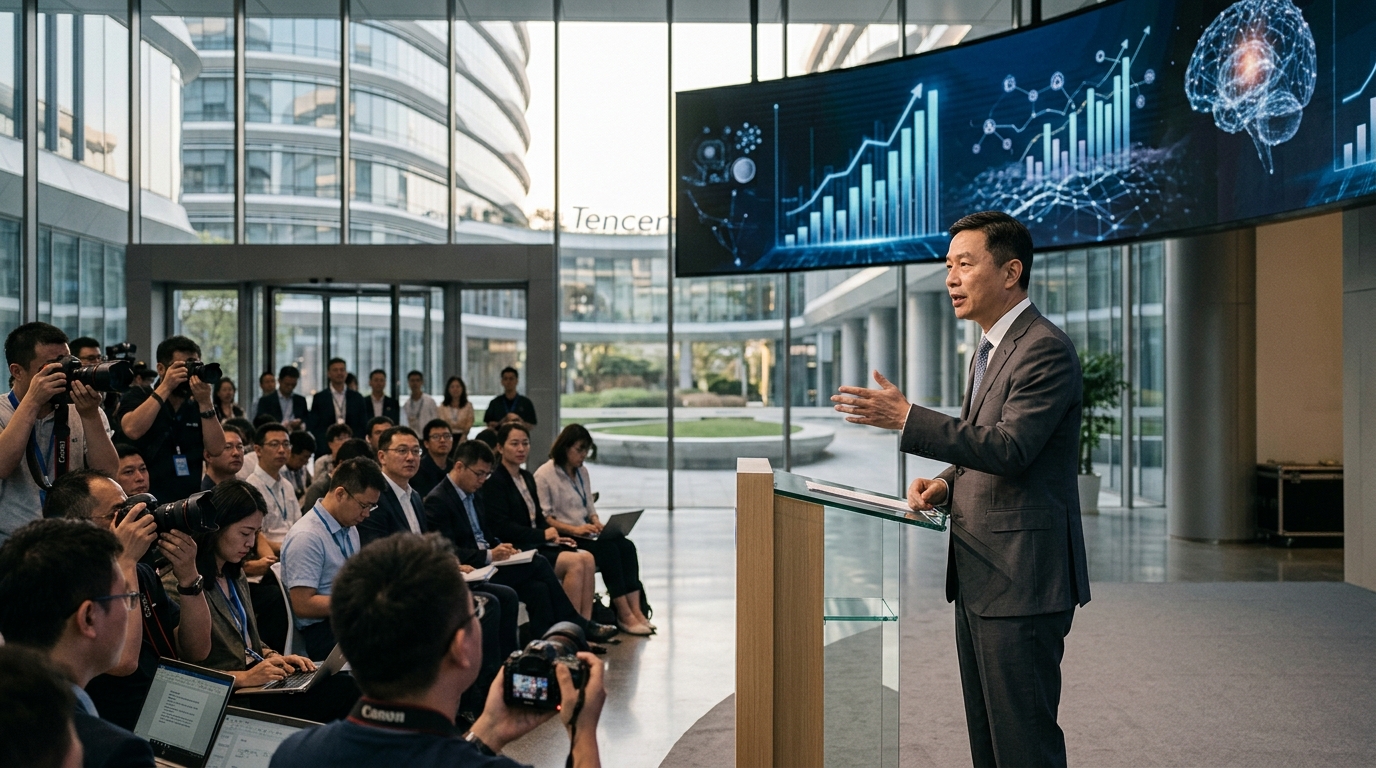
In an era of intense geopolitical shifts and technological rivalry, Chinese tech titan Tencent has proven that its pivot toward Artificial Intelligence (AI) is not merely a trend but the new backbone of its profitability. The results for the first quarter of 2026 (reflecting the upward trajectory established in 2024-25) exceeded analyst expectations, recording a significant jump in net profits largely attributed to the integration of advanced machine learning algorithms within its advertising ecosystem and cloud services.
Tencent, the powerhouse behind the 'super-app' WeChat and the world's largest video game publisher, has successfully navigated China's complex regulatory environment by focusing on operational efficiency. The deployment of its proprietary large language model (LLM), Hunyuan, has transformed how the company delivers targeted advertising, increasing conversion rates and, consequently, marketing revenues.
The Advertising Revolution via Hunyuan
The key to Tencent's financial renaissance lies in its ability to analyze vast amounts of user data with precision previously deemed impossible. Integrating the Hunyuan model into its advertising platforms has allowed businesses to create content that resonates directly with consumer preferences. This has led not only to revenue growth but also to reduced costs for advertisers, making the Tencent ecosystem more attractive than ever.
According to financial analysts, online advertising revenue saw double-digit growth, even as the broader Chinese economy showed signs of cooling. Tencent managed to 'steal' market share from traditional competitors, proving that AI is the ultimate power multiplier in the digital economy. Furthermore, the use of AI-generated content (AIGC) has drastically reduced production times for ad spots and graphics, allowing the company to operate with greater agility.
Gaming and Cloud: The Next Frontier
Despite challenges in the gaming sector due to strict domestic regulations regarding minors, Tencent has found new avenues through international expansion and the use of AI in game development. Using AI tools to create realistic environments and automate coding has accelerated the release of new titles, while gameplay quality has seen a marked improvement. International markets, such as Europe and Southeast Asia, now serve as a critical pillar for the group's growth.
- Increase in international gaming revenue through strategic acquisitions and AI optimization.
- Strengthening Cloud services with specialized AI solutions for enterprises (MaaS - Model as a Service).
- Improved profit margins through the automation of internal workflows.
In the Cloud sector, Tencent now offers Hunyuan as a service to third-party companies, allowing them to train their own models on its infrastructure. This move places it in direct competition with Alibaba and Baidu, creating a tripolar power system in the Chinese AI market. The 'AI-first' strategy appears to be paying off as businesses rush to digitalize to remain competitive in an increasingly automated world.
Geopolitical Challenges and the Road Ahead
However, the path is not without obstacles. U.S. export restrictions on advanced semiconductors (chips) to China pose a persistent threat to Tencent's ability to train even more powerful AI models. The company has stated it possesses sufficient chip inventories for the immediate future, but the long-term viability of its strategy will depend on China's ability to develop high-tech domestic production capabilities.
"Artificial Intelligence is not just a growth tool, but a fundamental transformer for all our business activities," a company executive stated during the earnings presentation.
In conclusion, Tencent is transforming from a social media and gaming giant into an AI-centric technological infrastructure company. Its success in Q1 2026 sends a strong signal to the markets: Chinese tech giants are not only surviving but leading the next digital revolution despite external pressures. Tencent's ability to convert innovation into net profit will be the key to its dominance in the years to come. The focus now shifts to how it will balance state compliance with global innovation.