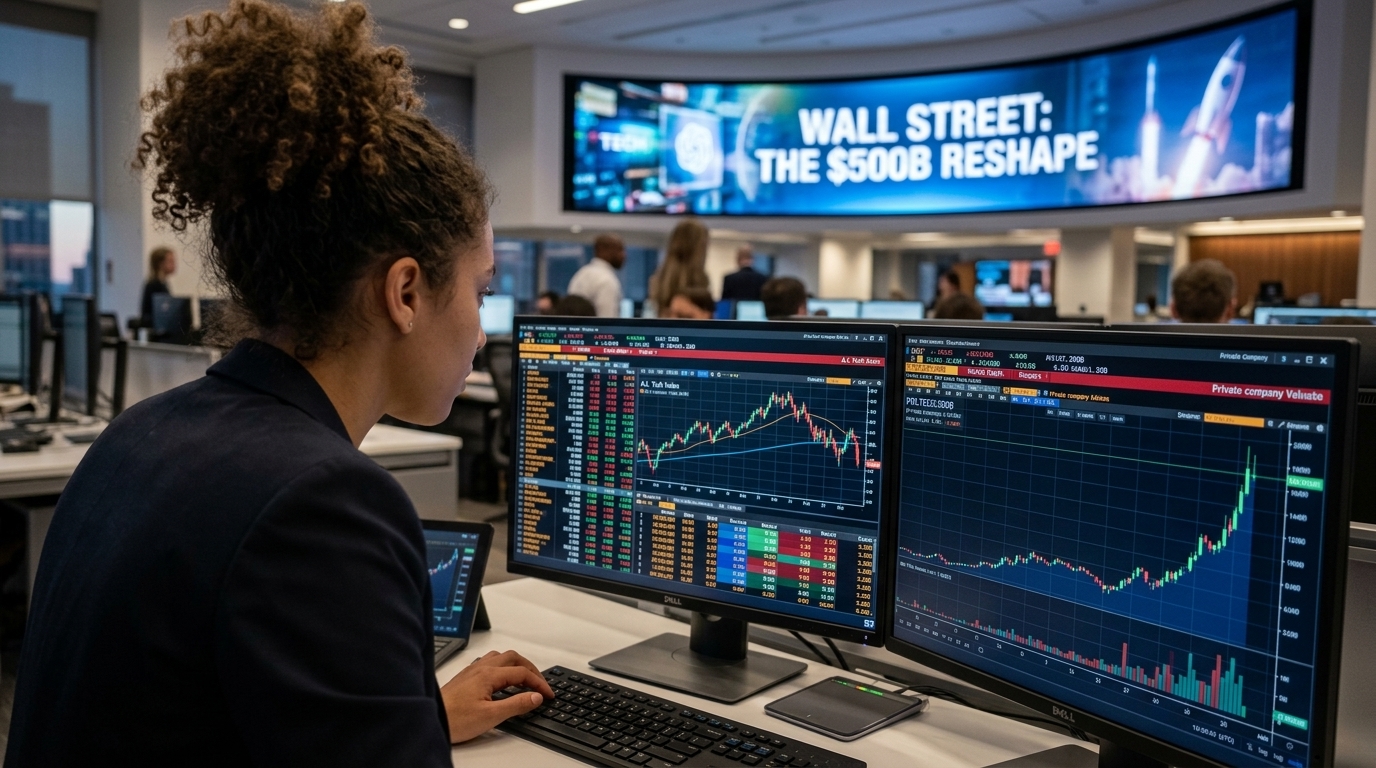
Wall Street stands on the precipice of one of the most radical transformations in its history. This is not merely a series of Initial Public Offerings (IPOs); it is a tectonic shift in economic power. Elon Musk’s SpaceX, Sam Altman’s OpenAI, and its primary rival Anthropic are preparing to cross the threshold of public markets, bringing with them a combined valuation approaching half a trillion dollars. 2026 marks the end of the era of the stubbornly private "unicorns" and the dawn of a new hegemony within the Nasdaq indices.
Nasdaq’s Strategy and the New Fast-Track Inclusion Rules
The traditional path for a company to join major stock indices required years of profitability and a consistent market presence. However, recognizing the risk of falling behind the "new economy," Nasdaq has undertaken a bold revision of its rulebook. New provisions now allow companies with market capitalizations exceeding $100 billion to join premier indices like the Nasdaq-100 in record time, bypassing the old waiting periods.
This move is calculated. SpaceX, with Starlink now serving as a profitable liquidity machine and Starship nearing full operational readiness, is no longer an experimental rocket firm. It is a global infrastructure provider. Its inclusion in the Nasdaq will force passive exchange-traded funds (ETFs) to purchase billions in shares, triggering a violent reallocation of capital from legacy tech powers toward this new generation.
OpenAI and Anthropic: The Battle for AI Supremacy
If SpaceX represents dominance in the physical realm, OpenAI and Anthropic represent control over the digital future. OpenAI, having transitioned from a non-profit foundation to a commercial juggernaut, is targeting a valuation that would place it directly within the top 10 most valuable companies globally. Anthropic, conversely, positions itself as the "safe" and ethical alternative, having secured massive investments from Amazon and Google.
- OpenAI: Focused on achieving Artificial General Intelligence (AGI) and integrating the Sora model into all aspects of content production.
- Anthropic: Investing in the Claude model and "Constitutional AI," attracting institutional investors wary of the risks of unchecked development.
- SpaceX: Dominance in satellite communications provides a stable financial floor that pure-play AI companies currently lack.
Wall Street views these companies as the antidote to the fatigue caused by the "Magnificent Seven." The market is hungry for new growth narratives, and Artificial Intelligence combined with the space economy offers the perfect backdrop for the next decade of speculation and investment.
Concentration Risks and Geopolitical Dimensions
However, this "invasion" of new giants is not without peril. The concentration of so much power in just three companies, largely controlled by a handful of individuals, raises questions about systemic stability. What happens if a failure at OpenAI drags down the entire Nasdaq? Furthermore, SpaceX now holds a critical role in U.S. national security, making its stock more than just a financial asset; it is a geopolitical instrument.
"We are not just seeing new listings. We are witnessing the privatization of the 21st century's foundations," notes a senior analyst at Goldman Sachs.
Europe watches these developments with unease. The lack of equivalent European "champions" in AI and space widens the gap between the two sides of the Atlantic. The listing of these companies on Wall Street will inevitably pull even more capital away from European markets toward the U.S., reinforcing the American monopoly on high-stakes innovation.
Conclusion: A New Era for the Investor
For the retail investor, the entry of SpaceX, OpenAI, and Anthropic offers access to sectors that were previously the exclusive playground of venture capitalists. However, volatility is expected to be unprecedented. Their valuations are built on promises of a future not yet fully realized. Wall Street’s gamble is immense: if these companies succeed, they will usher in a new golden age of growth. If they falter, the "earthquake" they are causing today will seem like a mere tremor before a much larger collapse.