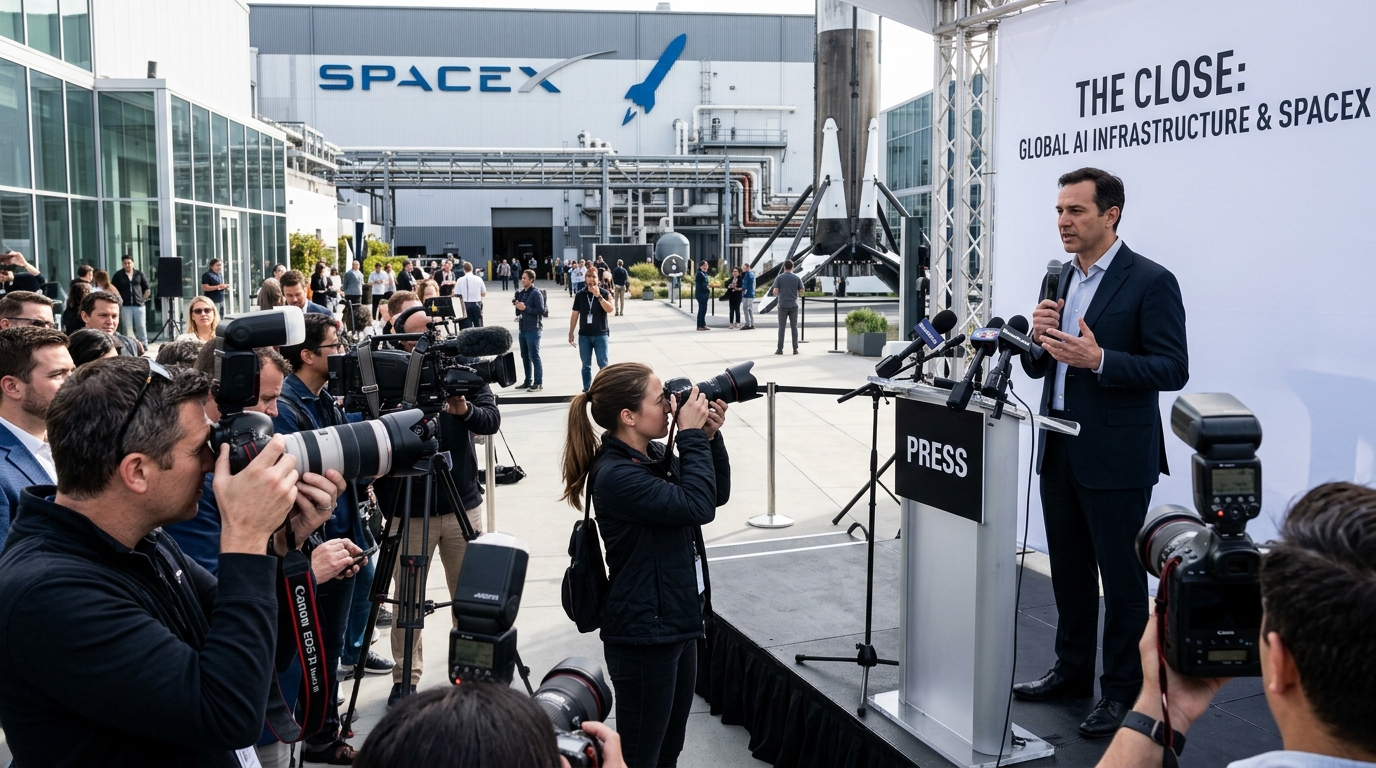
May 21, 2026, will be remembered in Wall Street history as the day the boundaries between aerospace engineering and Artificial Intelligence (AI) finally dissolved. On Bloomberg’s ‘The Close,’ the discussion surrounding Elon Musk’s SpaceX and its impending Initial Public Offering (IPO) went far beyond a staggering $250 billion valuation. Instead, a new reality emerged: SpaceX is no longer a transportation company; it is the cornerstone of the global AI build-out.
The Convergence of Orbit and Compute
Ross Gerber of Gerber Kawasaki and Chad Anderson of Space Capital analyzed how Starlink, SpaceX’s satellite subsidiary, is becoming the ‘nervous system’ of global AI. As AI models demand increasing amounts of data and lower latency, the ability to provide high-speed internet to every corner of the globe is no longer optional. AI cannot remain confined to the data centers of Silicon Valley; it must operate at the ‘edge’—in remote industrial sites, on autonomous vessels, and in smart cities that lack terrestrial fiber infrastructure.
The SpaceX IPO arrives at a moment when the market is starving for infrastructure. As Paul Abrahimzadeh of 1789 Capital noted, investing in SpaceX is now an investment in ‘Sovereign AI.’ Nations want their own computational capabilities without depending on vulnerable terrestrial cables that can be severed during geopolitical conflicts. SpaceX’s satellite constellation provides this essential autonomy, creating a decentralized backbone for the digital age.
The Economic Bet and Musk’s Grand Strategy
SpaceX’s valuation is dizzying, but Bloomberg’s analysts argued that the fundamentals are stronger than ever. Unlike other tech IPOs, SpaceX holds a functional monopoly on reusable rocket technology. This cost advantage allows it to deploy the Starlink constellation at a fraction of the cost incurred by competitors. The liquidity raised from the IPO is expected to be funneled into accelerating Starship, the massive rocket capable of carrying entire data centers into orbit.
But why put data centers in space? Cooling servers and harvesting solar power are abundant and free in the vacuum of space. Musk’s strategy appears to be moving toward creating an extra-terrestrial computing infrastructure that will power the needs of xAI and other industry giants, bypassing the constraints of Earth’s aging power grids and environmental regulations.
Risks and Geopolitical Implications
Despite the optimism, Bloomberg’s guests did not shy away from the risks. The ‘Musk Factor’ remains the largest variable. His political stances and involvement in multiple high-stakes ventures (Tesla, X, xAI) cause concern among institutional investors regarding the governance of SpaceX as a public entity. Furthermore, the increasing volume of orbital debris and regulatory hurdles from the FAA and international bodies could slow the cadence of launches.
“We are witnessing the vertical integration of the universe. From the silicon in the chips to the satellites in orbit, the infrastructure of intelligence is being centralized in ways we never imagined.” — Chad Anderson, Space Capital
The transition to a public company will force a level of transparency that SpaceX has avoided for two decades. However, for the investors interviewed on ‘The Close,’ the potential rewards outweigh the volatility. The synergy between SpaceX’s launch capabilities and the burgeoning AI economy creates a moat that no other company—not even Blue Origin or Boeing—can currently bridge.
Key Takeaways for the 2026 Market
- SpaceX is pivoting from a launch provider to a global data and AI infrastructure utility.
- The IPO will provide the massive capital required for Starship’s commercialization.
- Orbital edge computing is the next frontier for AI model training and inference.
- Geopolitical demand for Sovereign AI is driving Starlink’s exponential growth.
In conclusion, the SpaceX IPO is not merely a financial milestone. It is the formalization of a new era where space exploration and machine intelligence are inextricably linked. As Chad Anderson aptly put it, ‘You aren’t buying shares in a rocket company; you are buying the operating system of the future.’