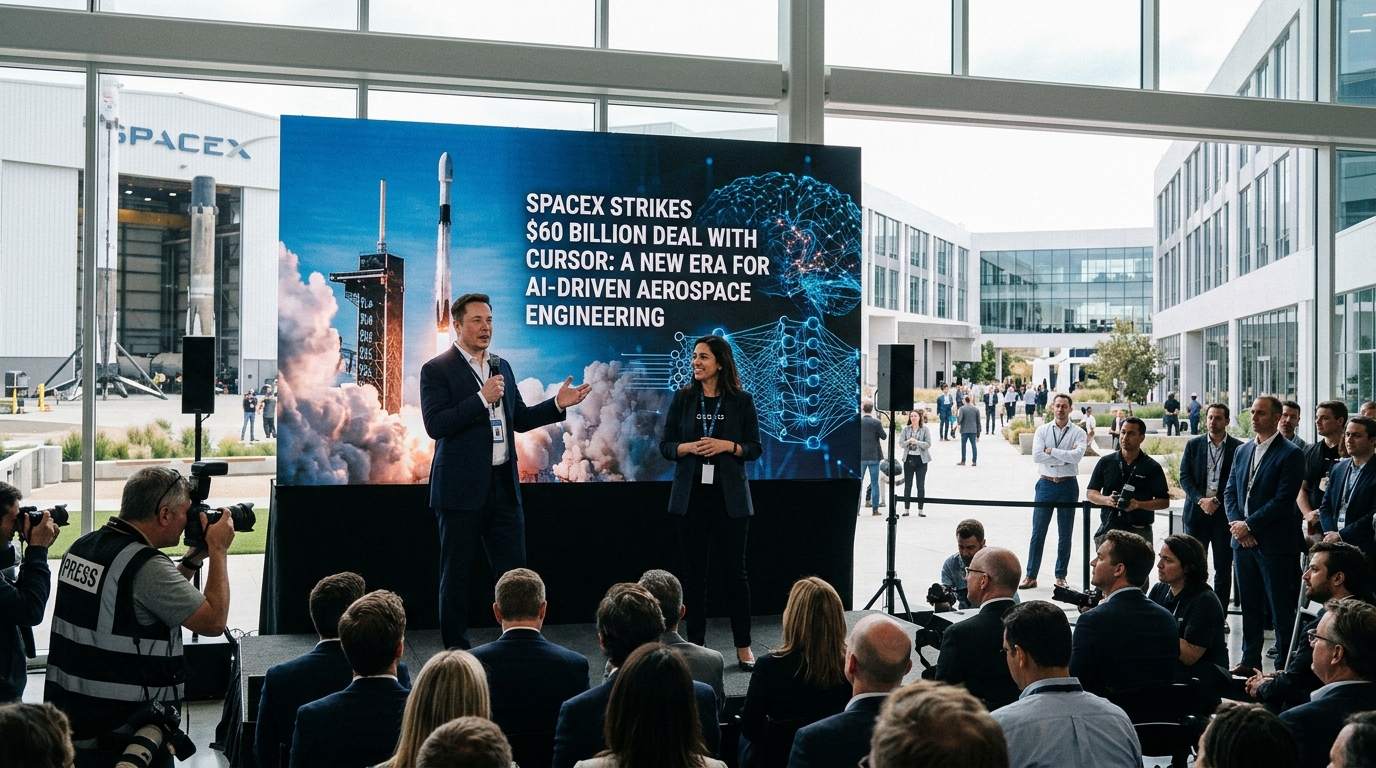
In a move that has sent shockwaves through the global technology and aerospace sectors, Elon Musk’s SpaceX has announced a definitive agreement to acquire Cursor, the leading AI-powered code development platform, for a staggering $60 billion. The news, first reported by the New York Times, is more than just a corporate acquisition; it is a strategic manifesto for the future of human engineering. By embedding Cursor’s sophisticated AI capabilities into SpaceX’s core workflows, the company aims to transform artificial intelligence from a mere productivity tool into the primary architect of the next generation of spacecraft and satellite constellations.
The Strategic Convergence of Engineering and AI
Cursor began its journey as an innovative Integrated Development Environment (IDE) built atop large language models, quickly dominating the market by enabling developers to write, debug, and optimize code in real-time with unprecedented AI assistance. For SpaceX, the requirement for flawless, high-performance code is a matter of mission success and human life. The Starship rockets rely on millions of lines of code that must process data from thousands of sensors every millisecond. The acquisition of Cursor allows SpaceX to build a proprietary, closed-loop ecosystem where the AI is intimately familiar with the hardware architecture, enabling the automated generation of software optimized for Raptor engines and complex orbital mechanics.
Wall Street analysts suggest that the $60 billion valuation reflects Musk’s core philosophy: that the speed of iteration is the only sustainable competitive advantage. With Cursor, SpaceX isn't just buying software; it is acquiring a 'force multiplier' for its engineering talent. The AI’s ability to simulate failure modes and suggest code fixes before physical testing even begins could potentially accelerate the Mars colonization timeline by several years.
From Code to Construction: The Dawn of 'Lights-Out Engineering'
This deal is expected to ripple far beyond pure software development. Cursor’s technology will likely be integrated into SpaceX’s manufacturing systems, driving what experts call "Lights-Out Engineering"—a paradigm where AI designs components, writes the control logic, and oversees automated fabrication.
- Automated real-time optimization of flight-critical software.
- An estimated 40% reduction in software development costs within the first two years.
- Integration of advanced predictive failure models into the Starlink network.
- The creation of a unified 'Digital Twin' for every vehicle in the SpaceX fleet.
"We are no longer just building rockets. We are building sentient machines that understand the physics of space as deeply as their human creators," a source close to SpaceX leadership remarked.
Challenges and Global Competition
Despite the optimism, the deal raises significant questions regarding power concentration and market competition. With Cursor under its wing, SpaceX gains exclusive access to technology that competitors—ranging from Jeff Bezos’s Blue Origin to legacy giants like Boeing—would desperately need to remain competitive. This move may trigger antitrust scrutiny, especially since Cursor was previously an open-access tool for the broader developer community. Furthermore, there is the inherent risk of over-reliance on AI for safety-critical systems. While Cursor’s AI is remarkably capable, the unforgiving vacuum of space leaves no room for the 'hallucinations' or logic errors that still plague modern large language models.
In conclusion, SpaceX’s acquisition of Cursor is the boldest bet in the history of modern industrial technology. If successful, it will cement the company’s dominance in the space economy for decades to come. If it falters, it will serve as a multi-billion dollar cautionary tale regarding the limits of AI in high-stakes environments. One thing is certain: the relationship between the engineer and the code has been permanently altered.