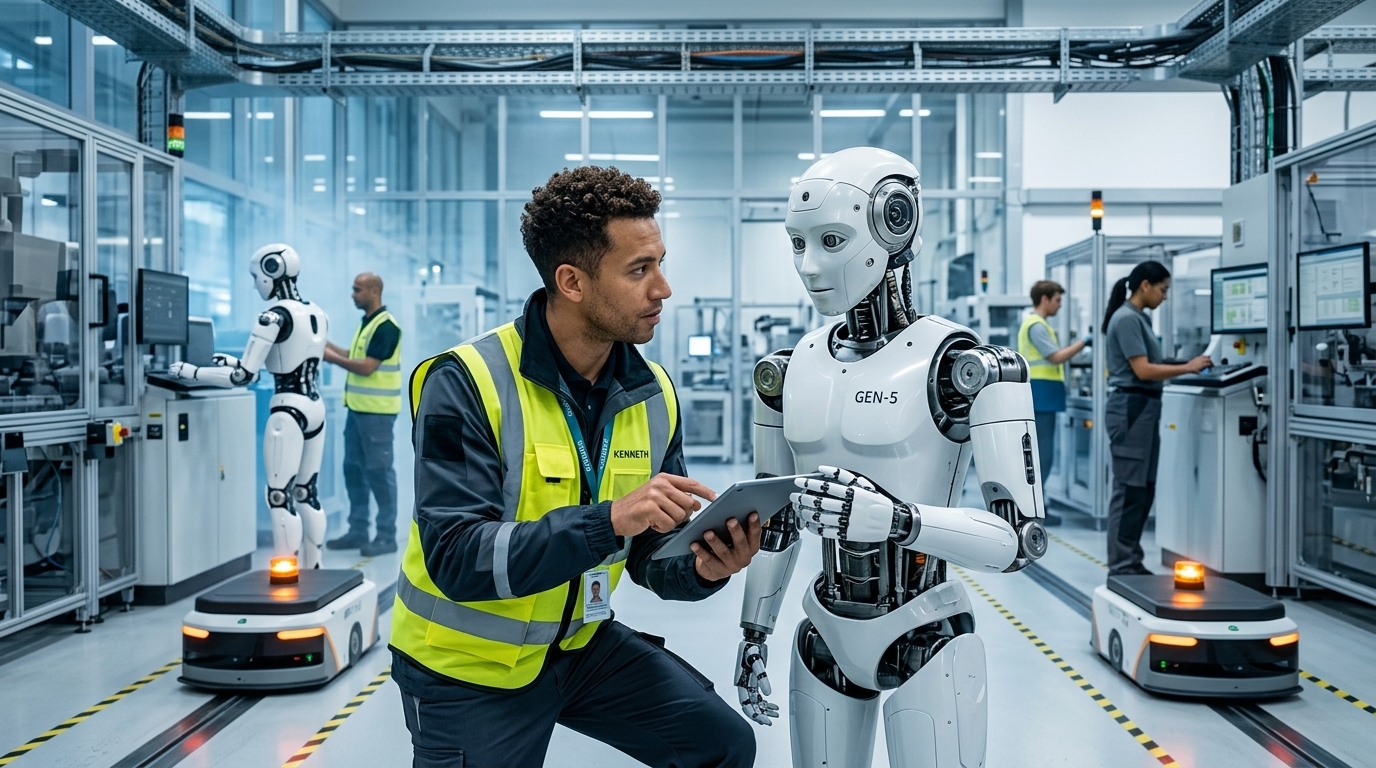
The vision of a factory floor where humanoid robots move naturally alongside human workers, transporting components and performing complex assembly tasks, is no longer the stuff of science fiction. Siemens, the German industrial titan, and Nvidia, the undisputed leader in AI chips, have announced the successful testing of humanoid robots in real-world production environments. This development is not merely a technological demonstration; it is the beginning of a radical restructuring of the global supply chain and our fundamental understanding of labor.
The Synergy of Giants: Omniverse and Xcelerator
The partnership is built upon the integration of two powerhouse platforms: Nvidia Omniverse and Siemens Xcelerator. Omniverse serves as the 'Digital Twin' of the physical world, allowing robots to train in high-fidelity simulated environments before ever stepping foot on a real factory floor. Siemens, for its part, provides its deep expertise in industrial automation and process control.
According to the announcements, these humanoid robots utilize Nvidia's GR00T model—a foundation AI model for general-purpose robotics. This enables the machines to understand natural language and mimic human movements by observing workers. This capability is critical, as it allows robots to adapt to environments designed for humans without requiring a complete overhaul of production lines.
Why Humanoids? The Strategy of Flexibility
Many wonder why the industry is investing in humanoid robots instead of traditional industrial arms, which are already highly efficient. The answer lies in flexibility. Traditional robots are static and programmed for a single task. In contrast, a humanoid can climb stairs, open doors, and use tools specifically designed for human hands.
- Adaptability: They can move from the assembly line to the warehouse without hardware changes.
- Collaboration: State-of-the-art sensors allow for safe coexistence with humans (Cobots).
- Infrastructure Costs: No special spatial configuration is required, as the robot adapts to the factory rather than the other way around.
"AI is giving robots the ability to perceive and interact with the world in ways that were impossible just a few years ago," said an Nvidia executive during the presentation.
The Future of Work and the Demographic Challenge
The move by Siemens and Nvidia comes at a time when global industry is facing a massive labor shortage. In Germany, Japan, and the US, aging populations are creating vacancies in low-skilled but physically demanding positions. Humanoid robots are intended to fill these gaps, taking over the "3D" jobs: Dull, Dirty, and Dangerous.
However, this transition is not without social challenges. Concerns about the replacement of workers by machines remain potent. Siemens maintains that the goal is the 'augmentation' of the workforce, not its elimination. The workers of the future will function more as 'robot fleet supervisors' than manual laborers, requiring a new generation of skills in programming and AI system management.
Conclusion: Toward the Autonomous Factory
The successful test by Siemens and Nvidia marks the milestone for the 'Industrial Metaverse.' Within the next five years, mass production of such robots is expected, with their costs gradually decreasing as the technology matures. Industry is not just changing tools; it is changing its foundations. The collaboration between human and machine is entering a phase where the distinction between physical and digital labor becomes increasingly blurred, promising an era of unprecedented productivity and innovation.