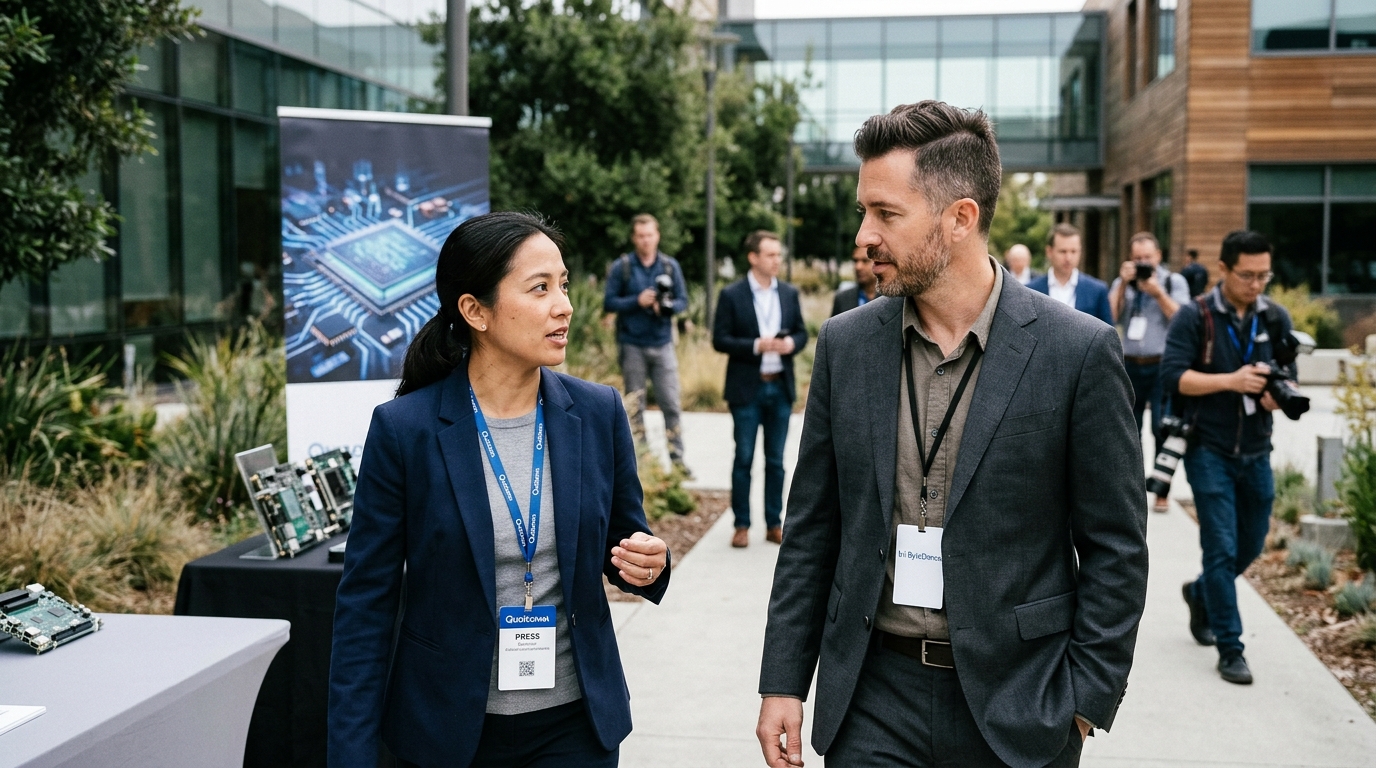
In a move that sends shockwaves through the global technology ecosystem, Qualcomm, the traditional leader in mobile processors, has announced an extensive partnership with ByteDance, the parent company of TikTok. The deal involves the supply of specialized Artificial Intelligence (AI) chips for the Chinese giant's data centers, marking a critical turning point in Qualcomm's ambition to challenge Nvidia's dominance in AI infrastructure.
Qualcomm's Strategic Pivot
For decades, Qualcomm's name has been synonymous with smartphones. However, under the leadership of Cristiano Amon, the company has embarked on an ambitious diversification path. Entering the data center market is not just a new revenue stream; it is a necessity for survival in a world where computing power is migrating from our pockets to the cloud. Qualcomm's Cloud AI 100 series chips promise something the market is desperate for: energy efficiency. Unlike Nvidia's power-hungry GPUs, Qualcomm's solutions focus on "inference"—the process where a pre-trained AI model makes real-time decisions.
For ByteDance, the need for such technology is existential. TikTok relies on one of the most sophisticated recommendation algorithms in the world. As the company expands into Generative AI with its Doubao platform, electricity costs and the need for speed make Qualcomm an attractive partner. The shift from training models to deploying them at scale is where Qualcomm believes it can win.
Navigating the Geopolitical Minefield
This deal cannot be analyzed without considering the strained climate between Washington and Beijing. The US has imposed strict export controls on advanced AI chips to China, primarily targeting Nvidia's flagship models. Qualcomm, however, appears to be navigating these murky waters with precision. By utilizing architectures that prioritize efficiency over raw training power, the company often manages to stay within the legal boundaries of export licenses.
- ByteDance seeks to reduce its heavy reliance on Nvidia's supply chain.
- Qualcomm offers solutions that can reduce data center operating costs by up to 50%.
- The deal reinforces the presence of American technology at the heart of Chinese infrastructure, despite political headwinds.
This partnership highlights a modern irony: while politicians speak of "decoupling," tech giants are becoming increasingly interdependent. ByteDance needs American design, and Qualcomm needs Chinese scale to prove it can stand toe-to-toe with Nvidia's Jensen Huang. It is a dance of necessity performed on a very thin tightrope of international regulation.
The End of the Nvidia Monoculture?
While Nvidia holds over 80% of the AI chip market, Qualcomm's entry into ByteDance's data centers represents a significant crack in the wall. If Qualcomm can prove its chips can handle TikTok's massive workload at a fraction of the energy currently required, other giants like Meta or Google might rethink their procurement strategies. The future of AI will not be decided solely by who has the most powerful model, but by who can run it most cheaply and sustainably. In this race, Qualcomm has just secured a vital inside lane.
"This collaboration isn't just about silicon. It's about who controls the cadence of the digital economy for the next decade."
In conclusion, the Qualcomm-ByteDance deal is a bold wager. For Qualcomm, it is the opportunity to prove it is more than just a telecommunications firm. For ByteDance, it is a shield against hardware shortages. And for the market, it is the promise of healthy competition that could accelerate AI adoption across every facet of our daily lives. As data centers become the factories of the 21st century, the tools used to build them are changing hands.