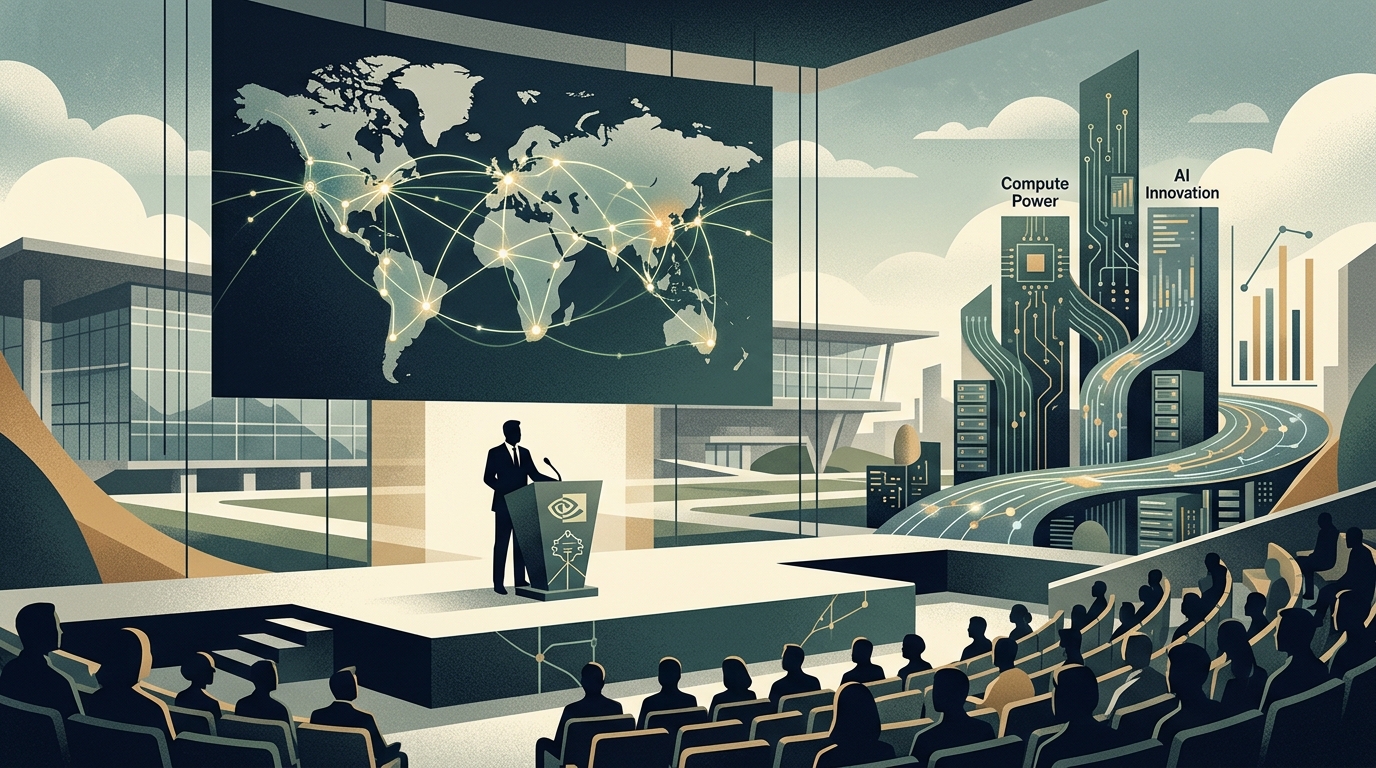
Nvidia's financial results announcements have evolved into a global ritual, a moment when markets hold their breath to measure the pulse of the digital age. For yet another quarter, the Santa Clara giant has exceeded every expectation, proving that the demand for Artificial Intelligence (AI) processors is not just high, but insatiable. As we move through May 2026, Nvidia is no longer just a semiconductor company; it is the architect of the "AI factories" powering everything from medical research to national security.
The Transition from Hardware to Ecosystem
The secret to Nvidia's success lies not only in the superiority of its hardware, such as the recent Rubin architectures that dominate the market. Its true strength resides in the CUDA software, which has created a formidable "moat" around the company. Millions of developers worldwide have been trained and work within this ecosystem, making the transition to competitive solutions—such as those from AMD or Intel—an extremely costly and time-consuming process. Nvidia has successfully established itself as the de facto standard for accelerated computing.
Furthermore, the company has strategically expanded into high-speed networking. With the acquisition of Mellanox and the development of Spectrum-X technology, Nvidia now controls not only the "brain" (GPU) of the data center but also the "nervous system" (networking) that allows thousands of chips to function as a single, giant supercomputer. This holistic approach is what allows major cloud providers like Microsoft, Google, and Amazon to continue their massive orders, despite their efforts to develop their own internal silicon.
Sovereign AI: The New Geopolitical Chessboard
One of the most intriguing trends highlighted in the latest financial data is the rise of "Sovereign AI." Nations across the globe, from Saudi Arabia and the UAE to France and Japan, are investing billions to build their own domestic AI infrastructure. The logic is simple: compute power is the "oil" of the 21st century. No nation wants to be exclusively dependent on American cloud companies for processing national data or developing its own large language models.
This shift toward Sovereign AI creates a massive new market for Nvidia, which now acts as a diplomatic and technological partner to governments. Despite export restrictions to China, which continue to pose a challenge, Nvidia is finding new avenues in emerging economies eager to enter the AI race. The geopolitical significance of the company is now such that Jensen Huang's movements are monitored with the same scrutiny given to central bankers' statements.
From Training to Inference
A critical question occupying analysts is whether demand will wane once the training of large language models (LLMs) is complete. The market's response, as reflected in Nvidia's revenue, is a resounding "no." The market is shifting from training to inference—the use of these models by billions of users daily. Inference requires a different type of compute power, but at an enormous scale. Every time a user asks an AI to write code or generate an image, an Nvidia processor is working in the background.
"We are not at the end of a bubble, but at the beginning of a new industrial revolution, where software generates intelligence instead of just data," Huang recently stated, and the numbers seem to bear him out.
However, challenges remain. The energy consumption of data centers has become a central political issue, with the European Union considering stricter regulations. Nvidia responds with increased energy efficiency in its new product lines, but the total demand for power remains a complex problem that could serve as a ceiling for the industry's growth.
The Future: Robotics and Physical AI
Looking ahead, Nvidia is betting on "Physical AI" and robotics. The Isaac platform and Jetson processors aim to give AI a "body," allowing robots to perceive and interact with the physical world in real-time. If Nvidia manages to dominate autonomous movement and industrial robotics as it did in data centers, then today's record revenues will look like just the starting point of a much longer journey.