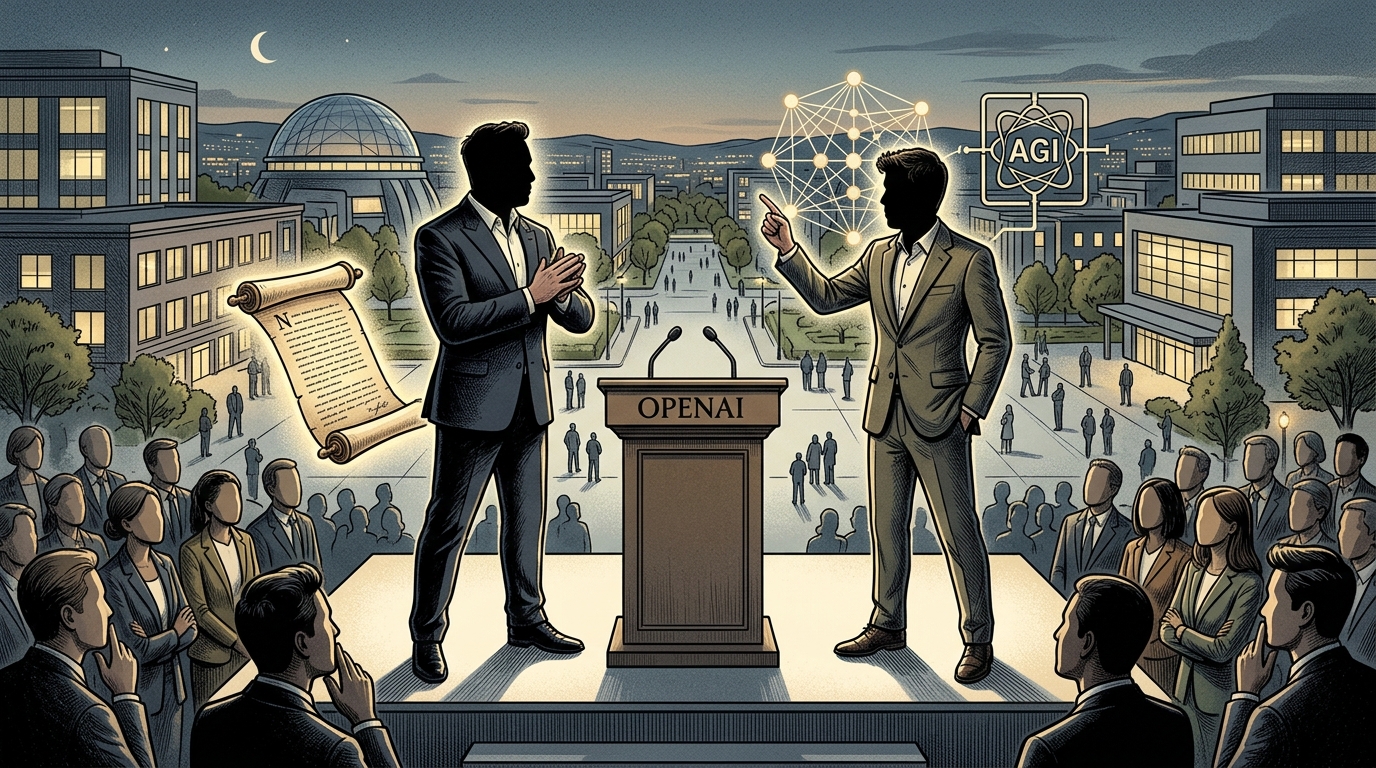
The third week of the legal showdown between Elon Musk and OpenAI in San Francisco was more than just a legal dispute; it was a total character assassination. As the proceedings draw to a close, the courtroom transformed into a theater where the credibility of two of technology's most powerful figures was placed under a microscope. Musk’s side sought to portray Sam Altman as a "manipulator" who betrayed OpenAI's humanitarian mission for profit, while OpenAI’s defense fired back, painting Musk as a bitter former partner driven by envy and a bruised ego.
The Strategy of Deconstructing Sam Altman
Musk’s lawyers focused on what they called a "pattern of insincerity" in Altman's career. At the center of the storm were revelations regarding Altman's personal investments in companies that do extensive business with OpenAI, such as Helion Energy and Rain AI. The accusation is clear: Altman allegedly used his position at OpenAI to bolster his own financial interests, a practice known in Silicon Valley as "self-dealing." During cross-examination, Altman was grilled on whether he had fully disclosed these relationships to the board prior to his infamous firing (and subsequent rehiring) in November 2023.
Musk’s argument hinges on the idea that OpenAI is no longer the non-profit organization it promised to be in 2015. Instead, it has become a "de facto subsidiary" of Microsoft, closing its code and pursuing Artificial General Intelligence (AGI) for the enrichment of its shareholders. Musk’s lawyers presented internal emails showing a gradual shift in the company's culture from radical transparency to extreme secrecy.
The Counter-Attack: Musk as the "Failed Conqueror"
OpenAI, however, did not take the hits lying down. Their legal team presented a completely different narrative. According to the defense, Musk doesn't care about the "safety of humanity," but rather about the fact that his own AI company, xAI, is lagging behind technologically. Their most potent weapon was a series of emails from 2018, where Musk proposed that Tesla should absorb OpenAI, claiming it was the only way to compete with Google.
"Mr. Musk doesn't have a problem with profit; he has a problem with profit he doesn't control," stated one of OpenAI’s attorneys. The defense argued that OpenAI had to change its structure to survive, as the cost of computational resources required to train models like GPT-4 far exceeds the capabilities of any donation-based model. The partnership with Microsoft was presented as a necessary survival strategy rather than a betrayal of principles.
The Legal Void and the Definition of AGI
One of the most contentious issues of the trial is the definition of AGI. In OpenAI’s charter, Microsoft’s license does not include AGI. Musk claims that GPT-4 is already a form of early AGI, and therefore OpenAI is breaching its contract by continuing to provide exclusive access to Microsoft. Expert witnesses who testified this week were split: some argued we are still far from "human-level intelligence," while others emphasized that the term's ambiguity allows OpenAI to move the goalposts at will.
The jury is now tasked with deciding whether a "Founding Agreement" actually existed. OpenAI maintains there was never a formal signed document with that title, only a series of oral promises and email exchanges. If the jury is convinced that these promises constitute a binding contract, the consequences for OpenAI could be catastrophic, potentially leading to a forced "open-sourcing" of its proprietary models.
Conclusion: An Industry in Limbo
As the case moves to the jury, Silicon Valley is watching with bated breath. The decision will not only determine the fate of two billionaires but also the legal framework within which artificial intelligence will develop over the next decade. Is AI a public good that must be protected from corporate interests, or is it simply the next great commercial product in a free market? The verdict is expected to provide the first serious answer to this existential question of our time.