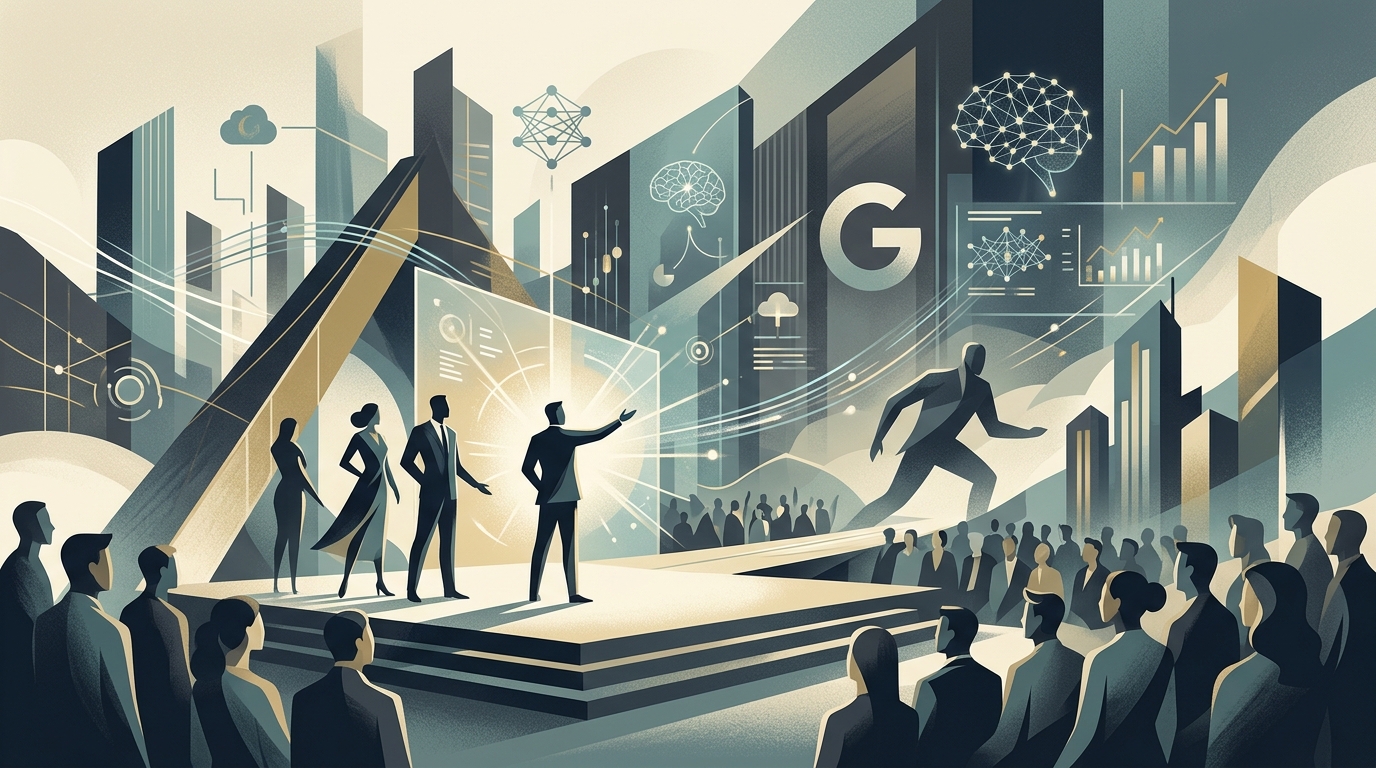
Technology history will likely remember 2023 as the year Google found itself on the defensive. The meteoric rise of OpenAI’s ChatGPT and Microsoft’s swift multi-billion dollar alliance sent shockwaves through Mountain View, triggering a 'code red.' However, 2024 and 2026 have emerged as the years of the great counter-strike. Google isn't just accelerating; it is fundamentally re-engineering its entire ecosystem around Gemini, its most capable AI model to date, proving that the data giant was merely a sleeping titan that has now fully awakened.
The Strategy of Integration: The Gemini Era
Google's masterstroke wasn't simply launching a chatbot; it was the total infusion of Generative AI into every fiber of its digital empire. From Google Workspace and Android to the core Search engine, Gemini now serves as the connective tissue. The transition from Bard to Gemini was far more than a rebranding exercise; it was a declaration of intent. Google now possesses a multimodal architecture capable of processing text, images, video, and code simultaneously with unprecedented efficiency.
The company’s competitive moat lies in its scale. While rivals often rely on third-party compute or niche datasets, Google controls the entire value chain. It designs its own Tensor Processing Units (TPUs), operates its own global fiber-optic network, and holds the keys to the largest repository of human knowledge ever assembled via Search and YouTube. This vertical integration provides a level of agility that startups simply cannot match.
Redefining Search and the Advertising Engine
The existential challenge for Google was modernizing Search without cannibalizing its primary revenue stream: advertising. The rollout of the Search Generative Experience (SGE) suggests the company has found its equilibrium. Instead of a sterile list of blue links, users now receive synthesized summaries that facilitate complex reasoning, with advertisements woven organically into the conversational flow. This paradigm shift is forcing publishers and creators to rethink their SEO strategies, as Google evolves from an 'internet traffic controller' to the 'final destination' for information.
"We aren't just building AI tools; we are building a new way of reasoning that will be accessible to every person, in every corner of the planet," a Google Cloud executive recently stated, highlighting the company's global ambitions.
Infrastructure: The High Cost of Dominance
The multi-billion dollar war is being fought in silicon as much as in software. Google has announced massive capital expenditures for new data centers across Europe and Asia, aiming to decouple its future from Nvidia’s supply chain. The new TPU v5p chips are purpose-built for training massive-scale models, offering double the performance of their predecessors. This infrastructure allows Google to offer AI services at a lower price point for enterprises, directly challenging Microsoft Azure and Amazon Web Services (AWS) in the cloud wars.
- Integration of Gemini across 2 billion Android devices globally.
- Enhancement of Google Cloud with Vertex AI tools for enterprise-grade deployment.
- A renewed focus on 'Responsible AI' with advanced safety filters and digital watermarking.
- Strategic licensing deals with media organizations for high-quality training data.
Challenges: Regulation, Ethics, and the Hallucination Problem
Despite its technological momentum, Google faces significant headwinds. The European Union, through the AI Act, is scrutinizing Google’s dominance, fearing an irreversible concentration of power. Furthermore, the issue of 'hallucinations'—where AI generates confident but false information—remains a critical hurdle. When a search engine trusted by billions provides inaccurate medical or legal advice, the consequences are severe. Google must now walk a tightrope between the breakneck speed of innovation and the absolute necessity of user safety, in a landscape where the competition is waiting to pounce on any misstep.