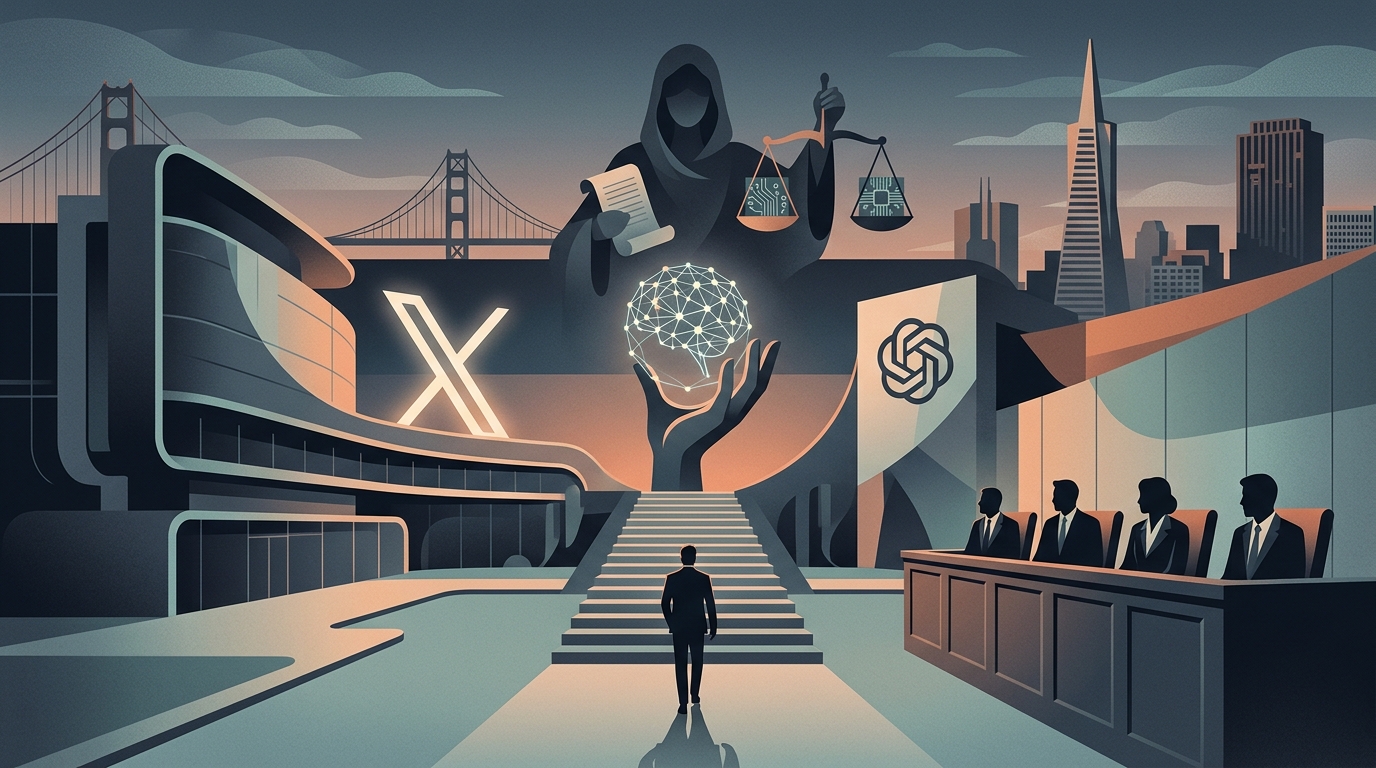
The atmosphere in the San Francisco courtroom was electric as Elon Musk, the billionaire CEO of Tesla and xAI, took the stand to testify against the company he helped found: OpenAI. The case, which has captured global attention, is not merely a personal vendetta between two of technology's most powerful figures; it poses fundamental questions about the future of Artificial General Intelligence (AGI) and its control by private interests.
Musk alleges that Sam Altman and Greg Brockman induced him to invest tens of millions of dollars into OpenAI during its infancy in 2015 with the promise that the organization would remain non-profit and its technology would be open-source for the benefit of humanity. Today, OpenAI, valued at over $100 billion and deeply entwined with Microsoft, is accused by Musk of becoming a "closed-source de facto subsidiary" of the Redmond-based tech giant.
A Conflict of Visions: Altruism vs. Arbitrage
During the first day of his testimony, Musk was characteristically blunt. "The name is OpenAI, not ClosedAI," he stated, prompting whispers throughout the gallery. His legal team presented a series of emails from 2015 and 2016 in which Altman appeared to agree on the necessity of absolute transparency to prevent a monopoly on AI by companies like Google. Musk claims that OpenAI's pivot to a "capped-profit" model in 2019 was a flagrant breach of the "founding agreement."
On the other side, OpenAI's defense, led by top-tier litigators, argues that there was never a formal, written "founding agreement" that bound the company in perpetuity. They counter that the need for massive computational resources—costing billions—rendered the initial non-profit model unsustainable. Sam Altman, watching the testimony with a stoic expression, is expected to argue that Musk is simply attempting to sabotage a competitor as his own AI venture, xAI, struggles to close the gap.
The Microsoft Shadow and the AGI Question
One of the most critical points of the trial is the definition of Artificial General Intelligence (AGI). OpenAI's agreement with Microsoft stipulates that Microsoft holds rights to OpenAI's technology until the latter achieves AGI. Once AGI is reached, the technology is supposed to belong exclusively to the non-profit arm for humanity's benefit. Musk contends that GPT-4 and its successors are already early forms of AGI and that OpenAI is intentionally downplaying its models' capabilities to keep the Microsoft funding flowing.
"It is an accounting fraud with existential consequences," Musk argued. The trial is expected to unearth internal documents showing how decisions regarding safety and model release are made. Musk's testimony also revealed his deep-seated anxiety over safety: "If you give the key to ultimate intelligence to a profit-hungry corporation, you are signing the death warrant of democracy."
Implications for the AI Ecosystem
The outcome of this trial could reshape the entire industry. If Musk prevails, OpenAI might be forced to open-source its code or return donations, an event that would cause an earthquake in the markets and its partnerships. If OpenAI wins, it will solidify the model of "hybrid" AI organizations, where a mission for public good coexists with aggressive profitability.
Already, EU regulators and the FTC in the US are closely monitoring the proceedings. The trial highlights the legislative vacuum regarding how "benefit to humanity" is defined in a world where algorithms can generate trillions in wealth. The Musk-Altman battle is not just a fight over shares; it is a struggle over who will hold the steering wheel of human evolution.
"Artificial intelligence is the most powerful tool we have ever created. Whether it liberates or enslaves us depends on whether the truth is for sale," Musk stated as he concluded his first day of testimony.
In the coming weeks, testimony is expected from Microsoft executives, former OpenAI board members involved in Altman's brief 2023 ousting, and expert scientists who will be asked to determine: Have we finally reached AGI? And if so, who owns it?