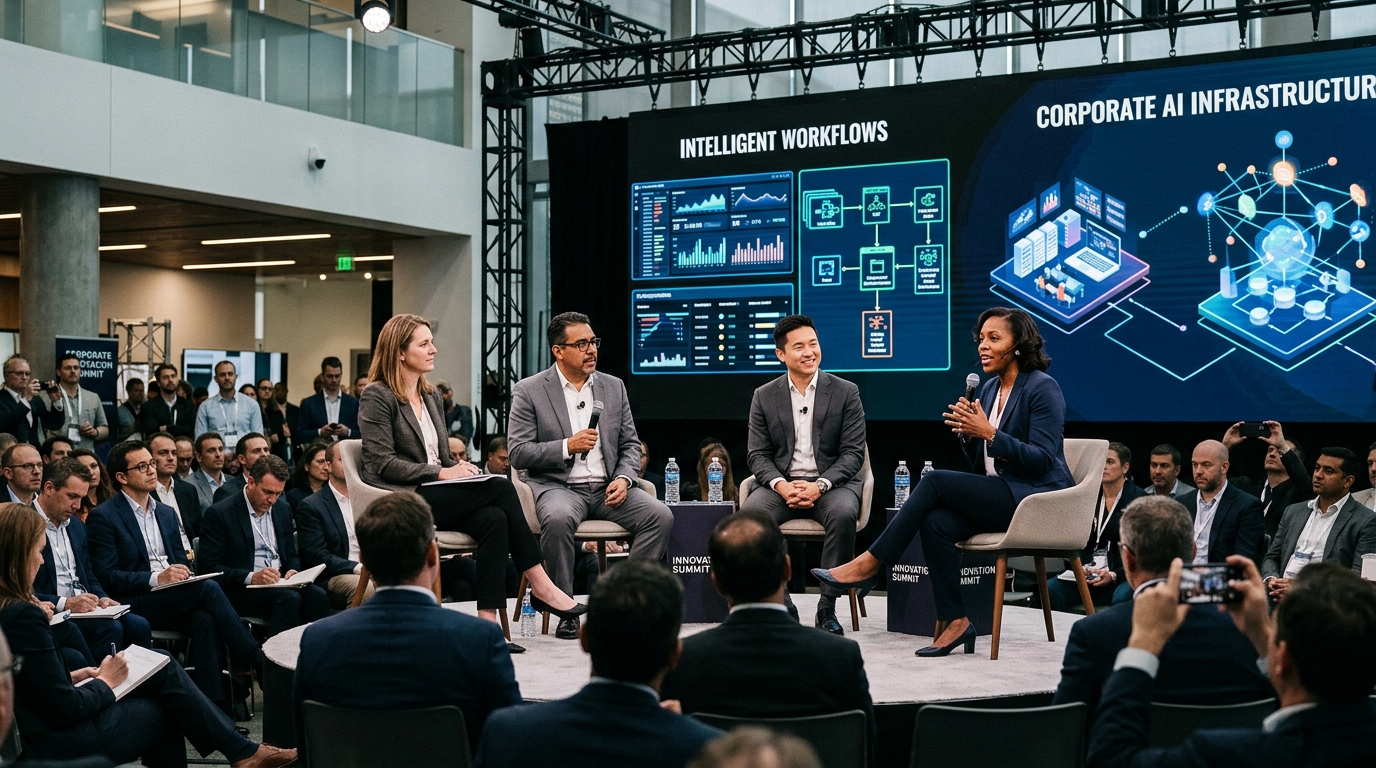
In the current business landscape of May 2026, the conversation surrounding Artificial Intelligence (AI) has decisively shifted from the theoretical potential of large language models to the practical implementation of "intelligent workflows." In a recent discussion on Bloomberg Tech, senior executives from three industry titans—Elevance Health, MetLife, and Capital One—shared their insights from the front lines of this digital transformation. The consensus is clear: AI is no longer an experimental add-on, but the backbone of modern corporate infrastructure.
Healthcare Transformation: Elevance Health
Ratnakar Lavu, EVP and Chief Digital Information Officer at Elevance Health, highlighted how AI is being leveraged to solve chronic complexity issues in healthcare. Elevance, which manages vast volumes of patient data, has focused on creating workflows that connect fragmented data points to provide a holistic view of a member's health. The application of Generative AI allows for the automation of claims processing and the personalization of care plans, drastically reducing the time clinicians spend on administrative burdens.
According to Lavu, the challenge is not just technological adoption but building trust. "When it comes to health, accuracy is non-negotiable," he noted. Elevance Health is investing in "human-in-the-loop" systems, where AI suggests and humans validate, ensuring that technology augments human judgment rather than replacing it. This approach has led to improved clinical outcomes and a more proactive approach to care, identifying risks before they escalate into emergencies.
Insurance and Risk Management: MetLife's Strategy
For Nick Nadgauda, EVP and Global CIO at MetLife, AI is the key to scaling personalization globally. MetLife uses intelligent workflows to enhance the customer experience during life's most critical moments. Automating underwriting allows the company to issue policies in record time while simultaneously analyzing data from multiple sources to offer fairer, more precise pricing.
Nadgauda emphasized that shifting to intelligent workflows requires a radical overhaul of data architecture. "You can't have smart AI on top of dumb data," he stated bluntly. MetLife has invested heavily in integrating legacy systems with modern cloud platforms, allowing AI to "flow" freely across all departments, from sales to claims and customer service. This has not only reduced operational costs but also increased employee satisfaction, as repetitive tasks are now handled by algorithms, freeing staff for higher-value advisory roles.
Banking and Tech: Capital One's Edge
Sharmila Ravi, SVP of Card Technology at Capital One, presented a vision of banking that looks more like a software company than a traditional financial institution. Capital One, already a cloud-native pioneer, utilizes AI for real-time fraud detection and the optimization of credit decisions. Intelligent workflows here operate at millisecond speeds, analyzing billions of transactions to identify anomalies that would be invisible to the human eye.
Ravi explained that Capital One is focused on "democratizing AI" within the organization. By providing low-code tools and robust data governance, the company enables engineers and analysts to build their own intelligent workflows. The emphasis remains on resilience and security, as regulatory requirements in banking are stricter than ever. AI doesn't just improve efficiency; it serves as a sophisticated shield protecting customer assets in an increasingly volatile digital economy.
Conclusions and Future Challenges
The convergence of these three sectors demonstrates that 2026 is the year of operational maturity for AI. Challenges remain, particularly regarding the shortage of specialized talent and the need for continuous workforce upskilling. However, as the participants agreed, failing to invest in intelligent workflows now represents an existential risk. AI is transforming organizations from reactive entities into proactive powerhouses, ushering in a new era where business value is generated by the speed of information and the precision of execution.
- Data integration remains the single largest hurdle to full AI realization.
- Ethical governance and algorithmic transparency are now prerequisites for operating in regulated markets.
- The future of work involves a tight partnership between humans and machines, with AI handling the processing load and humans focusing on strategy and empathy.