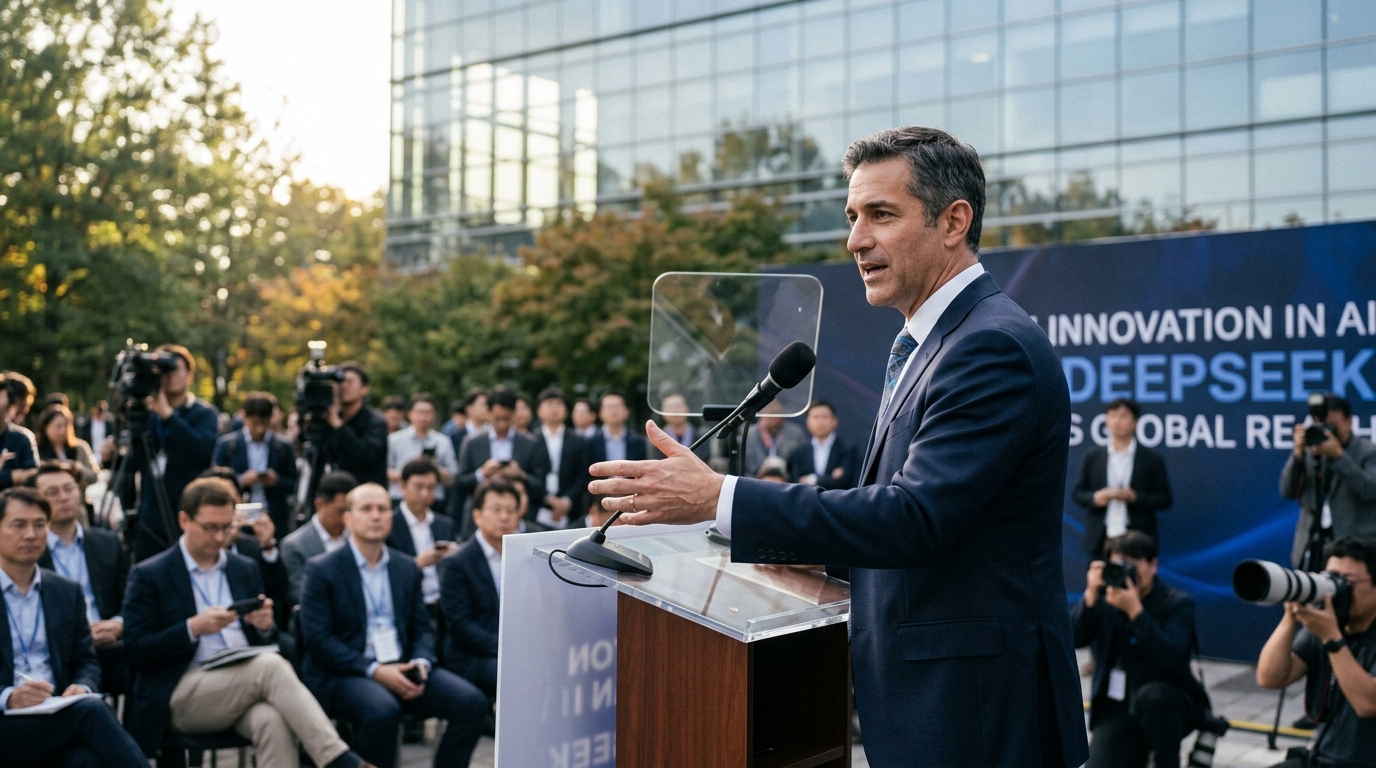
In the high-stakes geopolitical chessboard of artificial intelligence, the move that often wins isn't the one with the most raw power, but the one with the highest efficiency. DeepSeek, the Chinese AI lab that has become the 'enfant terrible' of Silicon Valley, has announced an unprecedented 75% price cut for its flagship model, DeepSeek-V4 Pro. This move isn't just a commercial promotion; it is a declaration of war against the U.S. establishment, aimed at making top-tier intelligence accessible at a fraction of the cost of its rivals.
The Price War and the 'Scorched Earth' Strategy
The price reduction brings the cost of V4 Pro to levels previously thought impossible for GPT-4 or Claude 3.5-class models. While American companies like OpenAI and Anthropic are struggling to maintain high margins to cover billions in infrastructure investments, DeepSeek appears to be pursuing a 'scorched earth' strategy. By offering 1 million input tokens at prices approaching a few cents, it is forcing the market to ask: Is AI a luxury or a commodity?
This strategy is deeply rooted in the Chinese business culture of scale. By becoming the cheapest provider for developers and enterprises globally, DeepSeek is not just gaining market share but also massive amounts of usage data to fuel its next generation of models. For many startups in Europe and Asia, the choice between a prohibitively expensive American model and an equally capable but 75% cheaper Chinese alternative is becoming a no-brainer.
MoE Architecture: The Secret to Efficiency
How does DeepSeek manage to survive with such aggressive pricing? The answer lies in its technological edge in Mixture-of-Experts (MoE) architecture. Unlike traditional 'dense' models that activate all their parameters for every query, V4 Pro activates only a small fraction of its billions of parameters depending on the context of the question. This dramatically reduces the computational cost per token.
- Inference Optimization: DeepSeek has developed proprietary routing algorithms that minimize GPU utilization.
- Vertical Integration: Its close relationship with High-Flyer Quant allows access to specialized hardware at lower costs.
- Performance Focus: V4 Pro is designed to be 'lean' yet powerful, avoiding the unnecessary overhead of general-purpose models.
This approach poses a challenge to Nvidia and U.S. cloud providers. If DeepSeek can deliver the same output with 1/4 of the resources, the need for the endless purchase of new GPUs might begin to be questioned, potentially impacting the market valuation of infrastructure giants.
Geopolitics and the Response to Sanctions
DeepSeek's move comes at a time when the U.S. is intensifying export restrictions on AI chips to China. Rather than being deterred, the Chinese ecosystem seems to have found a way to do 'more with less.' The price cut is also a political statement: China can lead in AI not just through state power, but through market dominance.
"DeepSeek isn't just selling tokens; it's selling proof that U.S. restrictions have failed to stop Chinese innovation," says an industry analyst.
However, concerns remain. Dependence on Chinese models raises questions about data security and censorship, especially for Western companies. Nevertheless, in the business world, cost is often the final arbiter. If the price gap remains at 75%, ethics and geopolitics may take a backseat to profit margins.
Conclusion: The New Normal in AI
2026 will be remembered as the year AI stopped being an expensive experiment and became a cheap production tool. DeepSeek, with its aggressive pricing, is accelerating this transition. American giants are now in a difficult position: they must either follow the price cuts, sacrificing their profits, or prove that their intelligence is worth four times more than that of the East. The battle for AI supremacy just got much cheaper, and at the same time, much more dangerous.