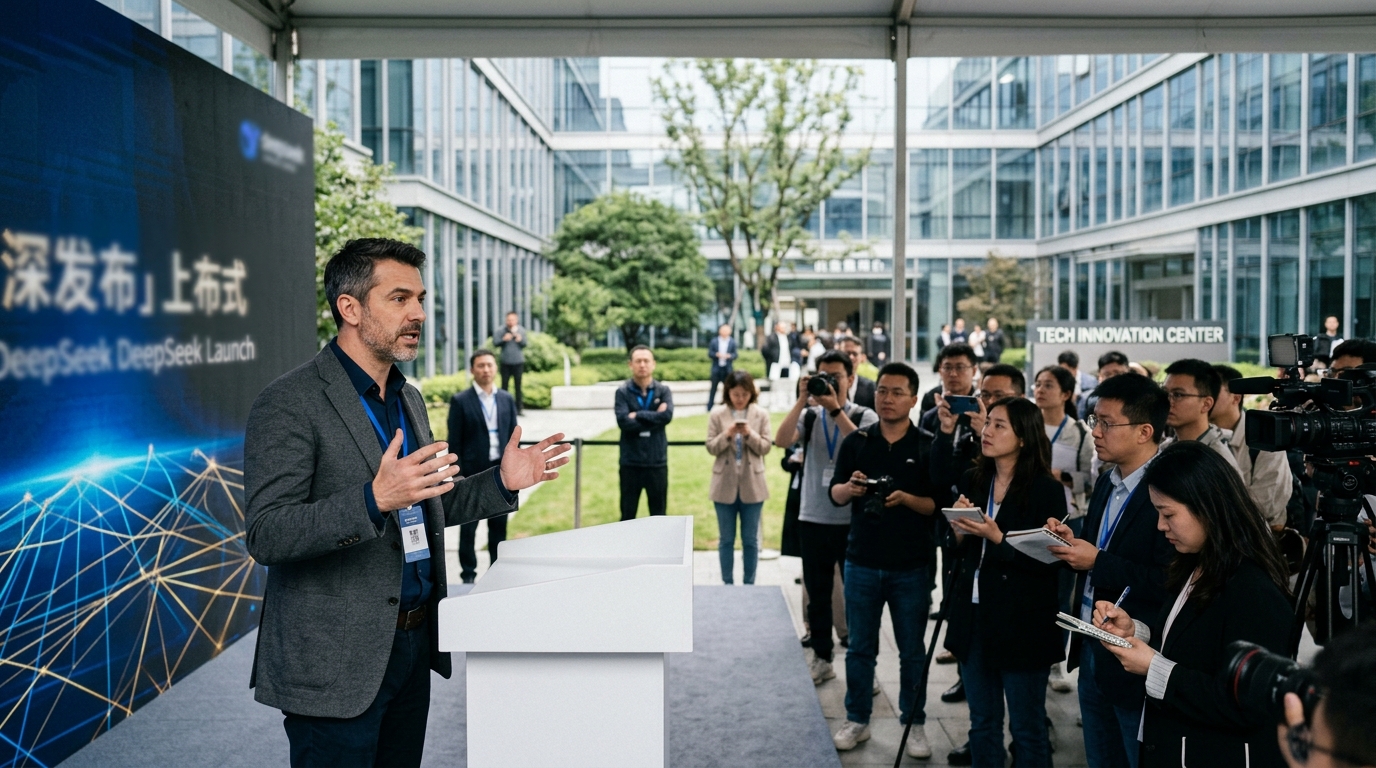
In the heart of Spring 2026, the global AI landscape is experiencing a seismic shift that originates not from Silicon Valley, but from Hangzhou. DeepSeek, the Chinese firm that has become the primary antagonist to OpenAI and Google, has announced the release of DeepSeek V4 Pro. This is not merely another large language model; it is a declaration of economic and technological warfare. With pricing that hovers at roughly one-tenth of its Western counterparts like GPT-5 or Claude 4, V4 Pro is systematically eroding the profit margins of the American tech giants.
The Anatomy of a Market Upset
DeepSeek V4 Pro utilizes a highly refined Mixture-of-Experts (MoE) architecture, allowing the model to activate only a fraction of its parameters for any given query. This significantly reduces computational overhead without compromising the depth or accuracy of the output. Early benchmarks indicate that V4 Pro outperforms GPT-4o in complex coding tasks and mathematical reasoning, all while being offered at a price point that makes API usage a negligible expense for enterprises.
The strategy is clear: the commoditization of intelligence. If access to top-tier AI models costs pennies, the competitive moat of companies relying solely on proprietary model power evaporates. This forces Western incumbents to pivot their business models, shifting focus from selling "intelligence by the token" to providing integrated ecosystems and specialized, high-value services.
Geopolitical Chess and Technical Ingenuity
The ascent of DeepSeek is more than a corporate success story; it is a geopolitical milestone. Despite stringent US export controls on high-end GPUs (such as NVIDIA’s H-series), DeepSeek has demonstrated that innovation in software architecture can circumvent hardware scarcity. By employing creative training methodologies and hyper-optimized algorithms, the Chinese team has achieved more with significantly less raw compute power.
"DeepSeek V4 Pro proves that the barrier to entry for super-intelligence is no longer just capital, but the elegance of design," notes a leading industry analyst.
This development is causing significant concern in Washington. If Chinese firms can offer world-class AI at subsidized or highly efficient prices, the global developer ecosystem’s reliance on Chinese infrastructure will grow exponentially. Already, thousands of startups across Europe and Asia are migrating away from expensive American APIs in favor of DeepSeek, fostering a new digital reality where China dictates the cost of knowledge.
Market Consequences and the Road Ahead
The response from OpenAI and Google has been swift yet defensive. Within 48 hours of the V4 Pro announcement, both companies introduced aggressive price cuts to their flagship models, confirming that a "race to the bottom" is officially underway. However, a critical question remains: can American companies, burdened by massive operational costs and investor pressure for high margins, compete with a firm that appears prioritized on market dominance over immediate profitability?
Looking forward, DeepSeek’s success may usher in a phase where AI is viewed as a public utility, much like electricity or water. For the end-user, this translates to smarter devices and applications at a lower cost. For the tech industry, it necessitates a brutal adaptation to a world where intelligence is abundant and cheap. DeepSeek V4 Pro is not just a tool; it is the catalyst for the dismantling of the Silicon Valley monopoly.