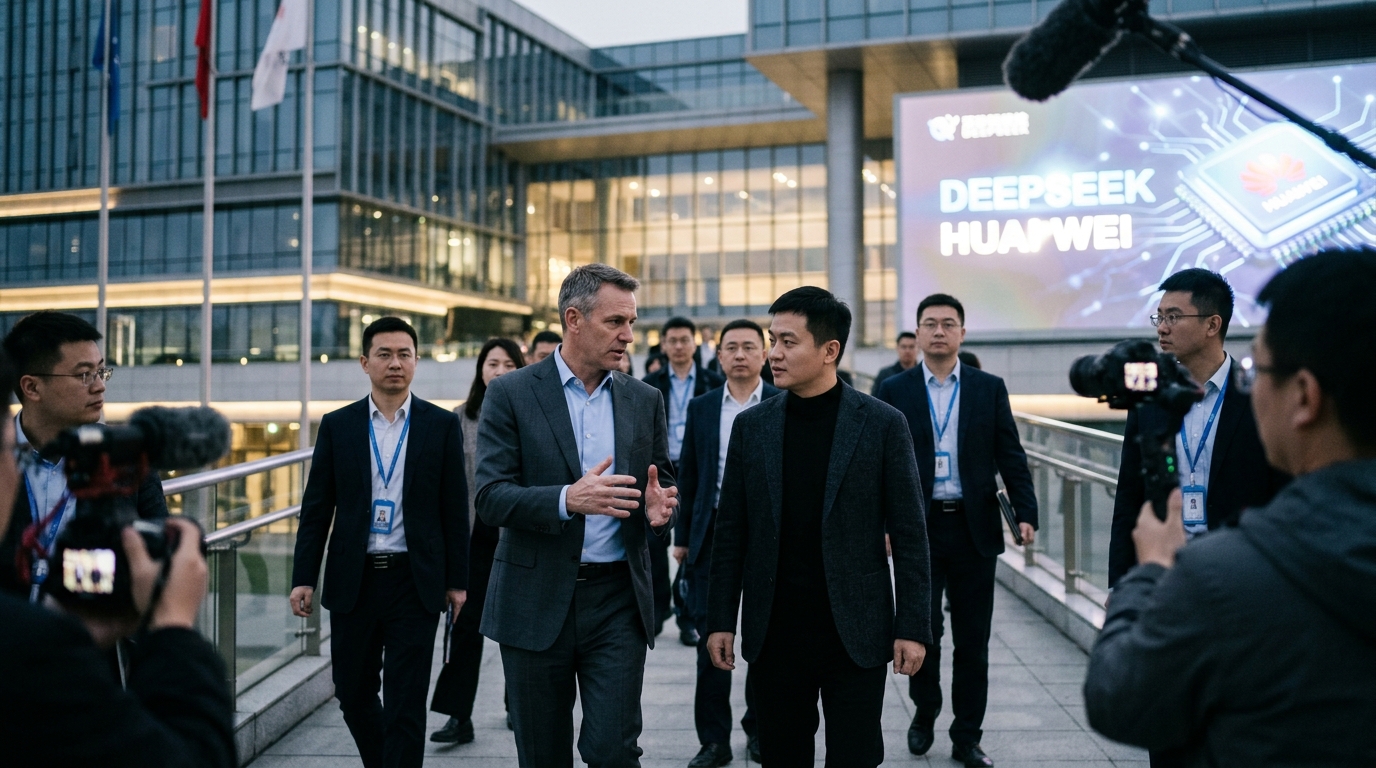
The global AI chessboard is witnessing a tectonic shift as news trickles out from the East. DeepSeek, the Chinese AI firm that stunned Silicon Valley with its hyper-efficient models, has offered a preview of its upcoming DeepSeek V4. The headline, however, is not just about its cognitive capabilities, but its physical foundation: V4 is being trained and deployed on Huawei infrastructure, utilizing the domestic Ascend series of AI chips.
This move marks a definitive milestone in China's quest for technological decoupling. Following the stringent export restrictions imposed by Washington on high-end Nvidia silicon, the narrative was that China’s AI ambitions would hit a hardware ceiling. DeepSeek, having already disrupted the status quo with its V3 model—which achieved near-frontier performance at a fraction of the cost—is now proving that software ingenuity can bridge the gap created by hardware sanctions.
The Architecture of Sovereignty: Moving Beyond Nvidia
Transitioning from Nvidia’s ubiquitous CUDA ecosystem to Huawei’s CANN (Compute Architecture for Neural Networks) is no minor feat. It represents a massive engineering undertaking and a significant geopolitical pivot. While Western consensus suggested that Huawei’s Ascend 910B chips were hampered by inferior software stacks and interconnect bottlenecks, DeepSeek appears to have cracked the code on optimization.
Industry analysts anticipate that DeepSeek V4 will leverage an even more refined Mixture-of-Experts (MoE) architecture. By activating only a sparse subset of its parameters for any given task, the model drastically reduces the computational overhead. This efficiency is critical when operating on hardware that, while impressive, still faces challenges in raw throughput compared to Nvidia’s Blackwell or Hopper architectures.
"DeepSeek’s success on Huawei silicon demonstrates that algorithmic efficiency can act as a force multiplier. China is not just chasing the West; it is attempting to leapfrog it by redefining the economic and energy costs of intelligence," notes a senior tech analyst based in Singapore.
Geopolitical Chess and the Huawei Resurgence
Huawei, once nearly crippled by US sanctions targeting its smartphone business, has reinvented itself as the backbone of China’s national AI strategy. The collaboration with DeepSeek for V4 serves as a proof of concept for the Ascend ecosystem. The rumored use of the Ascend 910C chip positions Huawei as a viable alternative to Nvidia’s H200, challenging the idea that American chips are the only path to AGI.
For the United States, this development is a double-edged sword. If DeepSeek V4 matches or exceeds the performance of models like GPT-4o or Claude 3.5 while running on domestic Chinese hardware, it would signal the failure of export controls to stifle Chinese progress. Instead of containment, the sanctions may have inadvertently catalyzed the birth of a fully independent, vertically integrated AI stack in China—one that operates entirely outside Western influence.
- Cost Disruption: DeepSeek has consistently shown it can train models for 1/10th the cost of its US counterparts.
- Software-Hardware Synergy: Techniques like Multi-head Latent Attention (MLA) are being tailored specifically for the memory bandwidth characteristics of Huawei chips.
- Open-Source Pressure: By releasing open weights, DeepSeek is forcing the global AI community to re-evaluate the necessity of massive, closed-source compute clusters.
Challenges and the Road Ahead for V4
Despite the momentum, significant hurdles remain. Huawei’s manufacturing partner, SMIC, continues to struggle with yield rates for advanced nodes, potentially limiting the scale of hardware deployment. Furthermore, the energy consumption of Chinese accelerators often lags behind the efficiency of Nvidia’s designs, posing a challenge for large-scale data center operations.
Moreover, DeepSeek must navigate the complexities of Chinese domestic regulation. The requirement for AI models to adhere to "core socialist values" creates a unique set of constraints on model behavior and safety tuning that Western models do not face. Balancing these requirements with the need for creative, uninhibited reasoning will be the ultimate test for the V4 model.
Ultimately, DeepSeek V4 is more than a technological update; it is a symbol of a new era of silicon sovereignty. If DeepSeek proves that frontier-level intelligence can be birthed from non-Western hardware, the global tech landscape will be permanently bifurcated. The era of Nvidia’s absolute monopoly may be entering its twilight, replaced by a multipolar world of competing AI ecosystems.