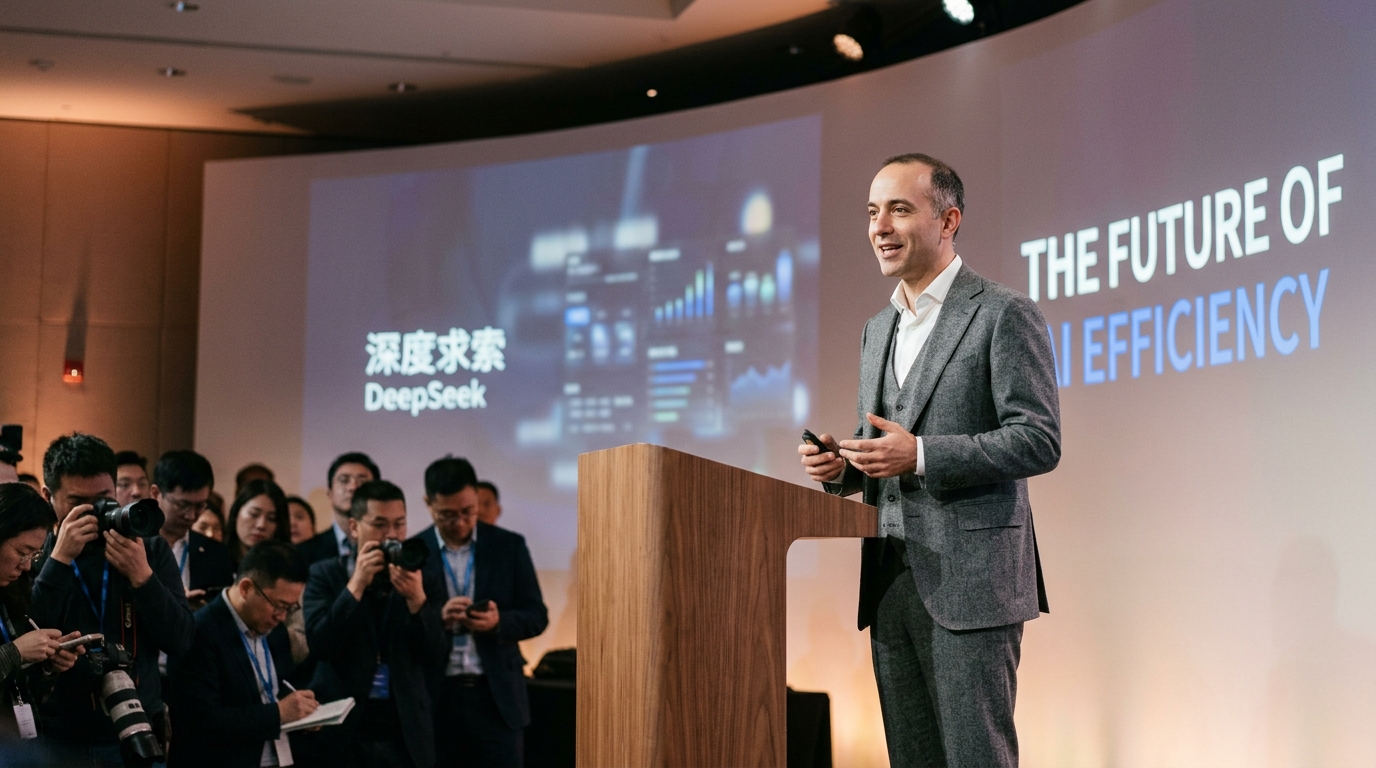
In a move that signals a new chapter in the global AI race, DeepSeek, the Chinese research lab that has become synonymous with computational efficiency, is reportedly launching its first external funding round. According to reports from AASTOCKS, the company is targeting at least $300 million, a move expected to skyrocket its valuation to unicorn status and place it directly in competition with US giants like OpenAI and Anthropic.
DeepSeek is no ordinary startup. Founded by High-Flyer Capital Management, a leading Chinese quantitative hedge fund, it has until now relied on internal resources for its meteoric rise. The decision to seek external capital suggests a strategic shift toward aggressive global expansion and the necessity for massive capital to secure critical computing resources, despite US-led export restrictions on high-end semiconductors to China.
The Efficiency Play: A New Paradigm
What sets DeepSeek apart on the global AI map is not just its origin, but its technical philosophy. While Western firms often follow the path of "brute force scaling"—throwing more data and more chips at the problem—DeepSeek has demonstrated that it can produce world-class models at a fraction of the cost. Its recent releases, DeepSeek-V3 and the reasoning-focused DeepSeek-R1, sent shockwaves through the industry by matching the performance of GPT-4 while being trained with significantly fewer resources.
By utilizing Mixture-of-Experts (MoE) architectures and innovative algorithmic optimizations, the company has managed to partially bypass the bottleneck of GPU shortages. For investors, this presents a highly compelling value proposition: a company that can innovate in a resource-constrained environment while maintaining operational costs at levels that allow for long-term sustainability.
Geopolitical Hurdles and Investor Appetite
This funding round comes at a sensitive time for Sino-American relations. DeepSeek operates under the shadow of US sanctions, which restrict China's access to NVIDIA’s most advanced H100 and B200 GPUs. However, this pressure appears to have acted as a catalyst for Chinese innovation. DeepSeek has managed to leverage older chip generations or domestic alternatives with such efficiency that it remains at the bleeding edge of the field.
- Access to Capital: $300 million is just the starting point for scaling cloud infrastructure.
- Talent War: The company needs to match Silicon Valley salaries to retain its top-tier researchers.
- Global Reach: Despite its Chinese roots, DeepSeek targets a global developer community through open-weight models.
"DeepSeek is not just a player in the Chinese market; it is proof that architectural and algorithmic intelligence can overcome raw compute power," market analysts suggest.
The Future of Open-Weights and AGI
One of the most intriguing aspects of DeepSeek is its commitment to releasing models with open weights. This places it on a similar trajectory to Meta (Llama) and Mistral AI, contrasting sharply with OpenAI’s closed-door policy. This strategy allows DeepSeek to build a massive ecosystem of users and developers who refine its models for free, creating a network effect that is difficult for competitors to disrupt.
The new funding will allow DeepSeek to double down on its quest for Artificial General Intelligence (AGI). If the company can maintain its efficiency while scaling its operations, it could pose the first real threat to the near-monopoly of US Big Tech in the AI space. The $300 million bet is, in reality, a wager on whether China can lead the next phase of the AI revolution—not through quantity, but through quality and strategic economy of scale.