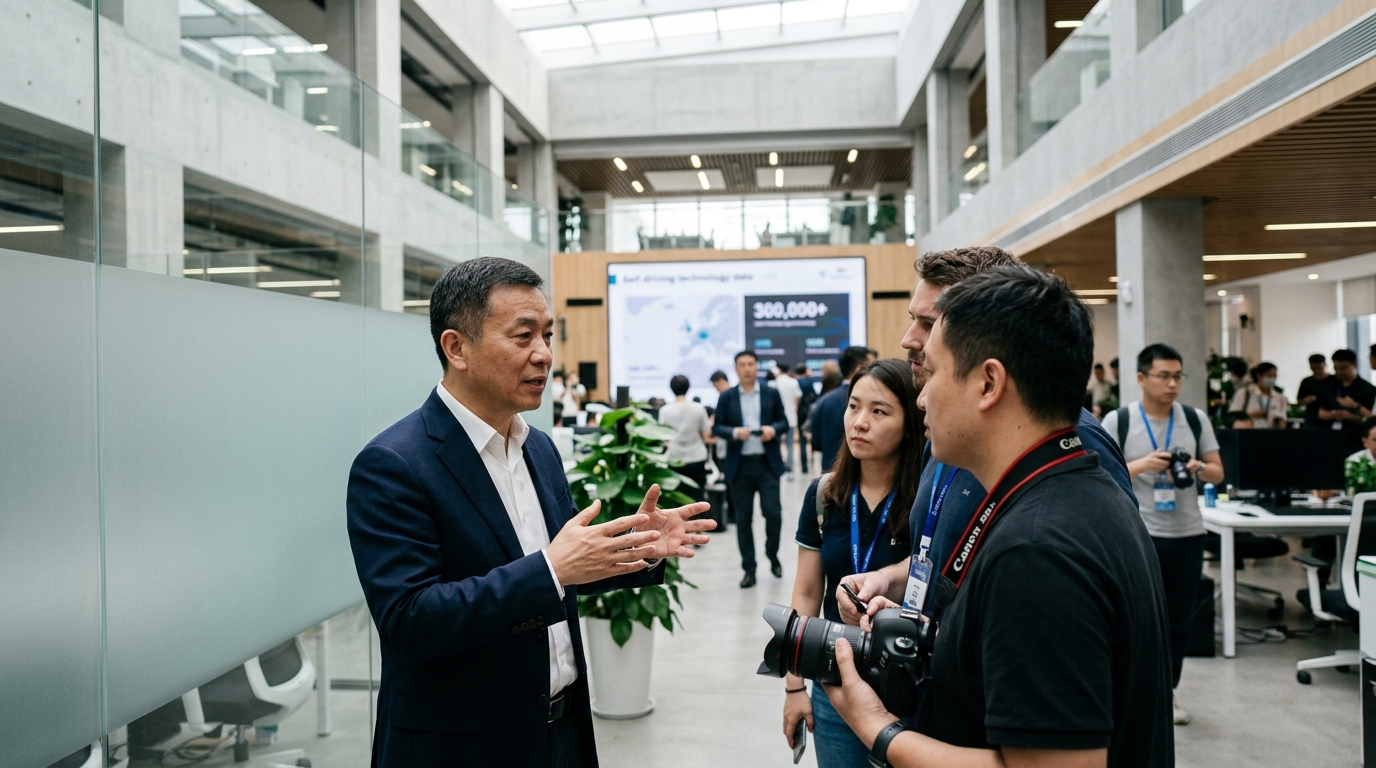
At the heart of the global race for autonomous driving supremacy, China continues to produce key players that challenge the Silicon Valley status quo. DeepRoute.ai, a Shenzhen-based startup with strategic financial backing from tech giant Alibaba, recently announced that its assisted-driving system is now integrated into more than 300,000 vehicles operating across China. This achievement is more than just a number on a balance sheet; it represents a fundamental shift in how artificial intelligence is being woven into the fabric of daily commuting.
DeepRoute.ai has managed to differentiate itself in an incredibly crowded market by focusing on two core pillars: affordability and technological flexibility. While many competitors rely on expensive LiDAR sensors and hyper-detailed high-definition (HD) maps, DeepRoute.ai champions a "mapless" approach. This strategy allows vehicles to navigate unfamiliar areas using only camera vision and real-time data processing, mimicking the way a human driver perceives and reacts to the environment.
The Strategy of Accessibility and the End-to-End Model
The success of DeepRoute.ai is built upon the adoption of "End-to-End" (E2E) AI technology. Unlike traditional systems that break down driving into separate modules—perception, prediction, and planning—the E2E model processes sensor data and generates driving commands through a single, unified neural network. This allows the system to learn from massive volumes of real-world driving data, improving its ability to handle complex scenarios, such as navigating dense urban environments or reacting to the unpredictable movements of pedestrians.
The most striking element of the company's strategy is cost. DeepRoute.ai aims to make autonomous driving accessible for vehicles priced around $20,000. This democratization of technology is crucial for mass adoption, moving Advanced Driver Assistance Systems (ADAS) out of the luxury niche and into the standard equipment of mid-range vehicles. With Alibaba's backing, the company has the financial runway to invest heavily in R&D while securing partnerships with major automakers.
"Our mission is not to build an expensive experiment, but a tool that will change the way millions of people move every day," company executives state.
Competition with Tesla and the Geopolitical Context
The announcement of the 300,000-vehicle milestone comes at a time when Tesla is preparing to launch its Full Self-Driving (FSD) system in the Chinese market. DeepRoute.ai stands at the forefront of the Chinese defense, offering a domestic solution tailored to the specificities of Chinese roads and local regulations. The battle for data is the next great frontier. With 300,000 cars constantly feeding real-world data back into its algorithms, DeepRoute.ai is building a "data moat" that will be difficult for foreign players to breach.
Furthermore, the geopolitical dimension cannot be ignored. As the US and Europe impose restrictions on Chinese tech and vehicle exports, DeepRoute.ai is focusing on consolidating its dominance within domestic borders while eyeing markets in Southeast Asia and the Middle East. Support from Alibaba provides not just capital, but also access to the cloud computing infrastructure necessary to train massive AI models.
Challenges and the Future of Autonomy
Despite rapid growth, the road to full autonomy (Level 4 and 5) remains fraught with obstacles. Regulators in China are cautious, and liability in the event of an accident remains a legal gray area. DeepRoute.ai must prove that its system is not only intelligent but also infallible in "edge cases"—extreme or rare traffic conditions. The transition from "assisted" to "fully autonomous" driving requires a level of reliability that the industry is still struggling to achieve.
However, the 300,000-vehicle milestone is a powerful testament that the era of AI in cars is no longer a future promise but a present reality. DeepRoute.ai's ability to scale its technology to hundreds of thousands of users suggests that China may soon set the global standards for smart mobility, potentially leaving traditional automotive powerhouses in the rearview mirror.
- Focus on low-cost hardware for mass-market production.
- Utilization of advanced neural networks for mapless navigation.
- Strategic partnership with Alibaba for data and cloud infrastructure.
- Competitive advantage in the local market against Tesla's FSD.
In conclusion, the trajectory of DeepRoute.ai reflects China's broader ambition: to lead the fourth industrial revolution through the convergence of software and hardware. With every kilometer these 300,000 vehicles travel, artificial intelligence becomes more experienced, safer, and ultimately, more inevitable.