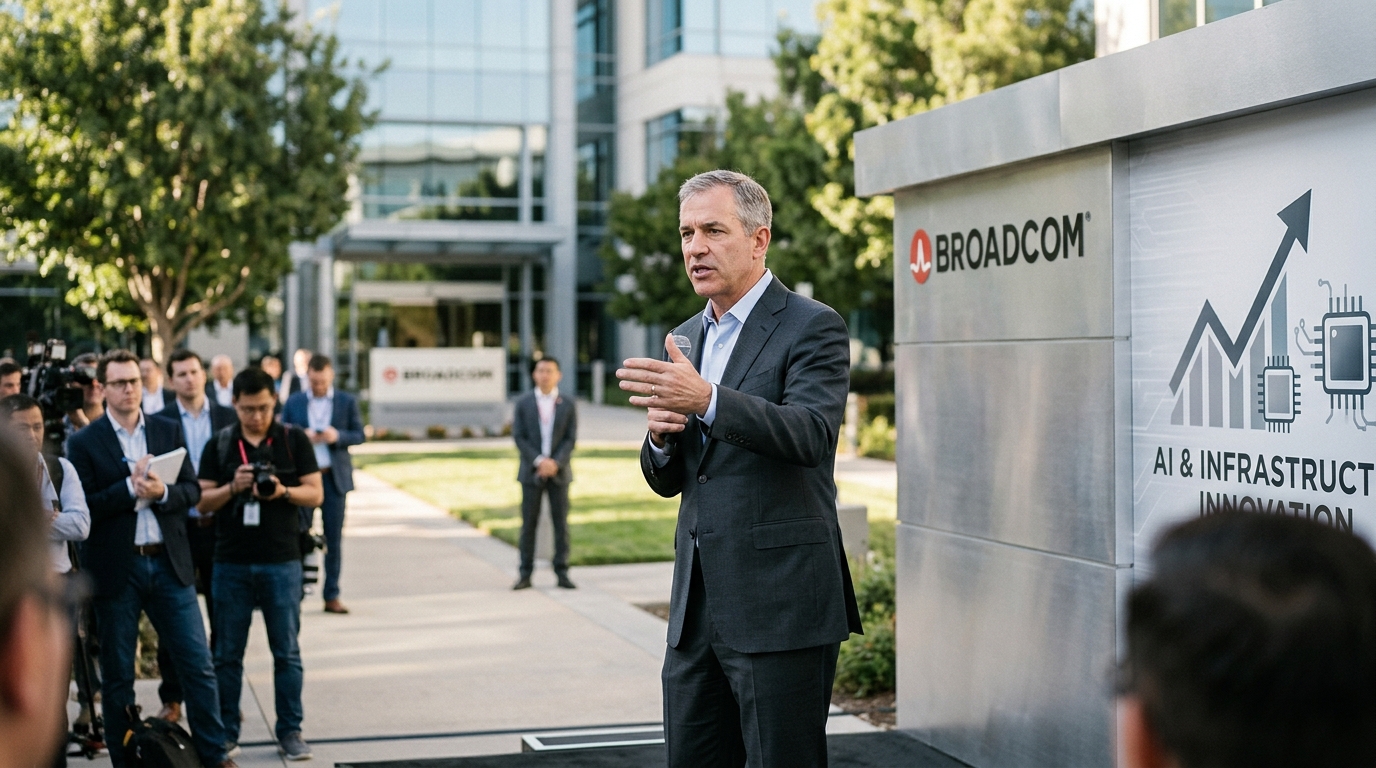
In the ever-shifting landscape of global technology, few companies have demonstrated the resilience and strategic acumen of Broadcom. As we navigate through April 2026, Broadcom is no longer just a semiconductor supplier; it is a foundational pillar of the world's digital infrastructure. Its recent induction into the exclusive "$2 Trillion Club" marks a historic turning point, highlighting how the convergence of hardware and software can create an unstoppable value-generation machine.
The Strategic Metamorphosis: From Chips to Cloud
Broadcom's ascent to $2 trillion was far from accidental. Under the leadership of Hock Tan, the company pursued an aggressive yet meticulously calculated acquisition model, culminating in the transformative integration of VMware. This move pivoted Broadcom from a cyclical chipmaker to an enterprise software giant with massive recurring revenue streams. Today, Broadcom controls critical segments of the Artificial Intelligence (AI) value chain, providing the essential Ethernet switches and custom ASICs (Application-Specific Integrated Circuits) that enable hyperscalers like Google and Meta to train their massive language models.
The market has increasingly recognized Broadcom as the "second best bet" after Nvidia in the AI revolution. While Nvidia dominates raw processing power, Broadcom dominates connectivity. Without Broadcom’s silicon, Nvidia’s GPUs could not communicate effectively at the scale of tens of thousands of units, making the company the indispensable "air traffic controller" of the digital age. This infrastructure moat is what has propelled its valuation to these dizzying heights.
Vanguard and Stock Splits: Democratizing Access
The meteoric rise in Broadcom’s share price necessitated a series of stock splits—a move mirrored by five major Vanguard ETFs. While stock splits do not alter a company's fundamental valuation, they make the shares more accessible to retail investors and facilitate easier options trading. For Vanguard, the titan of passive management, these adjustments were vital as Broadcom began to occupy a larger weight in growth and total market indices.
Four out of the five Vanguard ETFs that recently underwent stock splits—including the Vanguard Growth ETF (VUG) and the Vanguard Total Stock Market ETF (VTI)—hold significant positions in Broadcom. This means that millions of retirement plans and individual brokerage accounts are now directly tethered to Broadcom’s performance. Broadcom has effectively become the "new Apple" of institutional portfolios: a core holding that fund managers simply cannot afford to miss.
Identifying the Best ETF for Broadcom Exposure
Despite its presence in broad-market funds, analysts suggest that for investors seeking maximum exposure to Broadcom at the lowest possible cost, the Vanguard Information Technology ETF (VGT) remains the gold standard. With an expense ratio of just 0.10%, VGT offers a concentrated dose of Broadcom alongside other tech titans like Apple and Microsoft. However, this comes with a caveat: concentration risk. In an environment where a handful of companies dictate the direction of the entire sector, the potential for a systemic correction is magnified.
For the long-term investor, the choice between a specialized tech ETF and a broader index fund depends on risk tolerance. Broadcom now offers a compelling dividend yield, a rarity for high-growth tech firms, making it attractive for Dividend Growth investors. The VMware integration has started to yield significant free cash flow, allowing the company to fund both R&D and aggressive shareholder returns. This dual-threat of growth and income is what sets it apart from more speculative AI plays.
Conclusion and Future Outlook
Joining the $2 trillion club is not the finish line, but the start of a new phase of corporate maturity. Broadcom now faces the challenge of proving it can sustain VMware’s growth rates while fending off competition from internal chip designs developed by its own customers (such as Google’s TPUs or Amazon’s Inferentia). Nevertheless, the "moat" Broadcom has built around high-end networking remains largely impenetrable for the foreseeable future.
- Broadcom is now the undisputed leader in AI networking infrastructure.
- Vanguard ETFs provide the most cost-effective entry point for retail investors.
- The VMware acquisition has fundamentally de-risked the company's revenue model.
- Concentration risk in tech-heavy ETFs remains a factor for cautious investors.
In summary, Broadcom represents the quintessential modern tech conglomerate: quiet, ubiquitous, and financially formidable. For investors, understanding how Vanguard’s investment vehicles wrap around this giant is key to building a resilient 21st-century portfolio. As AI moves from training to inference, Broadcom’s role will only become more central to the global economy.